Freedom251 › Reverse Engineering Tools
GNU Binutils
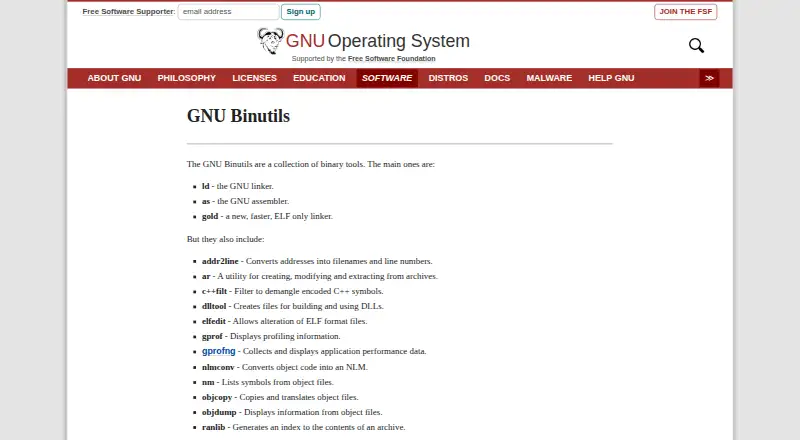
What GNU Binutils is
GNU Binutils is a free software collection for static analysis of compiled programs and related binary files. It runs on Linux, macOS, and Windows and includes a plugin API for extending the toolset. Architecture support depends on the way each build is configured; the architectures available to a build can be listed with the objdump -i command. Its stated analysis mode is static, focused on examining existing binaries rather than executing them. GNU Binutils does not include a decompiler, so it is not presented as a way to convert binaries back into source code. Firmware analysis is also not listed as a capability. The project provides a free plan, with no price to pay. Users selecting it should therefore consider whether their build exposes the architectures they need and whether static inspection, rather than decompilation or firmware-focused work, matches their task. The GNU Binutils website provides the project’s software and platform information.
Who it suits
It suits users who need free static inspection of binaries on Linux, macOS, or Windows. The plugin API is relevant when extending or integrating the tool collection.
What it does well
- Free plan available
- Runs on Linux, macOS, and Windows
- Static analysis mode
- Plugin API for extensions
- Architecture list available with objdump -i
What to know first
- No decompiler
- No listed firmware-analysis capability
- Architecture support depends on build configuration
Verdict
GNU Binutils provides free, cross-platform static binary analysis with an extension point through its plugin API.
Facts from GNU Binutils's own pages
- Address translation
- addr2line converts code addresses into source filenames and line numbers. · sourceware.org, 15 Oct 2026
- Archive management
- ar creates, modifies and extracts archive files used commonly as static libraries. · sourceware.org, 15 Oct 2026
- Assembler
- The as program assembles source code into machine-code object files. · sourceware.org, 15 Oct 2026
- BFD API
- The BFD manual documents a C API using bfd.h and libbfd.a to access object-file formats through a common interface. · sourceware.org, 15 Oct 2026
- BFD limitation
- Independent documentation notes that BFD API changes needed for new systems have limited its usefulness as a generic library, leaving GNU tools as its main clients. · en.wikipedia.org, 15 Oct 2026
- Bug reporting
- Bug reports are handled through Sourceware Bugzilla and patches can be emailed to [email protected]. · sourceware.org, 15 Oct 2026
- C++ demangling
- c++filt converts encoded C++ symbol names into readable names. · sourceware.org, 15 Oct 2026
- Community support
- The project provides bug-reporting, discussion and commit-notification mailing lists. · sourceware.org, 15 Oct 2026
- Current release
- The sourceware project page identifies version 2.47 as the latest release. · sourceware.org, 15 Oct 2026
- Developer complaint
- A Stack Overflow discussion reports that Binutils 2.39 introduced executable-stack linker warnings that can require assembly changes or linker flags. · stackoverflow.com, 15 Oct 2026
- Documentation depth
- The 2.47 documentation set includes manuals for the assembler, binary tools, linker, BFD, CTF, gprof, gprofng and SFrame libraries. · sourceware.org, 15 Oct 2026
- ELF inspection
- readelf displays the contents of ELF-format files. · sourceware.org, 15 Oct 2026
- ELF linker
- Gold is an alternative linker focused on ELF files. · sourceware.org, 15 Oct 2026
- Extensibility
- GNU ar supports plugins for additional object formats, including GCC and LLVM link-time-optimization plugins. · sourceware.org, 15 Oct 2026
- FSF legal status
- The Free Software Foundation is described as a U.S. 501(c)(3) nonprofit founded on October 4, 1985. · en.wikipedia.org, 15 Oct 2026
- FSF location
- The Free Software Foundation is reported as operating remotely with no physical headquarters, while being historically based in Boston. · en.wikipedia.org, 15 Oct 2026
- Homebrew availability
- Homebrew provides brew install binutils and marks the formula keg-only because Apple Command Line Tools already provide equivalent tools. · formulae.brew.sh, 15 Oct 2026
- Homebrew platforms
- Homebrew supplies bottles for Apple Silicon macOS, Intel macOS Sonoma, Linux ARM64 and Linux x86_64. · formulae.brew.sh, 15 Oct 2026
- Homebrew usage
- Homebrew reports 550,260 installs over the preceding 365 days for the binutils formula. · formulae.brew.sh, 15 Oct 2026
- Homebrew version
- The Homebrew formula reports stable version 2.47. · formulae.brew.sh, 15 Oct 2026
- Independent release coverage
- Linux Journal reported expanded RISC-V support, assembler and linker improvements, reproducible archives and enhanced AArch64 disassembly in 2.47. · linuxjournal.com, 15 Oct 2026
- Independent tool summary
- Wikipedia describes Binutils as GNU Project programming tools for executable code, assembly, linking and related development operations. · en.wikipedia.org, 15 Oct 2026
- Libraries
- The distribution includes libbfd, libctf, libopcodes and libsframe libraries. · sourceware.org, 15 Oct 2026
- License
- The GitHub mirror identifies GPL-2.0 plus three other licenses, while Homebrew lists GPL-2.0-or-later, GPL-3.0-or-later, LGPL-2.0-or-later and LGPL-3.0-only components. · github.com, 15 Oct 2026
Where GNU Binutils stands on Freedom251
- Reverse Engineering Tools#3 of 73