Freedom251 › Container Engines

balenaEngine
What balenaEngine is
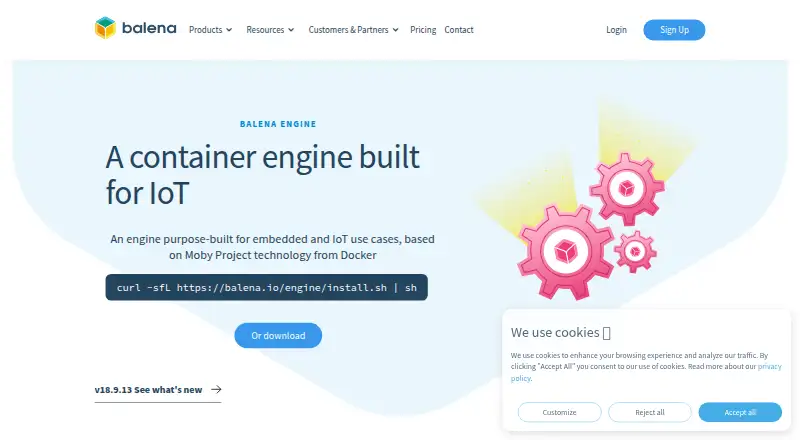
balenaEngine is a free Linux container engine for embedded and IoT systems, built on Moby Project technology from Docker. It runs Docker containers, uses the Docker runtime interface and image format, and supports image building. The engine is distributed as one binary described as 3.5 times smaller than Docker CE, with support for chipset architectures ranging from small IoT devices to industrial gateways. Linux downloads are listed for amd64, armv5e, armv6l, armv7hf, and i386. Binary-diff container updates can be 10–70 times smaller than pulling layers in common situations. Layers are extracted as they arrive to reduce disk writes, while atomic, durable pulls are designed to withstand power failures. Pull behavior also aims to avoid page-cache thrashing in low-memory systems. The product page links documentation, forums, a changelog, installation instructions, and a separate download. Docker Swarm, cloud logging drivers, plugins, overlay networking drivers, and non-BoltDB-backed stores are excluded.
Who it suits
balenaEngine suits embedded and IoT deployments where bandwidth, storage, power, or memory are limited. It is for Linux environments using Docker-compatible containers.
What it does well
- Free Linux container engine
- Docker container and image compatibility
- Single binary is described as 3.5x smaller
- Binary-diff updates can reduce transfer size
- Atomic pulls address power-failure interruptions
What to know first
- Docker Swarm is excluded
- Plugin support is excluded
- Overlay networking drivers are excluded
- Only Linux host downloads are listed
Limits
The product excludes Docker Swarm, cloud logging drivers, plugin support, overlay networking drivers, and non-BoltDB-backed stores.
Getting started
- Open the balenaEngine website
- Choose the installation command or separate download
- Select the Linux binary matching amd64, armv5e, armv6l, armv7hf, or i386
- Install the engine on a Linux host
- Build or run Docker-format container images
Verdict
balenaEngine provides a compact Docker-compatible runtime for constrained devices. Its design emphasizes smaller updates, lower storage impact, and resilient image pulls, while omitting several Docker ecosystem features.
Questions
What does balenaEngine cost?
balenaEngine is free.
Which operating systems and architectures are supported?
It supports Linux, with downloads listed for amd64, armv5e, armv6l, armv7hf, and i386.
Is it compatible with Docker?
Yes. It runs Docker containers and uses the Docker runtime interface and Docker image format.
Can balenaEngine build images?
Yes. Image building is supported.
Which features are excluded?
Docker Swarm, cloud logging drivers, plugin support, overlay networking drivers, and non-BoltDB-backed stores are excluded.
Facts from balenaEngine's own pages
- Architectures
- It supports a wide variety of chipset architectures, from small IoT devices to large industrial gateways. · balena.io, 10 Oct 2026
- Container deltas
- Binary-diff container updates are described as 10–70 times smaller than pulling layers in common scenarios. · balena.io, 10 Oct 2026
- Docker compatibility
- balenaEngine is compatible with Docker containers and runs Docker containers. · balena.io, 10 Oct 2026
- Download
- The product page provides an installation command and a separate download link. · balena.io, 10 Oct 2026
- Downloads
- The download table lists Linux binaries for amd64, armv5e, armv6l, armv7hf, and i386. · balena.io, 9 Oct 2026
- Excluded features
- The maker lists Docker Swarm, cloud logging drivers, plugin support, overlay networking drivers, and non-boltdb-backed stores as excluded. · balena.io, 10 Oct 2026
- Footprint
- It is packaged as a single binary and described as 3.5 times smaller than Docker CE. · balena.io, 10 Oct 2026
- Founded
- 2011 · balena.io, 28 Sept 2026
- Intended users
- The maker describes it for small, heterogeneous, remotely distributed IoT devices and embedded Linux use cases where footprint, bandwidth, power, or storage matter. · balena.io, 10 Oct 2026
- Memory use
- It prevents page-cache thrashing during image pulls to help applications run in low-memory situations. · balena.io, 10 Oct 2026
- Multi-architecture
- The product page says balenaEngine supports a wide variety of chipset architectures, from tiny IoT devices to large industrial gateways. · balena.io, 9 Oct 2026
- Pull reliability
- Atomic and durable image pulls are designed to defend against partial pulls during power failure. · balena.io, 10 Oct 2026
- Purpose
- balenaEngine is a container engine purpose-built for embedded and IoT use cases, based on Moby Project technology from Docker. · balena.io, 10 Oct 2026
- Resilient pulls
- Atomic and durable image pulls are designed to defend against partial pulls during power failure. · balena.io, 9 Oct 2026
- Security context
- Balena’s security page describes platform capabilities including secure boot and disk encryption, vulnerability management, failsafe updates, and supply-chain accountability. · balena.io, 9 Oct 2026
- Small footprint
- balenaEngine is packaged as a single binary and described as 3.5x smaller than Docker CE. · balena.io, 9 Oct 2026
- Storage
- It extracts image layers as they arrive to reduce disk writes and protect storage from eventual corruption. · balena.io, 10 Oct 2026
- Storage use
- It extracts image layers as they arrive to reduce excessive disk writes and help protect storage from eventual corruption. · balena.io, 9 Oct 2026
- Support resources
- The product page links to documentation, community forums, and a changelog. · balena.io, 10 Oct 2026
Where balenaEngine stands on Freedom251
- Container Engines#18 of 31