Freedom251 › AI DevOps Assistants

AWS DevOps Agent
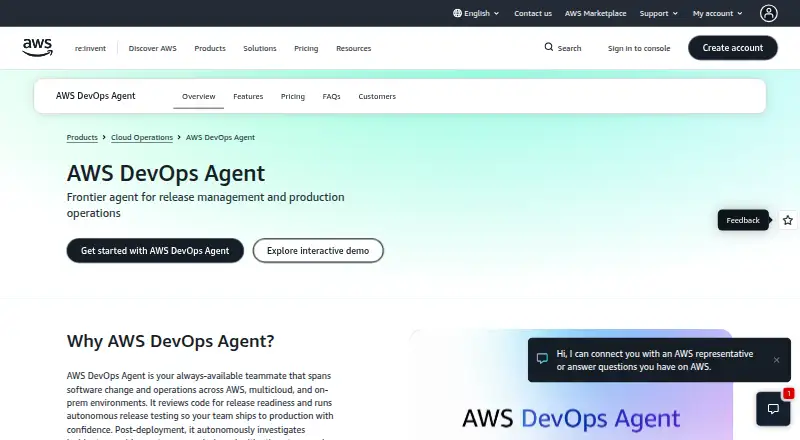
What AWS DevOps Agent is
AWS DevOps Agent is an operations tool for release readiness, incident response, and site reliability work. It reviews code before releases, runs release tests, investigates incidents, explains likely root causes, proposes mitigation steps, and recommends ways to prevent repeat problems. Its intended environments include AWS, other cloud providers, and on-premises systems. Release checks cover standards, dependency effects, access controls, service topology, and functional verification; release management is in preview.
For incidents, the agent can begin an investigation from an incident ticket, correlate related alarms, share findings, and provide a mitigation plan. Teams can also ask operational questions, create and share charts and reports, or configure custom SRE agents to run on a cadence. AWS lists built-in connections to tools such as CloudWatch, Dynatrace, Datadog, Grafana, New Relic, Splunk, Azure DevOps, GitHub, GitLab, ServiceNow, PagerDuty, and Slack. Private or remote MCP servers and A2A integrations provide routes to connect custom systems.
Agent Spaces set boundaries for accessible AWS accounts, resources, permissions, and third-party connections. AWS says data is encrypted in transit and at rest, remains in the Region where its Agent Space was created, and is not used to train models. The agent does not filter PII in summaries, so AWS recommends redacting it in observability logs.
Who it suits
AWS DevOps Agent suits teams that coordinate releases and incident response across AWS, other cloud environments, or on-premises systems. It is also relevant to site reliability teams that want operational answers, reports, or scheduled custom agents.
What it does well
- Checks release readiness across standards, dependencies, access, topology, and functionality.
- Can launch incident investigations from tickets and correlate alarms.
- Supports operational questions, shared charts, reports, and custom SRE agents.
- Connects to named monitoring, development, incident, and messaging tools.
- Agent Spaces define resource access and third-party connections.
What to know first
- Release management is in preview and limited to US East (N. Virginia).
- The agent does not filter PII from investigation, evaluation, or chat summaries.
- Pay-as-you-go pricing is $0.01 a month.
Limits
The listed pay-as-you-go rate is $0.01 a month, billed per second for active operational-task time, with no idle-time charges or upfront commitments. Release management is included at no additional cost during preview, which is available only in US East (N. Virginia).
Plans
| Plan | Billed and limits | Price |
|---|---|---|
| Pay-as-you-go | Per second for time actively spent on operational tasks; no idle-time charges or upfront commitments. · Investigations (Incident Response) · Evaluations (Site Reliability) · On-demand SRE tasks (Chat and Custom SRE Agents) · Release management is no additional cost during preview | $0.01 a month |
As aws.amazon.com lists them, read 8 Oct 2026. The maker's own page has the final word.
Getting started
- Visit https://aws.amazon.com/devops-agent/.
- Use the web or API platform.
- Choose a pay-as-you-go plan; free plan and free trial are available.
- Create an Agent Space and define its accessible accounts, resources, permissions, and connections.
- Connect built-in integrations or custom tools through MCP servers or A2A integrations.
Verdict
Choose AWS DevOps Agent if your team needs release checks, incident investigations, or recurring SRE tasks across varied environments. Consider the PII handling limitation when using observability data, and note that release management preview is region-limited.
Questions
How much does AWS DevOps Agent cost?
The pay-as-you-go plan is $0.01 a month. Billing is per second for time actively spent on operational tasks; idle time is not charged.
Is there a free plan or trial?
Yes, AWS lists both a free plan and a free trial.
Which platforms does it support?
The listed platforms are API and web.
What tools can it connect to?
AWS lists built-in integrations including CloudWatch, Dynatrace, Datadog, Grafana, New Relic, Splunk, Azure DevOps, GitHub, GitLab, ServiceNow, PagerDuty, and Slack. Custom systems can connect through private or remote MCP servers and A2A integrations.
Where is release management available?
Release management preview is available only in US East (N. Virginia). Production operations, on-demand tasks, and custom agents are listed for all supported Regions.
How does AWS handle agent data?
AWS says customer data is encrypted at rest and in transit and stored in the Region where the Agent Space was created. It says agent data, chat messages, and integrated-source data are not used to train models; the agent does not filter PII in summaries.
Facts from AWS DevOps Agent's own pages
- Availability limit
- Release management preview is available only in US East (N. Virginia), while production operations, on-demand tasks, and custom agents are listed for all supported Regions. · docs.aws.amazon.com, 8 Oct 2026
- Data protection
- Customer data is encrypted at rest and in transit, and Agent Space data is stored in the Region where the space is created. · docs.aws.amazon.com, 8 Oct 2026
- Environments
- It is designed to work across AWS, multicloud, and on-premises environments. · aws.amazon.com, 8 Oct 2026
- Extensibility
- It can connect to custom tools and systems through private or remote MCP servers and A2A integrations. · aws.amazon.com, 8 Oct 2026
- Incident response
- The agent can automatically launch investigations from incident tickets, correlate related alarms, share root-cause findings, and provide mitigation plans. · aws.amazon.com, 8 Oct 2026
- Integrations
- AWS lists built-in integrations including CloudWatch, Dynatrace, Datadog, Grafana, New Relic, Splunk, Azure DevOps, GitHub, GitLab, ServiceNow, PagerDuty, and Slack. · aws.amazon.com, 8 Oct 2026
- Model training
- AWS says it does not use agent data, chat messages, or integrated-source data to train models or improve the product. · docs.aws.amazon.com, 8 Oct 2026
- Privacy limitation
- AWS says the agent does not filter personally identifiable information when summarizing investigation, evaluation, or chat data, and recommends redacting PII in observability logs. · docs.aws.amazon.com, 8 Oct 2026
- Purpose
- AWS DevOps Agent reviews code for release readiness, runs release tests, investigates incidents, provides root-cause analysis and mitigation steps, and recommends ways to prevent recurring issues. · aws.amazon.com, 8 Oct 2026
- Release management
- Release readiness checks include standards, dependency impacts, access controls, service topology, and functional verification; release management is in preview. · aws.amazon.com, 8 Oct 2026
- Security boundaries
- Agent Spaces are isolated security boundaries that define accessible AWS accounts, resources, permissions, and third-party connections. · docs.aws.amazon.com, 8 Oct 2026
- SRE tasks
- Users can ask operational questions, create and share charts and reports, and configure custom SRE agents to run on a cadence. · aws.amazon.com, 8 Oct 2026
- Support
- Customers can escalate an investigation to AWS Support with its context, and paid AWS Support plans provide monthly DevOps Agent credits based on support charges. · aws.amazon.com, 8 Oct 2026
Where AWS DevOps Agent stands on Freedom251
- AI DevOps Assistants#4 of 26