Freedom251 › Image Upscaling Software
AuraSR
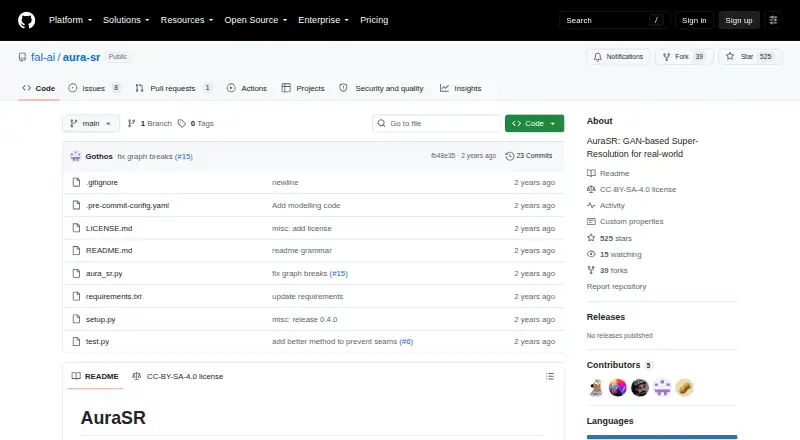
What AuraSR is
AuraSR is an open-source, GAN-based implementation for enlarging real-world images, described as a variation of GigaGAN for image-conditioned upscaling. It can be used as a Python package or through an API, and supports JPG, JPEG, PNG, WebP, GIF, AVIF, HEIC, and HEIF inputs. The repository shows installation with pip and a Python workflow that loads a model and calls a 4x upscaling method. Package requirements include PyTorch 2.0 or later, torchvision, NumPy, einops, huggingface_hub, and safetensors. The regular 4x method works on non-overlapping tiles that can leave seams. An overlapped method makes an extra pass and averages results to reduce seams, doubling processing time. The API supports v1 and v2 checkpoints and defaults to v1; requests can use public image URLs or Base64 data URIs, with queued processing, status checks, result retrieval, and optional webhooks. fal's API usage is listed as free, billed by compute second. AuraSR's open-source package is listed as free under the CC-BY-SA-4.0 license.
Who it suits
AuraSR suits developers, designers, and content creators who can work with a Python package or API for image upscaling. It also fits users who can manage its listed dependencies and API key handling.
What it does well
- Supports a broad range of listed image formats.
- API offers v1 and v2 checkpoints.
- Queued requests, status checks, results, and optional webhooks.
- Overlapped processing can reduce visible tile seams.
- Open-source package is listed as free.
What to know first
- Python package requires several dependencies.
- Overlapped processing doubles processing time.
- Regular tiling can leave seams.
- API key should be kept out of client-side code.
Plans
| Plan | Billed and limits | Price |
|---|---|---|
| fal API usage | per compute second · Pay for processing time · overlapping tiles double inference time | Free |
| AuraSR open-source package | GAN image upscaling · install with pip · CC-BY-SA-4.0 license | Free |
As github.com lists them, read 12 Oct 2026. The maker's own page has the final word.
Verdict
AuraSR provides both a Python package workflow and an API, with an overlapped option for reducing tile seams. Users should account for package dependencies, the extra processing time for overlap, and server-side API key handling.
Facts from AuraSR's own pages
- API access
- Yes · github.com, 22 Sept 2026
- API integration
- The model API documentation provides a JavaScript client flow using @fal-ai/client and an API key. · fal.ai, 12 Oct 2026
- API workflow
- The API supports queued requests, status checks, result retrieval, and optional webhooks. · fal.ai, 12 Oct 2026
- Architecture
- The project describes AuraSR as a variation of the GigaGAN paper for image-conditioned upscaling. · github.com, 12 Oct 2026
- Checkpoints
- The API supports v1 and v2 checkpoints and defaults to v1. · fal.ai, 12 Oct 2026
- Company founding
- fal says it was founded in 2021 by Burkay Gur and Gorkem Yurtseven. · fal.ai, 12 Oct 2026
- Dependencies
- The package metadata lists PyTorch 2.0 or later, torchvision, NumPy, einops, huggingface_hub, and safetensors as installation requirements. · github.com, 12 Oct 2026
- Deployment style
- The published usage example loads the model in Python and performs upscaling in code. · github.com, 12 Oct 2026
- Headquarters
- fal says it is headquartered in San Francisco. · fal.ai, 12 Oct 2026
- Image loading example
- The README example uses requests and Pillow to load an image from a URL before upscaling it. · github.com, 12 Oct 2026
- Input
- The API requires an image_url and accepts publicly accessible image URLs or Base64 data URIs for file inputs. · fal.ai, 12 Oct 2026
- Input formats
- JPG, JPEG, PNG, WebP, GIF, AVIF, HEIC, HEIF · github.com, 22 Sept 2026
- Install
- The repository README shows installation with pip install aura-sr and use through the Python AuraSR package. · github.com, 12 Oct 2026
- Installation
- The README shows installing AuraSR with `pip install aura-sr` and loading it in Python with `AuraSR.from_pretrained()`. · github.com, 12 Oct 2026
- Intended users
- fal describes the hosted model as suited to content creators, designers, and developers needing image enhancement. · fal.ai, 12 Oct 2026
- License
- The repository identifies its license as CC-BY-SA-4.0. · github.com, 12 Oct 2026
- Maintainer company
- fal describes itself as an AI inference platform for developers, while the AuraSR repository is hosted under the fal-ai GitHub organization. · fal.ai, 12 Oct 2026
- Maker
- fal says it was founded in 2021 and is headquartered in San Francisco. · fal.ai, 12 Oct 2026
- Maximum scale
- custom · github.com, 22 Sept 2026
- Moderation integration
- fal says it integrated OpenAI's Omni moderation API for automated, real-time harmful-content detection and filtering across modalities on its platform. · fal.ai, 12 Oct 2026
- Product pricing
- The AuraSR repository and its usage instructions provide no AuraSR-specific price or subscription plan. · github.com, 12 Oct 2026
- Purpose
- AuraSR is a GAN-based super-resolution implementation for real-world images, described as a variation of GigaGAN for image-conditioned upscaling. · github.com, 12 Oct 2026
- Seam handling
- The README says `upscale_4x` processes non-overlapping tiles that can cause seams, while `upscale_4x_overlapped` reduces seams by making an additional pass and averaging results, doubling processing time. · github.com, 12 Oct 2026
- Seam reduction
- Overlapping tiles help remove seams and double inference time. · fal.ai, 12 Oct 2026
Where AuraSR stands on Freedom251
- Image Upscaling Software#57 of 99