Freedom251 › AI Sound Effect Generators
AudioGen
What AudioGen is
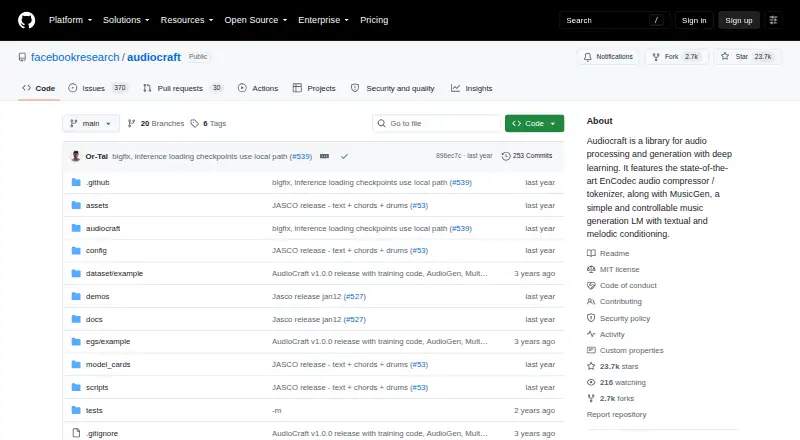
AudioGen is a text-guided sound-generation model available through AudioCraft. It turns written descriptions into audio and can also continue from an audio prompt or generate without a conditioning prompt. The API example creates five-second samples and saves them as WAV files; generation offers greedy, temperature, top-K, and top-P sampling. The listed pretrained model is facebook/audiogen-medium, with 1.5 billion parameters. Its released implementation combines an autoregressive Transformer with a 16 kHz EnCodec tokenizer. AudioGen is available through an API or for local use, including a Jupyter notebook demo. Local inference with the medium model requires a GPU with at least 16 GB of memory; installation requires Python 3.9 and PyTorch 2.1.0, and ffmpeg is recommended. It was trained on English descriptions and performs less well in other languages. It cannot generate realistic vocals, and prompt engineering may be needed for satisfactory results. The code is MIT-licensed, while the weights use CC-BY-NC 4.0; training datasets are not provided. The free plan costs nothing.
Who it suits
It suits audio and AI researchers, machine-learning practitioners, and amateurs learning about generative models. Local users need a GPU with at least 16 GB of memory for the medium model.
What it does well
- Generates audio from text descriptions.
- Supports audio continuation from a prompt.
- Offers greedy, temperature, top-K, and top-P sampling.
- API example saves audio as WAV.
- Free plan costs nothing.
What to know first
- Medium-model local inference needs at least 16 GB GPU memory.
- Performs less well with non-English descriptions.
- Cannot generate realistic vocals.
- Training datasets are not provided.
Limits
The free plan lists the pretrained medium model, but local inference requires a GPU with at least 16 GB of memory. AudioGen performs less well with descriptions in languages other than English and cannot generate realistic vocals.
Plans
| Plan | Billed and limits | Price |
|---|---|---|
| AudioGen (self-hosted) | No price stated by maker · Pretrained medium model · local inference requires a GPU with at least 16 GB memory | Free |
As github.com lists them, read 3 Oct 2026. The maker's own page has the final word.
Getting started
- Open the AudioCraft project on GitHub.
- Choose API access or follow the local installation route.
- For local installation, use Python 3.9 and PyTorch 2.1.0; ffmpeg is recommended.
- For local inference with the medium model, use a GPU with at least 16 GB of memory.
- Select facebook/audiogen-medium and generate audio from a text description or prompt.
AudioGen is a self-hosted model that turns written descriptions into generated sound. It is best suited to audio and machine-learning researchers, developers, and enthusiasts who can operate Python and a capable GPU. The main appeal is flexible, free experimentation; the hardware, language, vocal, and licensing constraints make it a poor fit for casual or commercial production.
Overview
AudioGen is delivered through AudioCraft as an API-oriented text-to-sound model, with generated audio saved as WAV. Its available facebook/audiogen-medium checkpoint has 1.5 billion parameters and combines EnCodec tokenization with an autoregressive Transformer. The supplied reimplementation is a single-stage Transformer working over a 16 kHz EnCodec tokenizer with four codebooks sampled at 50 Hz. It is not the original model used for the results reported in the AudioGen publication, so it should be treated as an implementation for exploration rather than a reproduction guarantee.
The documented example produces five-second samples from text. A local Jupyter notebook demonstrates the workflow, while the API provides a more programmable route. Only one pretrained model is offered, keeping the project focused on generative sound rather than presenting a broad creative application.
Key features
Text, reference, and continuation
Text descriptions can produce new sound samples, and the generation stage also supports unconditional output and continuation from an audio prompt. Continuation is useful when a sound needs to develop from existing material instead of being regenerated from words alone. The reference-input path adds flexibility for developers building repeatable audio workflows, although the model card warns that prompt engineering may be needed for satisfying results.
Sampling controls
Greedy, temperature, top-K, and top-P (nucleus) sampling let users trade predictability against variation. That is valuable for research and iterative sound design, where changing sampling behavior can be part of the creative or experimental process. It also means AudioGen rewards users who understand generation settings rather than expecting a single polished result from every prompt.
Model and training scope
AudioGenSolver supplies a training pipeline, but the maker cautions that it may not fully reproduce the paper's results. The datasets used to train AudioGen are not provided, limiting straightforward dataset-level reproduction or retraining. The model card advises risk evaluation and mitigation before downstream use, an important consideration for products that expose generated audio to the public.
Pricing
AudioGen (self-hosted) costs nothing, with no free trial because the product itself is free. The plan includes the pretrained medium model and local inference, but requires your own infrastructure rather than a hosted generation quota or managed service. Code is MIT-licensed, while the model weights use CC-BY-NC 4.0. That non-commercial restriction is decisive: commercial teams need permission or another model, even though the software code carries a permissive license.
Platforms
AudioGen supports API, Linux, and self-hosted use. Installation requires Python 3.9 and PyTorch 2.1.0; ffmpeg is recommended. Inference with the medium model requires a GPU with at least 16 GB of memory, which rules out many laptops and makes local hardware planning part of the cost. The notebook demo also expects a local GPU.
Who it's for
Choose AudioGen for research, prototyping, education, and hobby projects involving text-to-sound generation or audio continuation. It is a strong fit for technically comfortable users who value adjustable sampling and local control. It is not well suited to users seeking a browser-first experience, realistic singing or spoken vocals, multilingual prompting, or a commercially cleared production asset pipeline. AudioGen was trained on English descriptions and performs less well in other languages; it cannot generate realistic vocals.
Pros and cons
Pros
- Free self-hosted access lets researchers run generation locally without a subscription.
- Text, unconditional, and audio-continuation modes cover more than a single prompt-to-clip workflow.
- Four sampling strategies provide meaningful control for experimentation and variation.
- API access, WAV output, and a notebook demo support both scripted and exploratory use.
Cons
- A 16 GB GPU requirement makes local inference demanding and excludes many casual users.
- English-focused training reduces usefulness for other languages.
- Realistic vocals are outside the model's capability, narrowing music and voice applications.
- CC-BY-NC 4.0 weights restrict commercial deployment, and missing training datasets hinder reproduction.
- Prompt engineering may be necessary, so consistent results require technical iteration.
Alternatives
For a wider directory of sound-effect tools, see AI Sound Effect Generators; for music-focused options, see AI Music Generators.
Resemble AI is the better choice when you need hosted access across web, mobile, desktop, extension, API, or self-hosted environments, plus a free trial and paid plans.
Pick Creen for web or mobile generation with a free tier and optional $6.00-per-month annual PLUS plan. Mirelo suits creators wanting managed macOS, Windows, web, or API access and a 20.00 EUR monthly Creator plan with credits and projects.
Sonilo is aimed at users who prefer a freemium service with recurring credits, previews, and text-to-music and text-to-sound-effects allowances. Async combines media upload and AI credits with web, iOS, and API access. Autunes is a web option for song creation with a lifetime free-credit allowance. HueFold offers a simple free tier on Android and web. MMAudio is the closest alternative if you want another free, Linux/self-hosted project with MIT code and CC-BY-NC checkpoints.
Verdict
AudioGen is a good recommendation for technically capable researchers and learners who want controllable, local text-to-sound generation at no software price. Its strongest reason to choose it is the combination of prompt generation, continuation, and sampling controls in a self-hosted model. Look elsewhere if you need commercial rights, realistic vocals, multilingual reliability, low-hardware operation, or a polished hosted service.
Verdict
AudioGen provides text-to-sound generation with several sampling controls and prompt-based continuation. Its language and vocal limits, hardware requirement, and separate code and weights licenses are important considerations.
Questions
Does AudioGen have a free plan?
Yes. The AudioGen self-hosted plan is free.
Is there a free trial?
No, a free trial is not offered.
Which platforms are supported?
The listed platforms are API, Linux, and self-hosted.
Can I use AudioGen commercially?
Commercial use is restricted. The code is MIT-licensed, while the model weights use CC-BY-NC 4.0.
What pretrained model is available?
The listed pretrained model is facebook/audiogen-medium, with 1.5 billion parameters.
What output format does the example use?
The example generates sound from a text description and saves it as WAV audio.
Facts from AudioGen's own pages
- Audio continuation
- The generation stage supports conditional or unconditional sample generation and audio continuation from a prompt. · github.com, 3 Oct 2026
- Available model
- The page lists one pretrained AudioGen model, facebook/audiogen-medium, with 1.5 billion parameters. · github.com, 3 Oct 2026
- Free plan
- Yes · github.com, 20 Sept 2026
- Generation
- The example API generates sound from text descriptions and shows saving output as WAV audio. · github.com, 3 Oct 2026
- Generation modes
- The training documentation describes conditional and unconditional generation, audio continuation from a prompt, and greedy, temperature, top-K, and top-P sampling. · github.com, 3 Oct 2026
- Hardware requirement
- The instructions say inference with the medium-sized models requires a GPU with at least 16 GB of memory. · github.com, 3 Oct 2026
- Installation
- AudioCraft installation requires Python 3.9 and PyTorch 2.1.0; ffmpeg is also recommended by the repository instructions. · github.com, 3 Oct 2026
- Intended users
- The model card names audio, machine learning, and AI researchers, as well as amateurs learning about generative models, as primary users. · github.com, 3 Oct 2026
- Language limit
- The model card says AudioGen was trained on English descriptions and performs less well in other languages. · github.com, 3 Oct 2026
- License
- The repository says its code is MIT-licensed and its model weights use CC-BY-NC 4.0. · github.com, 3 Oct 2026
- Local demo
- The maker provides a Jupyter notebook demo that can be run locally with a GPU. · github.com, 3 Oct 2026
- Model architecture
- The released model combines EnCodec audio tokenization with an autoregressive Transformer language model and has 1.5 billion parameters. · github.com, 3 Oct 2026
- Model availability
- The AudioGen instructions list one pretrained model, facebook/audiogen-medium, and a local Jupyter notebook demo. · github.com, 3 Oct 2026
- Model design
- The provided reimplementation is a single-stage autoregressive Transformer trained over a 16 kHz EnCodec tokenizer with four codebooks sampled at 50 Hz. · github.com, 3 Oct 2026
- Model distinction
- The provided models are not the original models used to report results in the AudioGen publication. · github.com, 3 Oct 2026
- Output limit
- The model card says AudioGen cannot generate realistic vocals and may require prompt engineering for satisfying results. · github.com, 3 Oct 2026
- Prompt generation
- The documented API generates audio samples from text descriptions, with an example configured to generate five-second samples. · github.com, 3 Oct 2026
- Purpose
- AudioGen is a text-to-sound generation model provided through AudioCraft. · github.com, 3 Oct 2026
- Responsible use
- The model card advises against downstream use without further risk evaluation and mitigation. · github.com, 3 Oct 2026
- Sampling controls
- Generation supports greedy sampling, temperature sampling, top-K sampling, and top-P nucleus sampling. · github.com, 3 Oct 2026
- Support
- The model card directs questions and comments to the project’s GitHub repository or its issue tracker. · github.com, 3 Oct 2026
- Training
- AudioGenSolver implements the training pipeline, but the maker says it may not fully reproduce the paper results and does not provide the AudioGen training datasets. · github.com, 3 Oct 2026
- Training data
- The instructions say the datasets used to train AudioGen are not provided. · github.com, 3 Oct 2026
- What it does
- AudioGen is a text-guided audio generation model that generates sounds from text. · github.com, 3 Oct 2026
Where AudioGen stands on Freedom251
- AI Sound Effect Generators#2 of 29
- AI Instrumental Music Generators#2 of 25
- AI Podcast Music Generators#3 of 36
- AI Music Generators#82 of 123