Freedom251 › API Monetization Software
Aria Billing
What Aria Billing is
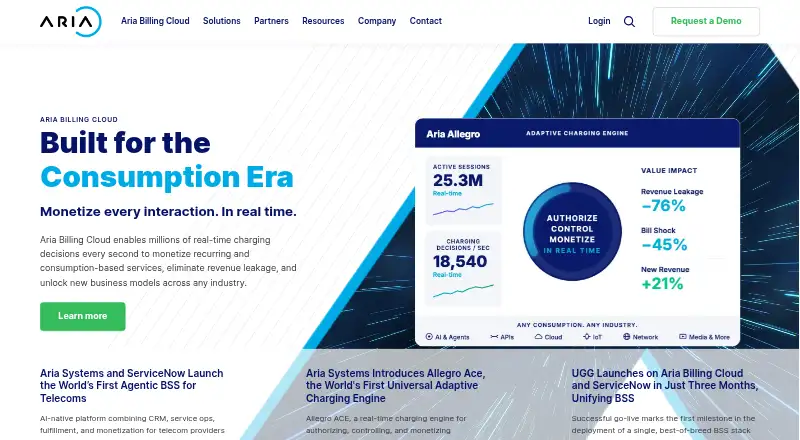
Aria Billing is an enterprise SaaS platform for automating order-to-cash work, from product catalogs and usage charges through invoices, payments, and collections. It supports one-time, subscription, consumption-based, usage-based, and hybrid billing. The Aria Allegro engine handles usage mediation, rating, and charging, with rating options such as per-unit, tiered, volume-based, pay-as-you-go, allowance-plus-overage, and shared pool. Account hierarchies can represent B2C, B2B, and B2B2C relationships, distribution channels, commercial arrangements, and connected-device groups. The platform processes subscriptions and usage in real time, applies taxes, and includes dunning and reporting. Aria lists more than 360 read-and-write APIs in REST and SOAP formats, plus connectors for Salesforce, ServiceNow, MuleSoft, Snowflake, Databricks, tax providers, and payment processors. Data Connect prepares billing data for analytics and AI applications. Billie Connect adds role-based controls and audit trails for AI access to billing tools and data. Pricing is on request.
Who it suits
Aria Billing is designed for established service businesses and enterprises with complex usage and subscription models. Its usage engine is positioned for high-volume industries including telecom, SaaS, fintech, utilities, and media.
What it does well
- Supports subscription, usage-based, one-time, and hybrid billing.
- Processes usage and subscriptions in real time.
- Provides over 360 REST and SOAP APIs.
- Includes dunning, taxation, and invoice generation.
What to know first
- Pricing is available only on request.
- Designed for enterprise billing needs.
- Billing Cloud is described as multi-tenant public cloud.
Getting started
- Visit the Aria website.
- Request a demo from Aria.
- Discuss pricing and the system support available for a launch.
- Connect relevant systems using Aria’s listed integrations or APIs.
Aria Billing is an enterprise SaaS platform for automating complex order-to-cash operations. It suits established businesses with substantial subscription, usage, or account-structure complexity; smaller teams looking for a self-serve billing tool will find the buying model less accommodating. Its breadth of rating, integration, API, and governance capabilities is compelling, although pricing requires a sales process.
Overview
Aria Billing combines product catalog management, invoicing, taxation, payments, collections, dunning, and reporting in a multi-tenant public cloud. It supports one-time, subscription, consumption-based, usage-based, and hybrid monetization, allowing recurring charges and metered usage to share one billing operation.
The account hierarchy covers B2C, B2B, B2B2C, distribution channels, commercial arrangements, and collections of connected devices. That range is useful for telecom, SaaS, fintech, utilities, and media businesses handling many relationships or high transaction volumes, but unnecessary overhead for a simple subscription service with one customer type.
Key features
Usage, rating, and automation
The Aria Allegro engine mediates usage, rates it, and charges customers. Rating options include per-unit, standard tiered, volume-based, flat rate per tier, high-water mark, threshold, pay-as-you-go, allowance-plus-overage, and shared-pool methods. This is a strong fit for products whose prices change with consumption, allowances, or shared entitlements. API metering, event ingestion, prepaid credits, proration controls, invoice generation, tax automation, multi-currency billing, and a customer billing portal cover the operational details that often complicate those models.
Subscriptions and usage can be processed in real time, with automated payments, collections, dunning, taxes, and invoices. The result is a broad order-to-cash scope rather than a narrowly focused invoice generator.
APIs, integrations, and data
More than 360 read-and-write REST and SOAP APIs expose the Aria environment. Aria describes them as backward compatible and perpetually versioned, a useful characteristic for long-lived integrations. Connectors and integrations span Salesforce, ServiceNow, MuleSoft, Snowflake, Databricks, tax providers, payment processors, and other systems, giving enterprise teams multiple routes into existing operations.
Aria Data Connect extracts, transforms, and loads billing data for business intelligence, analytics, and AI applications. Aria Billie Connect adds role-based profiles, secure access to billing functions and data, and a full audit trail for AI access, helping organisations govern automated or assisted workflows.
Security and support
Aria states that the platform has PCI-DSS, SOC 1 Type II, SOC 2 Type II, ISAE 3402, and TRUSTe certifications, and is compliant with HIPAA, CCPA, and GDPR. White-glove system support includes billing expertise and assistance with launches. Those controls and services are relevant where compliance and implementation risk matter as much as feature breadth.
Pricing
Aria Billing uses paid, custom pricing. The product page directs prospective customers to request a demo rather than publishing a price, seat allowance, usage quota, trial period, or renewal term. That approach is normal for an enterprise platform whose scope and transaction model vary, but it makes early budget comparison difficult and signals a substantial evaluation and implementation process.
Platforms
Aria Billing is offered through web and API access. Aria Billing Cloud is described as a multi-tenant public cloud platform, while REST and SOAP interfaces support programmatic operation and integration.
Who it's for
Choose Aria Billing when an established business needs several billing models, sophisticated usage rating, complex account hierarchies, and controlled integration with CRM, data, tax, and payment systems. Telecom, SaaS, fintech, utilities, and media organisations with high-volume usage are especially aligned with its stated use cases.
Look elsewhere if you need transparent self-serve pricing, a lightweight implementation, or only basic recurring invoices. Aria's enterprise scope and custom commercial process are likely disproportionate for a small product with uncomplicated billing.
Pros and cons
Pros
- Broad monetization support: one-time, subscription, consumption, usage, and hybrid models can operate in one platform.
- Deep rating flexibility: nine named rating methods accommodate tiers, thresholds, allowances, pools, and pay-as-you-go charging.
- Extensive integration surface: more than 360 REST and SOAP APIs plus enterprise connectors support connected architectures.
- Governance and compliance: stated certifications, regulatory compliance, role-based AI controls, and audit trails address oversight requirements.
- End-to-end automation: taxation, payments, collections, dunning, invoicing, and reporting extend beyond metering alone.
Cons
- Custom pricing: without a published price or plan limits, buyers cannot quickly benchmark total cost.
- Enterprise complexity: the account hierarchy, integration range, and launch support are more than a straightforward subscription business may need.
- Sales-led purchase: requesting a demo is required to establish commercial terms, so experimentation is less immediate than with self-serve products.
Alternatives
Aforo is a better starting point for teams wanting a freemium API and web product; its Starter plan is free at $0 per month and includes 50,000 events per month, one storefront, six pricing models, basic revenue intelligence, Stripe integration, and community support.
Credyt suits early testing when a free-forever starting tier and test-mode access are priorities.
Flexprice is worth considering for developers seeking a free tier with 100,000 events per month, one pricing plan, a REST API, one SDK, basic invoice generation, email support, and 14-day data retention.
Lago is the alternative for teams that prefer AGPLv3 open-source, self-hosted deployment.
Solvimon offers a paid model with a free AI Essentials tier for the first $3 million, subject to qualification criteria.
Zuora CPQ is another enterprise option with custom pricing based on products, scope, transaction volume, business model, regions, and implementation needs.
Cheddar fits buyers wanting a published Builder price of $99 per month plus 30 cents per transaction.
Continuous Command is a custom-priced alternative scoped to transaction volume and configuration complexity.
For focused comparisons, review Usage-Based Billing Software, Subscription Billing Software, API Monetization Software, and Dunning Management Software.
Verdict
Aria Billing is a strong choice for established, high-volume businesses that need flexible hybrid billing, sophisticated usage rating, extensive APIs, and enterprise governance in one cloud platform. Choose it for that breadth and control; look elsewhere if transparent pricing, rapid self-service adoption, or a simpler billing model matters more than enterprise coverage.
Verdict
Aria Billing is suited to organisations managing complex billing models, usage, and account structures. Its broad API and rating options are relevant where order-to-cash processes need automation, while pricing requires a request.
Questions
How much does Aria Billing cost?
Aria Billing is paid, with pricing available on request.
Which billing models does it support?
It supports one-time, subscription, consumption-based, usage-based, and hybrid monetization.
What platforms does Aria Billing support?
The listed platforms are API and web. Aria Billing Cloud is described as a multi-tenant public cloud platform.
Can it integrate with other business systems?
Aria lists connectors for Salesforce, ServiceNow, MuleSoft, Snowflake, Databricks, tax providers, payment processors, and other systems. It also provides over 360 REST and SOAP APIs.
Who is Aria Billing designed for?
Aria describes it as designed for established as-a-service businesses and enterprises with complex usage and subscription models.
What security and compliance credentials does Aria state?
Aria states that it has PCI-DSS, SOC 1 Type II, SOC 2 Type II, ISAE 3402, and TRUSTe certifications, and is HIPAA, CCPA, and GDPR compliant.
Facts from Aria Billing's own pages
- Account structures
- Its account hierarchy supports B2C, B2B, B2B2C, distribution channels, commercial arrangements, and collections of connected devices. · ariasystems.com, 5 Oct 2026
- AI access controls
- Aria Billie Connect provides role-based access controls and profiles, secure access to billing data and functions, and a full audit trail. · ariasystems.com, 5 Oct 2026
- AI controls
- Aria Billie Connect provides role-based access controls and a full audit trail for AI access to billing tools and data. · ariasystems.com, 4 Oct 2026
- API access
- Aria provides over 360 read-and-write APIs in REST and SOAP formats, described as backward compatible and perpetually versioned. · ariasystems.com, 5 Oct 2026
- APIs
- Aria says it provides over 360 REST and SOAP APIs for read and write access to the Aria environment. · ariasystems.com, 4 Oct 2026
- Availability
- Aria Billing Cloud is described as a multi-tenant public cloud platform. · ariasystems.com, 4 Oct 2026
- Billing automation
- It processes subscriptions and usage in real time, applies taxes, handles payments, and automates billing and invoicing. · ariasystems.com, 5 Oct 2026
- Billing features
- Features include product catalog management, invoicing, taxation, payments, collections, dunning, and reporting. · ariasystems.com, 4 Oct 2026
- Billing models
- It supports one-time, subscription, consumption-based, usage-based, and hybrid monetization models. · ariasystems.com, 5 Oct 2026
- Data tools
- Aria Data Connect extracts, transforms, and loads billing data for business intelligence, analytics, and AI applications. · ariasystems.com, 5 Oct 2026
- Headquarters
- San Francisco, California, United States · ariasystems.com, 28 Sept 2026
- Integrations
- Listed integrations include Salesforce, ServiceNow, MuleSoft, Snowflake, Databricks, Avalara, Stripe, and Worldpay. · ariasystems.com, 5 Oct 2026
- Intended customers
- Aria describes its billing platform as built for enterprises and names telecom, SaaS, fintech, utilities, and media as high-volume industries for its usage engine. · ariasystems.com, 5 Oct 2026
- Monetization
- It supports subscription, usage-based, one-time, and hybrid billing models. · ariasystems.com, 4 Oct 2026
- Pricing availability
- The product page directs visitors to request a demo and does not state a product price. · ariasystems.com, 5 Oct 2026
- Product
- Aria Billing is an AI-powered enterprise SaaS billing platform for modernizing order-to-cash processes. · ariasystems.com, 5 Oct 2026
- Security and compliance
- Aria states that it is PCI-DSS Level 1 certified, SOC 1 Type II and SOC 2 Type II certified, TRUSTe certified, and HIPAA, CCPA, and GDPR compliant. · ariasystems.com, 5 Oct 2026
- Support
- Aria lists customer support at [email protected] and +1 415-852-7250. · ariasystems.com, 5 Oct 2026
- Target customers
- Aria Billing is designed for established as-a-service businesses and enterprises with complex usage and subscription models. · ariasystems.com, 4 Oct 2026
- Usage processing
- Aria Billing runs on the Aria Allegro engine for usage mediation, rating, and charging. · ariasystems.com, 4 Oct 2026
Where Aria Billing stands on Freedom251
- API Monetization Software#22 of 41
- Subscription Billing Software#30 of 49
- Usage-Based Billing Software#16 of 26
- Subscription Management Software#15 of 24
- Dunning Management Software#31 of 46