Freedom251 › Columnar Databases
Apache Kudu
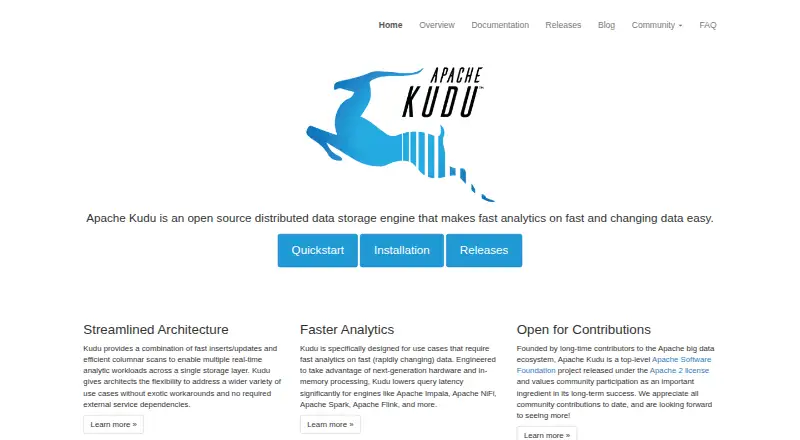
What Apache Kudu is
Apache Kudu is a free, open source distributed storage engine for analytics on data that changes quickly. It combines fast inserts and updates with efficient columnar scans in one storage layer. Tables use strongly typed columns and primary keys, allowing clients to read, update, or delete rows by key, with millisecond-scale access to individual rows. Kudu provides Java, C++, and Python APIs and lists Apache Impala, Apache NiFi, Apache Spark SQL, and Presto among its frequent integrations. It runs on Linux and stores data in the Linux filesystem; ext4 or XFS is recommended for storage directories. Raft replicates tablet operations, and clients that need it can use strict snapshot consistency. Security features include Kerberos authentication, TLS for authenticated internal connections, and fine-grained authorization through Apache Ranger policies. Kudu is self-hosted and supports Parquet, but it is not designed as an OLTP system and does not support automatic record deletion through a time-to-live property. The project offers documentation, mailing lists, and a chat room for help.
Who it suits
Kudu suits teams building self-hosted analytics systems around rapidly changing data, particularly where millisecond-scale row access and columnar scans both matter. It is not intended for OLTP workloads.
What it does well
- Combines fast inserts and updates with columnar scans.
- Supports millisecond-scale access to individual rows.
- Provides Java, C++, and Python APIs.
- Supports Kerberos, TLS, and Apache Ranger authorization.
- Free under the Apache 2.0 license.
What to know first
- Not designed as an OLTP system.
- Does not support automatic record deletion through a TTL property.
- Uses the Linux filesystem for storage.
Limits
Apache Kudu is free under the Apache 2.0 license. It is not designed for OLTP workloads and does not currently support automatic record deletion through a time-to-live property.
Plans
| Plan | Billed and limits | Price |
|---|---|---|
| Apache Kudu | Apache 2.0 licensed open source | Free |
As kudu.apache.org lists them, read 8 Oct 2026. The maker's own page has the final word.
Getting started
- Visit https://kudu.apache.org/ and review the project documentation.
- Prepare a Linux deployment and storage directories on ext4 or XFS.
- Use the Java, C++, or Python API to access Kudu.
- Connect it with a listed integration such as Apache Impala, Apache NiFi, Apache Spark SQL, or Presto.
Verdict
Apache Kudu brings changing records and analytical scans into one storage layer, with APIs, integrations, and security options. Its self-hosted Linux deployment and lack of TTL-based deletion may affect fit.
Questions
How much does Apache Kudu cost?
The Apache Kudu plan is free under the Apache 2.0 license.
Is Apache Kudu open source?
Yes. It is open source under the Apache 2.0 license.
Which platforms does it support?
The listed platforms are API, Linux, macOS, and self-hosted deployment. Kudu stores data on the Linux filesystem.
Which integrations are listed?
Frequently used integrations include Apache Impala, Apache NiFi, Apache Spark SQL, and Presto.
Does Kudu support automatic deletion after a set time?
No. It does not currently support automatic record deletion through a time-to-live property.
Where can users get help?
The project points users to its documentation, mailing lists, and chat room. Training may be offered by third-party vendors.
Facts from Apache Kudu's own pages
- Access
- Kudu supports millisecond-scale access to individual rows and provides Java, C++, and Python APIs. · kudu.apache.org, 8 Oct 2026
- Consistency
- Kudu uses Raft consensus to replicate tablet operations and provides strict snapshot consistency to clients that require it. · kudu.apache.org, 8 Oct 2026
- Data model
- Kudu stores tables with strongly typed columns and primary keys, and supports reading, updating, or deleting rows by primary key. · kudu.apache.org, 8 Oct 2026
- Deployment
- Kudu stores data on the Linux filesystem and recommends ext4 or XFS for storage directories. · kudu.apache.org, 8 Oct 2026
- Founded
- 2015 · kudu.apache.org, 28 Sept 2026
- Integrations
- The project lists Apache Impala, Apache NiFi, Apache Spark SQL, and Presto among its frequently used integrations. · kudu.apache.org, 8 Oct 2026
- Notable limitation
- The FAQ says Kudu does not currently support automatic record deletion through a time-to-live property. · kudu.apache.org, 8 Oct 2026
- Not an OLTP system
- The overview says Kudu is not designed as an OLTP system. · kudu.apache.org, 8 Oct 2026
- Purpose
- Apache Kudu is an open source distributed data storage engine for fast analytics on rapidly changing data. · kudu.apache.org, 8 Oct 2026
- Release
- The releases page lists Kudu 1.18.1, released January 9, 2026, as the latest release. · kudu.apache.org, 8 Oct 2026
- Security
- Kudu supports Kerberos authentication, TLS for authenticated internal connections, and fine-grained authorization using Apache Ranger policies. · kudu.apache.org, 8 Oct 2026
- Storage model
- Kudu combines fast inserts and updates with efficient columnar scans in one storage layer. · kudu.apache.org, 8 Oct 2026
- Support
- The project points users to documentation, mailing lists, and its chat room for help; training may be offered by third-party vendors. · kudu.apache.org, 8 Oct 2026
Where Apache Kudu stands on Freedom251
- Columnar Databases#5 of 27