Freedom251 › AI Animation Makers
AnimateDiff
What AnimateDiff is
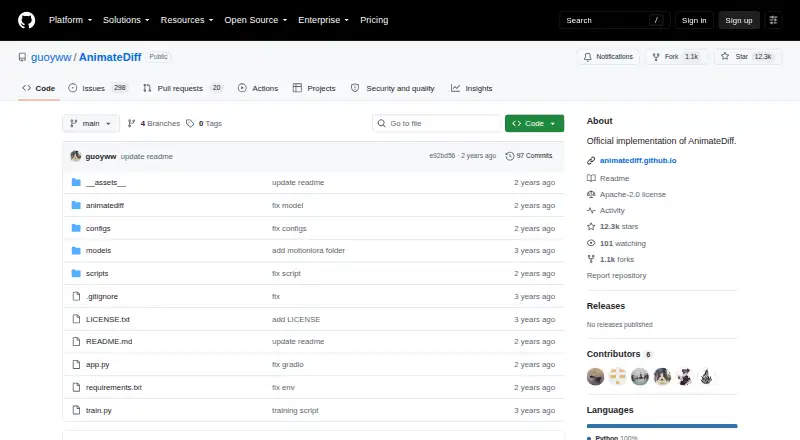
AnimateDiff is a free, open-source module that turns many community text-to-image models into animation generators without additional training. Its main branch targets Stable Diffusion 1.5, with a separate branch for Stable Diffusion XL. MotionLoRA adapts motion modules for patterns such as camera zooming and rolling, while SparseCtrl uses sparse RGB images or sketches to guide animation content. The project runs locally: install dependencies with pip and run its animation scripts, which save generated samples in a samples folder. A Gradio demo can also run locally at localhost:7860 by default. The project points to official Diffusers support and community integrations for Stable Diffusion WebUI and ComfyUI. Model weights are linked through Hugging Face, Google Drive, and CivitAI, and scripts handle checkpoint downloads automatically. For SDXL beta inference, the project says the usual requirement is about 13 GB of VRAM, depending on the personalized model and tuned settings. It lists noticeable small flicker and limited visual quality for general text-to-video, and recommends images from the same community model for closer style alignment. The repository lists an Apache-2.0 license and says the project is released for academic use.
Who it suits
AnimateDiff suits people working with community text-to-image models who want to generate animations locally. It may fit users comfortable installing dependencies and running scripts, particularly those using Stable Diffusion 1.5 or XL.
What it does well
- Works with Stable Diffusion 1.5 and a separate XL branch.
- MotionLoRA adapts motion patterns such as zooming.
- SparseCtrl accepts sparse images or sketches.
- Local Gradio demo is available.
What to know first
- SDXL beta inference usually needs about 13 GB of VRAM.
- The project notes noticeable small flicker.
- General text-to-video visual quality is limited.
- The project says it is released for academic use.
Limits
The project lists small flicker and limited visual quality for general text-to-video. SDXL beta inference usually requires about 13 GB of VRAM, depending on the personalized model and tuned hyperparameters.
Plans
| Plan | Billed and limits | Price |
|---|---|---|
| AnimateDiff | Released for academic use; no paid plans or pricing listed | Free |
As github.com lists them, read 4 Oct 2026. The maker's own page has the final word.
Getting started
- Open the AnimateDiff repository
- Install dependencies with pip according to the repository instructions
- Run the animation scripts locally or launch the local Gradio demo
- Use the scripts to download required checkpoints automatically
- Find generated samples in the samples folder
AnimateDiff is a plug-in module that adds animation to community text-to-image models without additional training. It is best for creators who can run local scripts or a local web interface and want to direct motion or content. Its free, open-source approach is attractive, but the stated flicker and text-to-video quality limits make it a weaker choice when polished output is essential.
Overview
AnimateDiff’s central appeal is that it works with personalized community models rather than requiring model-specific tuning. The main branch targets Stable Diffusion 1.5, with a separate branch for Stable Diffusion XL. That flexibility suits people already working in these model ecosystems; it is less suited to anyone looking for a turnkey animation service.
Key features
MotionLoRA adapts motion modules for patterns such as camera zooms and rolls, offering a way to shape movement. SparseCtrl accepts sparse RGB images or sketches to guide animation content, so users can provide visual direction as well as text. Image-to-animation is supported, with MP4 export.
The project identifies noticeable small flicker and limited visual quality for general text-to-video as shortcomings. It recommends using images created by the same community model for better style alignment. These caveats matter most when consistency and finished visual quality outweigh experimentation and control.
Setup relies on installing dependencies with pip and running animation scripts locally; generated samples are saved in a samples folder. A Gradio demo can also run locally, at localhost:7860 by default. The README points to official Diffusers support and community integrations for Stable Diffusion WebUI and ComfyUI. Model weights are linked through Hugging Face, Google Drive, and CivitAI, and scripts handle checkpoint downloads automatically.
For SDXL, the beta guidance puts inference at about 13 GB of VRAM in typical use, with actual needs varying by personalized model and tuned hyperparameters. That makes the SDXL route demanding for systems with limited graphics memory.
Pricing
AnimateDiff is free and open source. Its listed plan costs nothing, and there are no paid plans. The project is released for academic use; its disclaimer also disclaims responsibility for user-generated content. The repository lists an Apache-2.0 license, so users should consider both the license and the academic-use statement when deciding whether it fits their intended use.
Platforms
AnimateDiff is available for Linux, self-hosting, and the web through a locally launched Gradio demo. Its scripts run locally, and the demo uses localhost:7860 by default. The project page makes no security certification or compliance claims.
Who it's for
Choose AnimateDiff if you are comfortable managing a local setup and want to animate personalized text-to-image models with motion modules and image or sketch guidance. It is a better fit for experimentation than for general text-to-video work where visual quality and low flicker are priorities. The SDXL option is most practical for users with sufficient VRAM.
Pros and cons
Pros
- Works with community text-to-image models without additional training, making it useful for creators with personalized models.
- MotionLoRA and SparseCtrl offer distinct ways to guide movement and animation content.
- Free and open source, with local scripts, a Gradio demo, and integrations for Diffusers, Stable Diffusion WebUI, and ComfyUI.
- Scripts handle checkpoint downloads automatically, reducing one setup step.
Cons
- Noticeable small flicker and limited general text-to-video quality make it less suitable for polished output.
- SDXL inference usually requires about 13 GB of VRAM, depending on model and settings.
- Local setup requires installing dependencies and running scripts or a demo, so it is not a turnkey hosted service.
- The academic-use statement may not suit every intended use.
Alternatives
For a broader set of options, browse AI Photo Animation Tools or AI Animation Makers.
- HeyGen is a freemium web, mobile, and API option; its free plan allows up to three videos per month, each up to one minute.
- Pika is a freemium web, iOS, and API alternative with a free plan described as packs only and zero monthly credits.
- Animate Photo AI is a web-based freemium option; its free plan includes 50 credits.
- Hedra offers web and API access; its Basic plan is $20 a month with 2,000 credits/month and slower generations.
- Immersity AI is an API-based freemium alternative whose free plan includes watermarked conversions up to 720p for non-commercial use.
- Kling AI is an API-based freemium option with a free Basic plan and no monthly credits.
- Merge is an iOS option with a free Starter plan that includes 300 credits per month and Full HD AI motion videos.
- PicAlive is an iOS freemium alternative with a first animation free during onboarding; free videos have usage limits, a watermark, and occasional ads.
These alternatives may be a better fit if you prefer a service accessed through an app, web product, or API rather than a locally run animation framework.
Verdict
AnimateDiff is a strong fit for technically comfortable creators who want a free way to animate personalized community models and steer motion or content. Its flexibility and local control are the main reasons to choose it. Look elsewhere if you need polished, low-flicker general text-to-video output or want a turnkey service.
Verdict
AnimateDiff adds motion controls to community image-generation models and can be run locally through scripts or a Gradio demo. Its listed flicker and general text-to-video quality limits are worth considering, as is the academic-use statement.
Questions
How much does AnimateDiff cost?
The listed plan is free. The project is open source.
Which platforms does it support?
The listed platforms are Linux, self-hosted, and web. The repository instructions describe local setup and a local Gradio demo.
Which models does it support?
The main branch targets Stable Diffusion 1.5, and a separate branch is provided for Stable Diffusion XL.
Can it animate images or export video?
Image-to-animation is supported, and MP4 is the listed export format.
What controls and integrations are available?
MotionLoRA adapts motion modules, and SparseCtrl accepts sparse RGB images or sketches. The project points to Diffusers support and community integrations for Stable Diffusion WebUI and ComfyUI.
What license and use terms does the project list?
The repository lists an Apache-2.0 license. Its disclaimer says the project is released for academic use and disclaims responsibility for user-generated content.
Facts from AnimateDiff's own pages
- Compute needs
- The SDXL beta section says inference usually requires about 13 GB of VRAM, depending on the personalized model and tuned hyperparameters. · github.com, 4 Oct 2026
- Integrations
- The README points to official Diffusers support and community integrations for Stable Diffusion WebUI and ComfyUI. · github.com, 4 Oct 2026
- Intended audience
- The project page presents AnimateDiff as a framework for animating personalized text-to-image models without model-specific tuning. · animatediff.github.io, 4 Oct 2026
- Interface
- A Gradio demo can be launched locally and runs at localhost:7860 by default. · github.com, 4 Oct 2026
- Known limitations
- The project lists noticeable small flicker, limited visual quality for general text-to-video, and recommends using images made by the same community model for style alignment. · github.com, 4 Oct 2026
- License and use
- The repository lists an Apache-2.0 license, while its disclaimer says the project is released for academic use and disclaims responsibility for user-generated content. · github.com, 4 Oct 2026
- Model downloads
- The README links model weights through Hugging Face, Google Drive, and CivitAI, and says checkpoint downloads are handled automatically by the scripts. · github.com, 4 Oct 2026
- Model support
- The main branch targets Stable Diffusion 1.5, while a separate branch is provided for Stable Diffusion XL. · github.com, 4 Oct 2026
- Motion controls
- MotionLoRA adapts motion modules for patterns such as camera zooming and rolling. · github.com, 4 Oct 2026
- Purpose
- AnimateDiff is a plug-and-play module that turns most community text-to-image models into animation generators without additional training. · github.com, 4 Oct 2026
- Security
- The repository page does not state security certifications or compliance claims. · github.com, 4 Oct 2026
- Setup
- The repository instructions install dependencies with pip and run animation scripts locally; generated samples are saved in a samples folder. · github.com, 4 Oct 2026
- Sparse controls
- SparseCtrl accepts sparse RGB image or sketch inputs to control animation content. · github.com, 4 Oct 2026
Where AnimateDiff stands on Freedom251
- AI Animation Makers#1 of 23
- AI Photo Animation Tools#2 of 25