Freedom251 › Product Analytics Tools
Amplio
What Amplio is
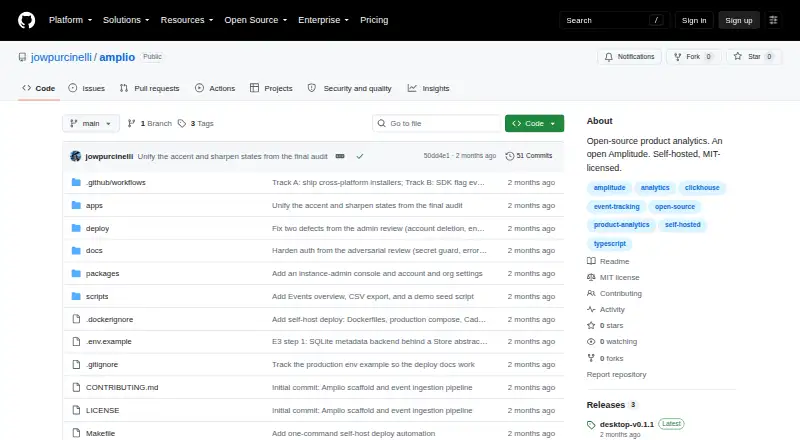
Amplio is a free, MIT-licensed, self-hosted product analytics platform for teams that want to analyze events on infrastructure they control. It supports event exploration, segmentation, funnels, retention, cohorts, user lookup, saved charts, dashboards, and user activity analysis. The ingestion API mirrors Amplitude's HTTP V2 contract; the project says existing SDKs and event schemas can be ported with minimal changes. Browser and Node SDKs are listed, along with ingestion endpoints at /2/httpapi and /batch. Event data is stored in ClickHouse, while metadata uses Postgres or SQLite depending on deployment. Self-hosting uses Docker with Caddy; the desktop application runs the analytics stack locally without Docker. Desktop installers are listed for macOS on Apple Silicon and Intel, and for Linux in AppImage and deb formats. The desktop documentation describes local ClickHouse and embedded SQLite storage, with events staying on the user's machine. The project describes Amplio as early and moving fast; session replay, experimentation, marketing attribution, alerting, and warehouse sync are later roadmap modules.
Who it suits
Amplio suits teams that want product analytics on infrastructure they control, including teams porting event schemas or SDKs compatible with its ingestion API. It offers both self-hosted deployment and a local desktop option.
What it does well
- MIT-licensed and listed as free
- Supports funnels, retention, and cohort management
- Browser and Node SDKs are listed
- Desktop app runs locally without Docker
- Desktop events stay on the user's machine
What to know first
- Project describes itself as early and moving fast
- macOS desktop builds are unsigned and trigger a Gatekeeper warning
Limits
The free plan is listed as free with no stated usage limits. Session replay, experimentation, marketing attribution, alerting, and warehouse sync are later modules.
Plans
| Plan | Billed and limits | Price |
|---|---|---|
| Amplio | MIT-licensed · self-hosted · no stated usage limits | Free |
As github.com lists them, read 4 Oct 2026. The maker's own page has the final word.
Getting started
- Choose self-hosted deployment or the desktop app.
- For self-hosting, use the Docker deployment with Caddy.
- For desktop use, get the installer for macOS or Linux.
- Connect event collection through the listed browser or Node SDKs or the /2/httpapi and /batch endpoints.
- Explore events, segmentation, funnels, retention, users, and cohorts in the dashboard.
Verdict
Amplio provides event analysis with self-hosted and local desktop deployment options. Its early status and unsigned macOS builds are worth considering before choosing it.
Questions
How much does Amplio cost?
Amplio is listed as free. The plan is MIT-licensed and self-hosted, with no stated usage limits.
Is Amplio open source?
Yes. The repository describes Amplio as MIT-licensed.
Which platforms are listed?
The listed platforms are API, Linux, macOS, self-hosted, web, and Windows. Desktop installers are listed for macOS and Linux.
Where does Amplio store event data?
It stores events in ClickHouse. For desktop use, the documentation describes local ClickHouse and embedded SQLite storage, with events staying on the user’s machine.
Can existing analytics SDKs and event schemas be used?
The ingestion API mirrors Amplitude’s HTTP V2 contract, and the project says existing SDKs and event schemas can be ported with minimal changes. Browser and Node SDKs are listed.
Who makes Amplio?
Amplio is described in the jowpurcinelli GitHub repository.
Facts from Amplio's own pages
- Analytics
- The dashboard includes event exploration, segmentation, funnels, retention, user lookup, cohort management, saved charts, and dashboards. · github.com, 4 Oct 2026
- Compatibility
- Its ingestion API mirrors Amplitude's HTTP V2 contract, and the project says existing SDKs and event schemas can be ported with minimal changes. · github.com, 4 Oct 2026
- Data control
- Amplio stores event data in ClickHouse and says self-hosted events stay on infrastructure the user controls. · github.com, 4 Oct 2026
- Deployment
- The self-hosted deployment uses Docker with Caddy, while the desktop app runs the analytics stack locally without Docker. · github.com, 4 Oct 2026
- Desktop data handling
- The desktop README says events stay on the user's machine and describes local ClickHouse and embedded SQLite storage. · github.com, 4 Oct 2026
- Desktop platforms
- The maker lists macOS installers for Apple Silicon and Intel, plus Linux AppImage and deb installers. · github.com, 4 Oct 2026
- Development status
- The README describes Amplio as early and moving fast, and its roadmap lists session replay, experimentation, marketing attribution, alerting, and warehouse sync as later modules. · github.com, 4 Oct 2026
- Installer limitation
- The maker says desktop builds are unsigned, so macOS Gatekeeper warns on first open. · github.com, 4 Oct 2026
- Intended users
- The project describes Amplio as an open replacement for Amplitude for teams that want to run product analytics on infrastructure they control. · github.com, 4 Oct 2026
- License
- The repository describes Amplio as MIT-licensed. · github.com, 4 Oct 2026
- Product
- Amplio is an open-source, self-hosted product analytics platform for tracking events and analyzing segmentation, funnels, retention, cohorts, and user activity. · github.com, 4 Oct 2026
- SDKs and API
- The project lists browser and Node SDKs, plus ingestion endpoints at /2/httpapi and /batch. · github.com, 4 Oct 2026
- Security
- The architecture documentation says ingestion API keys are resolved to projects and unknown keys are rejected. · github.com, 4 Oct 2026
- Storage
- Amplio uses ClickHouse for events and Postgres or SQLite for metadata, depending on deployment. · github.com, 4 Oct 2026
Where Amplio stands on Freedom251
- Product Analytics Tools#3 of 45