Freedom251 › Product Serialization Software
Amazon Transparency
What Amazon Transparency is
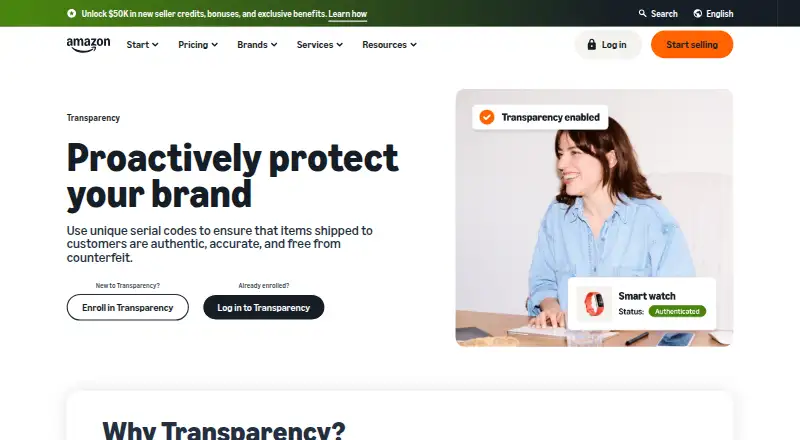
Amazon Transparency is a product serialization service for brands that want to check product authenticity and trace units through the supply chain. It assigns a unique code to each unit of an enrolled product. In supported Amazon stores, protected products need a valid Transparency code when listed or shipped, whether Amazon or the seller fulfills the order. Customers can scan Amazon-issued codes with the Amazon Shopping app or Transparency app to check authenticity and view information supplied by the brand. Batch- and lot-level traceability helps brands investigate supply chain issues and their causes.
Brands can apply codes with self-printed or pre-printed labels, print them on packaging, use service providers, connect code ordering to workflow software, or link existing serial codes. Existing serial codes do not offer customer app-scanning verification or the engagement benefits associated with Amazon-issued codes. Brands enroll with Amazon Brand Registry credentials from eligible origins, and protections begin only after an operational performance review. Every unit must carry an Amazon-issued or connected serial code. The portal provides performance reports, and Amazon's team helps enrolled brands choose an implementation option. There are no enrollment or subscription charges or minimums; fees are charged per ordered code.
Who it suits
Amazon Transparency suits brands seeking unit-level authenticity checks and batch- or lot-level traceability for products sold through supported Amazon stores. It is also relevant to brands that can enroll through Amazon Brand Registry and apply a valid code to every protected unit.
What it does well
- Assigns a unique code to each enrolled product unit.
- Checks codes when products are listed or shipped in supported stores.
- Lets customers scan Amazon-issued codes for authenticity and brand information.
- Provides batch- and lot-level traceability.
- Supports labels, packaging prints, workflow software, and existing serial codes.
- Includes performance reports and implementation guidance.
What to know first
- Every unit needs a valid code, and protection awaits an operational review.
- Existing serial codes lack customer app-scanning verification and engagement benefits.
- Code fees apply, with per-code rates depending on annual volume.
Limits
The lowest listed tier is $0.05, paid once for 1 to 1,000,000 generated codes; the annual volume resets on the account anniversary. The next tiers are $0.03, paid once for 1,000,001 to 10,000,000 codes and $0.01, paid once above 10,000,000. There are no enrollment or subscription costs or minimums, but protections require an operational performance review and a valid code on every unit.
Plans
| Plan | Billed and limits | Price |
|---|---|---|
| Transparency codes: 10,000,001+ | per code · 10,000,001+ generated codes · annual volume resets on account anniversary | $0.01, paid once |
| Transparency codes: 1,000,001 to 10,000,000 | per code · 1,000,001 to 10,000,000 generated codes · annual volume resets on account anniversary | $0.03, paid once |
| Transparency codes: 1 to 1,000,000 | per code · 1 to 1,000,000 generated codes · annual volume resets on account anniversary | $0.05, paid once |
As sell.amazon.com lists them, read 7 Oct 2026. The maker's own page has the final word.
Getting started
- Open the Amazon Transparency page.
- Enroll using Amazon Brand Registry credentials from an eligible origin.
- Choose a code application option, such as labels, packaging prints, workflow software, or connected existing serial codes.
- Apply a valid code to every unit and pass the operational performance review.
- Use the portal's performance reports to follow program results.
Overview
Amazon Transparency assigns unique codes to enrolled product units to help brands detect counterfeits and verify authenticity. It best suits brands selling in supported Amazon stores that need unit-level serialization and traceability. Its central trade-off is clear: Amazon-issued codes enable customer scans, while connected existing serial codes do not.
Key features
Each enrolled unit receives a unique code, and protected products need a valid code when listed or shipped in supported Amazon stores, whether Amazon or the seller fulfills the order. That makes the program useful for checking units across the marketplace, but it also makes code coverage an operational requirement: every protected unit must carry a valid Amazon-issued or connected existing serial code.
Customers can scan Amazon-issued codes in the Amazon Shopping or Transparency app to verify authenticity and see information the brand provides. Brands using existing serial codes retain the program’s traceability role but give up app-based customer verification and its customer engagement benefits.
Batch- or lot-level traceability helps brands investigate supply chain issues and root causes. Code application can fit different production workflows: brands can print labels themselves, use pre-printed labels or service providers, print codes on packaging, order codes through workflow software, or connect existing serial codes. Print workflow software and China-only regional ERP integration partners are also listed as integration paths. The portal provides performance reports, and Amazon’s team helps enrolled brands choose an implementation option.
Enrollment uses Amazon Brand Registry credentials. Eligible enrollment origins are the US, Canada, Germany, France, Italy, Spain, the UK, India, Japan, and China; supported stores also include Australia. Protections begin only after a product passes an operational performance review, so enrollment alone does not activate coverage.
Pricing
There are no enrollment or subscription costs, no minimums, and no charge to add or remove products. Fees apply when codes are ordered, with annual volume resetting on the account anniversary:
| Annual generated codes | Price | Practical fit |
|---|---|---|
| 1 to 1,000,000 | $0.05, paid once, billed per code | Brands beginning serialization or generating up to one million codes in the annual volume period. |
| 1,000,001 to 10,000,000 | $0.03, paid once, billed per code | Higher-volume programs that generate more than one million and up to ten million codes. |
| 10,000,001+ | $0.01, paid once, billed per code | Very large programs generating more than ten million codes. |
The per-code rate falls at higher annual volumes, but the cost follows codes ordered, so brands should account for their expected unit volume. There is no subscription or free-plan quota to manage; the listed free plan and paid pricing model coexist with usage-based code fees.
Platforms
Amazon Transparency is available on Android, iOS, and the web. Customer scanning with Amazon-issued codes works through the Amazon Shopping app or Transparency app.
Who it's for
This is a strong fit for brands enrolled in Amazon Brand Registry that sell in supported stores and need counterfeit detection, customer authenticity checks, or lot-level traceability. It is also practical for manufacturers able to incorporate codes into packaging or existing workflow software. Brands relying on existing serial codes can use the connection option, but should choose it only if customer-facing app verification is not a requirement.
It is a weaker fit for products whose units cannot reliably carry valid codes or for brands seeking customer app scans without using Amazon-issued codes. The operational review and unit-by-unit code requirement make implementation part of the protection itself.
Pros and cons
- Pros: Unique unit codes support counterfeit detection and customer checks for Amazon-issued codes.
- Pros: Batch- or lot-level traceability helps investigate supply chain issues, while portal reports give brands performance visibility.
- Pros: Multiple label, packaging, software, and serial-code paths can accommodate different production workflows.
- Pros: No enrollment or subscription fees, no minimums, and free product additions or removals keep fixed program costs low.
- Cons: Every protected unit needs a valid code, and protection waits for an operational performance review.
- Cons: Existing serial codes do not support customer app verification or the associated engagement benefits.
- Cons: Coverage is tied to the listed supported Amazon stores, and enrollment origins are separately limited to eligible countries.
Alternatives
Product Serialization Software is the broader category to compare if Amazon Transparency’s marketplace-linked code checks do not match your serialization needs.
Cerfinity may suit qualifying brands that want a 30-day pilot with 500 certificates, full platform access, and white-glove onboarding before committing.
Auth3D is a freemium option for teams that can start with 10 permanent part records and need public authentication pages plus QR, NFC, RFID, or serial-friendly lookup URLs.
Selinko Protect&Engage may fit brands seeking a customised solution with tailor-made hardware and software, onboarding, and industrial integration services.
Authentific is an enterprise deployment option whose price is scoped to issuance volume, access tier, production volume and lines, geography, and modules.
Origify offers monthly plans starting at €99 a month, including 10 authentications monthly on its Small plan, for brands whose needs fit its smartphone-model limitation.
SEA Vision Track & Trace is an alternative for organizations looking for Level 0–4 serialization and aggregation, Level 5 regulatory notifications, and enterprise or production-site solutions.
advanco ARC Platform is another paid option to consider for track-and-trace needs.
AltiusHub is another paid option to consider for track-and-trace needs.
Verdict
Choose Amazon Transparency if your brand needs unit-level serialization tied to supported Amazon stores, customer verification with Amazon-issued codes, or lot-level visibility for supply chain investigations. Its flexible code application and lack of fixed enrollment fees are compelling, but the per-code cost and operational obligation apply to every protected unit. Look elsewhere if existing serial codes must provide customer app verification, or if your products cannot consistently carry valid codes.
Verdict
Choose Amazon Transparency if your brand needs unit-level serialization, customer checks for Amazon-issued codes, or traceability for investigating supply chain issues. Brands using existing serial codes give up app-based customer verification, and every protected unit must carry a valid code after the operational review.
Questions
Is Amazon Transparency free?
There are no enrollment or subscription charges and no minimums. Fees apply when codes are ordered.
How much do codes cost?
The listed rates are $0.05, paid once for 1 to 1,000,000 codes, $0.03, paid once for 1,000,001 to 10,000,000, and $0.01, paid once for 10,000,001 or more. Annual volume resets on the account anniversary.
Where is Transparency available?
Supported stores are in the US, Canada, Germany, France, Italy, Spain, the UK, Australia, India, and Japan. Eligible enrollment origins are the US, Canada, Germany, France, Italy, Spain, the UK, India, Japan, and China.
Can customers scan product codes?
Customers can scan Amazon-issued codes with the Amazon Shopping app or Transparency app to verify authenticity and access brand-provided information. Products linked through existing serial codes do not receive those app-scanning benefits.
What integrations does it offer?
The page lists print workflow software and China-only regional integration partners using ERP systems as ways to integrate Transparency workflows.
What must happen before protection starts?
The product must pass an operational performance review, and every unit must carry a valid Amazon-issued or connected existing serial code.
Facts from Amazon Transparency's own pages
- Code application options
- Brands can self-print labels, use pre-printed labels or service providers, print codes on packaging, integrate code ordering into workflow software, or connect existing serial codes. · sell.amazon.com, 7 Oct 2026
- Customer verification
- For Amazon-issued codes, customers can scan codes with the Amazon Shopping app or Transparency app to verify authenticity and access brand-provided product information. · sell.amazon.com, 7 Oct 2026
- Eligibility
- Brands enroll using Amazon Brand Registry credentials; eligible enrollment origins listed are the US, Canada, Germany, France, Italy, Spain, the UK, India, Japan, and China. · sell.amazon.com, 7 Oct 2026
- Existing code limitation
- Products connected using existing serial codes do not have customer authenticity verification by app scanning or the customer engagement benefits available with Amazon-issued codes. · sell.amazon.com, 7 Oct 2026
- Geographic coverage
- Transparency-supported stores listed are the US, Canada, Germany, France, Italy, Spain, the UK, Australia, India, and Japan. · sell.amazon.com, 7 Oct 2026
- Integrations
- The page lists print workflow software and China-only regional integration partners using ERP systems as ways to integrate Transparency workflows. · sell.amazon.com, 7 Oct 2026
- Listing and shipment checks
- Once protected, products require a valid Transparency code when listed or shipped in supported Amazon stores, whether orders are fulfilled by Amazon or by the seller. · sell.amazon.com, 7 Oct 2026
- Operational requirement
- Protections are not active until the product passes an operational performance review, and every unit must carry a valid Amazon-issued or connected existing serial code. · sell.amazon.com, 7 Oct 2026
- Pricing structure
- There are no enrollment or subscription costs and no minimums; fees apply when codes are ordered, and adding or removing products is free. · sell.amazon.com, 7 Oct 2026
- Product purpose
- Amazon Transparency is a product serialization service and anti-counterfeiting program that helps protect brands from manufacturing through delivery. · sell.amazon.com, 7 Oct 2026
- Reporting and support
- The Transparency portal provides performance reports, and Amazon says its team helps enrolled brands choose an implementation option. · sell.amazon.com, 7 Oct 2026
- Supply chain visibility
- Transparency provides batch- or lot-level traceability to help identify supply chain issues and investigate root causes. · sell.amazon.com, 7 Oct 2026
- Unique codes
- The program assigns a unique code to every unit of an enrolled product for counterfeit detection and product-authenticity verification. · sell.amazon.com, 7 Oct 2026
Where Amazon Transparency stands on Freedom251
- Product Serialization Software#1 of 29