Freedom251 › Demand Planning Software
Alloy Planning
What Alloy Planning is
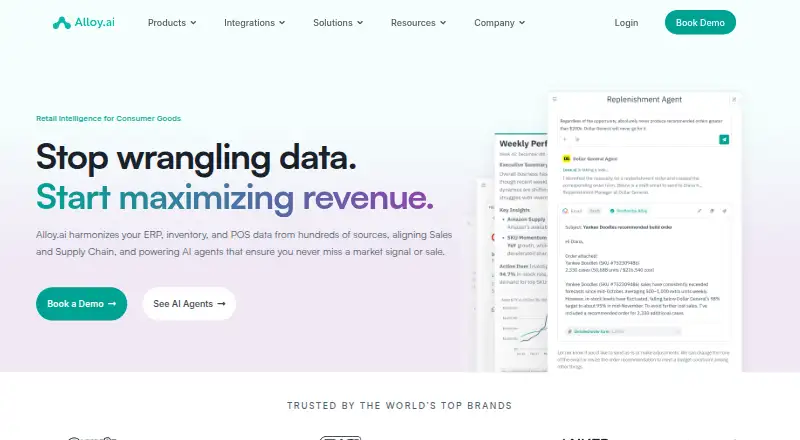
Alloy Planning is a web-based forecasting and planning solution for consumer goods brands. It uses harmonized retail point-of-sale and channel inventory data to reflect demand changes by retailer and SKU. The platform automatically updates point-of-sale, inventory, and shipment data, then alerts users to areas needing attention. Sales and supply chain teams can create and track consensus demand and inventory plans using demand projections, sales forecasts, promotions, and capacity forecasts. Alloy.ai says its wider platform combines commerce and inventory data from retailers, ecommerce platforms, distributors, 3PLs, and ERPs, and models product movement across manufacturing, warehouses, and retail locations. Tools include an AI analyst for natural-language questions, a performance reporting agent, and a replenishment agent that prepares store-level stockout recovery orders for approval. Demand sensing, scenario planning, and hierarchical forecasting are listed, with forecasts at SKU-location level. Integrations include SAP IBP, Anaplan, Kinaxis, and Logility, with custom integrations available for discussion. Pricing is on request; prospective customers can book a demo.
Who it suits
It is presented for consumer goods brands coordinating sales and supply chain planning. It may suit teams that need demand forecasts at SKU-location level and shared plans across functions.
What it does well
- Tracks demand by retailer and SKU.
- Automatically updates POS, inventory, and shipment data.
- Supports demand sensing and scenario planning.
- Forecasts at SKU-location level.
- Lists integrations including SAP IBP and Anaplan.
What to know first
- Pricing is available on request.
- Runs on the web platform.
- Other integrations require contacting Alloy.ai to discuss.
Overview
Alloy Planning is a forecasting and planning tool for consumer goods brands that need retailer-level demand signals alongside channel inventory. It is strongest for teams coordinating sales and supply-chain plans around changing retail demand; companies seeking a general-purpose planner or a self-serve purchase should look elsewhere.
Key features
Retail point-of-sale and channel inventory data inform forecasts down to retailer and SKU level. Demand sensing, hierarchical forecasting and scenario planning give planners ways to adjust forecasts as conditions shift, rather than treating demand as a single top-line figure. The fine-grained approach is most useful when retailer sell-through and location-level inventory matter to decisions.
Teams can build plans and track performance together. Alloy Planning automatically harmonizes and refreshes point-of-sale, inventory and shipment data, then alerts users to areas that need attention. That workflow can help planners focus on exceptions and coordinate action to limit stockouts and excess inventory costs; it is less relevant to organizations without retailer-specific data or shared planning needs.
For sales and operations planning, Alloy Planning brings together point-of-sale projections, sales forecasts, promotions and capacity forecasts to produce consensus demand and inventory plans. It integrates with SAP IBP, Anaplan, Kinaxis and Logility, and Alloy.ai invites customers to discuss a custom integration if they use another demand-planning system.
The broader Alloy data platform combines commerce and inventory information into a shared source for sales and supply-chain teams. Alloy.ai says it offers 450+ pre-built integrations spanning retailers, ecommerce platforms, distributors, 3PLs and ERPs, and automates collection from APIs, retailer portals and flat files. Its SKU-Location Inference Model maps partner identifiers to internal SKUs, converts units and harmonizes metrics, calendars and currencies. That groundwork can reduce the reconciliation burden of fragmented data, though the value depends on having those varied sources to bring together.
Beyond planning, the platform models product movement across manufacturing, warehouses and retail locations, with visibility across network tiers. Lens answers natural-language questions and analyzes performance across dimensions; the Replenishment Agent identifies store-level stockouts and prepares recovery orders for approval; and the Performance Reporting Agent turns data into executive narratives and visualizations. These capabilities broaden Alloy.ai’s role beyond forecasting, but should matter most to buyers seeking a connected data and supply-chain platform rather than a standalone planning tool.
Alloy.ai says customer data is encrypted at rest and in transit, hosted on Google Cloud Platform, and protected in transit and service requests with TLS 1.2. It maintains SOC 2 Type II for Security, is GDPR compliant, describes its CCPA approach, and supports SAML single sign-on. Customers retain exclusive ownership of raw signals and AI-generated insights, and Alloy.ai says it does not use proprietary customer data to train third-party or general AI models.
Pricing
Alloy Planning is paid, with custom pricing. Prospective customers can book a demo; after a request, a sales representative will email within 24 hours to schedule an introductory call. This sales-led process suits buyers evaluating a specialized solution with their existing planning stack, but there is no published price to compare or self-serve option to try before engaging.
Platforms
Alloy Planning runs on the web. Alloy.ai also lists Snowflake, BigQuery, Databricks, Redshift and Azure Data Lake as warehouse destinations, and Tableau, Power BI, Looker, Kinaxis, Anaplan and SAP IBP among downstream tools.
Who it's for
Alloy Planning is purpose-built for consumer goods brands, particularly teams that need to connect retailer and SKU-level demand with inventory and shared sales and supply-chain plans. Its broad data ingestion and normalization may suit companies dealing with many retail, distribution and ERP feeds. It is a weaker fit for buyers who do not depend on retail signals, need transparent upfront pricing, or want to start without a demo and sales conversation.
Pros and cons
- Pros: Forecasts use retail point-of-sale and channel inventory data down to retailer and SKU level, aligning plans more closely with consumer-goods demand.
- Pros: Automated data harmonization, shared planning and exception alerts give teams a common workflow for responding to changes.
- Pros: The platform combines broad data ingestion, supply-chain visibility and AI agents with SAML, SOC 2 Type II and GDPR measures.
- Cons: Custom pricing and a demo-led process make it harder to assess cost or begin independently.
- Cons: Its specialized retail and consumer-goods focus is less compelling for organizations with different forecasting needs.
Alternatives
For buyers comparing demand-planning tools, Demand Planning Software is the broader category to explore. Choose frePPLe if a free open-source edition and API, Linux, self-hosted or web options matter more; its Cloud plan is capped at six scenarios. OpsFactor offers a free, self-hosted Community plan on Windows with selected statistical models and heuristic planning, making it a possible fit for teams prioritizing a no-cost starting point.
NETVIBES is another paid option, with a free plan and free trial. Infor Learning Management System is a paid alternative with a free trial. Consider Arkieva Demand Planning if you want a web or Windows demand-planning product and are willing to request a demo; Blue Ridge Supply Chain Intelligence is another quote-based subscription to discuss by demo. DELMIA Demand Planning may suit buyers seeking a Windows option with a quote based on package and business requirements. E2open Planning is a paid connected-planning alternative whose pricing requires contacting the provider.
Verdict
Choose Alloy Planning if you are a consumer goods brand that needs retailer-level demand signals, inventory data and coordinated planning in one workflow. Its clearest advantage is connecting granular retail demand to shared inventory and S&OP plans. Look elsewhere if you need transparent pricing, a self-serve trial, or a planning tool not centered on consumer-goods retail data.
Verdict
Alloy Planning brings retail demand signals, inventory information, and shared planning workflows together for consumer goods brands. Buyers need to request pricing and can discuss unlisted integrations with Alloy.ai.
Facts from Alloy Planning's own pages
- Access controls
- Alloy.ai supports single sign-on through SAML. · alloy.ai, 4 Oct 2026
- AI analysis
- Lens is an on-demand AI analyst that answers natural-language questions and explains performance through multidimensional analysis. · alloy.ai, 4 Oct 2026
- Availability
- Alloy.ai directs prospective customers to book a demo; after a request, a sales representative will email within 24 hours to schedule an introductory call. · alloy.ai, 4 Oct 2026
- Compliance
- Alloy.ai says it maintains SOC 2 Type II for Security and is GDPR compliant, and describes its approach to CCPA data protection and compliance. · alloy.ai, 4 Oct 2026
- Custom integrations
- Alloy.ai invites customers to contact it to discuss building an integration if their demand planning software is not listed. · alloy.ai, 4 Oct 2026
- Data collection
- The platform automates data extraction from APIs, retailer portals, and flat files. · alloy.ai, 4 Oct 2026
- Data normalization
- Its SKU-Location Inference Model maps partner identifiers to internal SKUs, converts units of measure, and harmonizes metrics, calendars, and currencies. · alloy.ai, 4 Oct 2026
- Data ownership
- Alloy.ai says customers retain exclusive ownership of raw signals and AI-generated insights and that it does not use proprietary customer data to train third-party or general AI models. · alloy.ai, 4 Oct 2026
- Data platform
- The platform combines commerce and inventory data into a unified source of truth for Sales and Supply Chain teams. · alloy.ai, 4 Oct 2026
- Data sources
- Alloy.ai says it has 450+ pre-built integrations for retailers, ecommerce platforms, distributors, 3PLs, and ERPs. · alloy.ai, 4 Oct 2026
- Demand planning integrations
- The site lists SAP IBP, Anaplan, Kinaxis, and Logility as popular demand planning integrations. · alloy.ai, 4 Oct 2026
- Forecasting
- It uses harmonized retail point-of-sale and channel inventory data to reflect demand shifts down to retailer and SKU level. · alloy.ai, 4 Oct 2026
- Headquarters
- San Francisco, California, United States · alloy.ai, 28 Sept 2026
- Integrations
- Alloy.ai lists Snowflake, BigQuery, Databricks, Redshift, and Azure Data Lake as warehouse destinations, plus Tableau, Power BI, Looker, Kinaxis, Anaplan, and SAP IBP as downstream tools. · alloy.ai, 4 Oct 2026
- Planner workflow
- The platform automatically harmonizes and updates retail point-of-sale, channel inventory, and shipment data, and alerts users to areas needing attention. · alloy.ai, 4 Oct 2026
- Planning collaboration
- Teams can plan and track performance against plan in one place to respond to changes and reduce stockouts and excess inventory costs. · alloy.ai, 4 Oct 2026
- Purpose
- Alloy.ai is built to help consumer goods brands sell more products, save time, and solve supply chain challenges. · alloy.ai, 4 Oct 2026
- Replenishment agent
- The Replenishment Agent detects store-level stockouts and prepares recovery orders for approval. · alloy.ai, 4 Oct 2026
- Reporting agent
- The Performance Reporting Agent synthesizes data into executive narratives and custom visualizations. · alloy.ai, 4 Oct 2026
- Security
- Alloy.ai says it encrypts customer data at rest and in transit, stores it in Google Cloud Platform, and uses TLS 1.2 for transit and service requests. · alloy.ai, 4 Oct 2026
- S&OP
- Alloy Planning feeds consensus demand and inventory plans based on point-of-sale demand projections, sales forecasts, marketing promotions, and capacity forecasts. · alloy.ai, 4 Oct 2026
- Supply chain visibility
- The platform models product movement across manufacturing, warehouses, and retail locations, with visibility across network tiers. · alloy.ai, 4 Oct 2026
- Support
- Alloy.ai directs users to contact its support team for product questions and provides security contact [email protected] for security concerns. · alloy.ai, 4 Oct 2026
- What it does
- Alloy Planning is a point-of-sale-driven forecasting and planning solution for consumer goods companies. · alloy.ai, 4 Oct 2026
Where Alloy Planning stands on Freedom251
- Demand Planning Software#27 of 53