Freedom251 › Supply Chain Management Software

OpsFactor
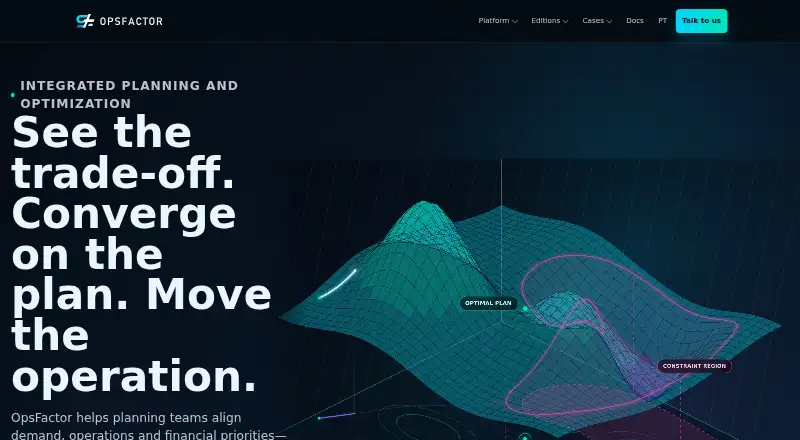
What OpsFactor is
OpsFactor helps planning teams connect demand, operations, and financial priorities from strategy through execution. Demand Planning combines statistical forecasting and diagnostics with product and customer clustering, while Planning Books support collaborative adjustments. Supply Planning tests network structures against production capacity, restrictions, and constrained demand plans. S&OE and Line Sequencing handle finite-capacity sequencing across resources, shifts, routings, and setup logic. Distribution Replenishment Planning covers replenishment, priority-aware allocation, load building, transfer consolidation, and vehicle formation. Inventory Optimization simulates coverage policies against capital, storage, projected writeoff, stockout, and service risk. Cost-to-Serve and P&L carry operational costs through the network and provide results by customer, product, and channel. The Windows product has a free, self-hosted Community edition with selected statistical models, heuristic MPS/MRP and DRP, Planning Books, and data operations. Pro is hosted by OpsFactor and includes advanced planning, optimization, MCP connectivity, and Level 2 technical support. Enterprise adds a native Planning Agent, client-owned identity provider support for single sign-on, and functional planning support.
Who it suits
Community suits teams starting on their own infrastructure. Pro is described for teams needing optimizer-driven planning and managed operation; Enterprise is for companies needing enterprise identity and business-planning support.
What it does well
- Demand planning includes collaborative Planning Books
- Scenario planning and hierarchical forecasting are supported
- Community edition is free and self-hosted
- Enterprise includes a native Planning Agent
What to know first
- Community excludes load building and fleet-capacity planning
- Pro and Enterprise pricing requires a quotation
- The listed platform is Windows
Limits
Community includes selected statistical models and heuristic MPS/MRP and DRP; its DRP excludes load building and fleet-capacity planning. Pro and Enterprise pricing is by quotation.
Plans
| Plan | Billed and limits | Price |
|---|---|---|
| Community | Self-hosted · selected statistical models · heuristic MPS/MRP and DRP · Planning Books and data operations | Free |
| Enterprise | Request a quotation · Shared or dedicated infrastructure · native Planning Agent · client-owned IdP for SSO · functional planning support | On request |
| Pro | Request a quotation · OpsFactor-hosted shared infrastructure · advanced planning and optimization · MCP connectivity · Level 2 technical support | On request |
As opsfactor.com lists them, read 7 Oct 2026. The maker's own page has the final word.
Getting started
- Visit the OpsFactor website.
- Choose the Community, Pro, or Enterprise edition.
- For Community, use its self-hosted offering.
- For Pro or Enterprise, request a quotation.
Overview
OpsFactor brings demand, supply, production, distribution, inventory, and financial planning into one platform. It is best suited to planning teams that need to connect decisions across those functions and can choose an edition that matches their hosting and support needs. Community makes it possible to start without a software charge, but its self-hosted setup and heuristic planning are meaningful trade-offs.
Key features
Demand Planning combines statistical forecasting and diagnostics with product and customer clustering and collaborative adjustments in Planning Books. Hierarchical forecasting, scenario planning, and SKU-location granularity let teams examine demand at different levels and compare possible outcomes. Community includes selected statistical models; teams needing advanced planning and optimization should look to Pro.
Supply Planning tests network structures against production capacity, restrictions, and constrained demand plans. S&OE and Line Sequencing carry plans into finite-capacity production sequencing across resources, shifts, routings, and setup logic. This breadth is useful when planners need to account for operating constraints rather than treating a forecast as a production plan.
Distribution Requirements Planning covers replenishment, priority-aware allocation, transfer consolidation, load building, and vehicle formation. Community has heuristic DRP and fair-share allocation, but no load building or fleet-capacity planning. That gap matters for teams whose distribution decisions depend on building loads or matching them to fleet capacity.
Inventory Optimization simulates coverage policies against capital, storage, projected writeoff, stockout, and service risk. Cost-to-Serve and P&L extend the view to operational costs across the network, with results by customer, product, and channel. Taken together, these functions help teams consider service and financial consequences alongside operational plans.
Pro and Enterprise include MCP connectivity for external AI clients when enabled for the environment. Enterprise also includes the native OpsFactor Planning Agent and supports client-owned Identity Provider authentication for Single Sign-On. Pro includes Level 2 technical support for execution errors; Enterprise adds functional planning and modeling support.
Pricing
Community: free. This self-hosted edition includes selected statistical models, heuristic MPS/MRP and DRP, Planning Books, and data operations. It suits teams starting on their own infrastructure, but gives up advanced optimization and, in distribution, load building and fleet-capacity planning.
Pro: custom pricing, billed by quotation. It provides OpsFactor-hosted shared infrastructure, advanced planning and optimization, MCP connectivity, and Level 2 technical support. It is the stronger fit for teams that want optimizer-driven planning and managed operation rather than self-hosting.
Enterprise: custom pricing, billed by quotation. It offers shared or dedicated infrastructure, the native Planning Agent, client-owned IdP SSO, and functional planning and modeling support. It is aimed at companies that need enterprise identity and business-planning support. Neither paid edition has a published price in these terms, so teams should request a quotation to compare costs.
Platforms
OpsFactor is available for Windows. Community is self-hosted, while Pro is hosted on shared OpsFactor infrastructure and Enterprise can use shared or dedicated infrastructure.
Who it's for
OpsFactor is a strong candidate for planning teams that need to link forecasts with capacity, execution, distribution, inventory, and financial analysis. Community fits teams able to manage their own infrastructure and work within heuristic planning and distribution limits. Pro suits teams seeking managed operation and optimization; Enterprise is the better match when SSO and functional planning support are priorities. Teams that need Community to handle load building or fleet-capacity planning should look elsewhere or consider a paid edition.
Pros and cons
- Pro: The platform connects forecasting, constrained supply and production planning, distribution, inventory policy, and network financial analysis, giving cross-functional teams a broad planning scope.
- Pro: Community has no software charge and includes Planning Books and data operations, offering a self-hosted starting point.
- Con: Community's heuristic planning and omitted load building and fleet-capacity planning limit its use for teams that need optimization or fuller distribution planning.
- Con: Pro and Enterprise require a quotation, so their cost cannot be compared from a published price alone.
Alternatives
For other options, browse Supply Chain Management Software or Demand Planning Software.
- ArrowStream is a paid option available on Android, iOS, and web; consider it if those platforms matter.
- Infor Public Sector is paid, supports a wider set of platforms including self-hosted and Windows, and asks customers to contact Infor for pricing details.
- NETVIBES is paid, offers a free plan and free trial, and supports Android, iOS, self-hosted, and web; its Enterprise Data Science plan lists 17 portfolio roles.
- Aera Technology Supply Chain is a paid platform subscription with use-case pricing available by contacting Aera, and supports Android, API, iOS, and web.
- Manhattan Active Inventory Replenishment is paid, has no free plan, and supports API and web.
- SupplyOn has a free plan and fee-based supplier solutions at $45 a month maximum per customer; some solutions are free and fees may be waived under an existing contract. It supports API, iOS, and web.
- AIMMS Supply Chain Planning is a paid option for Linux, web, and Windows.
- Arkieva Demand Planning is paid, supports web and Windows, and offers pricing by demo request.
Verdict
Choose OpsFactor if your planning team needs to connect demand forecasts to constrained operations, distribution, inventory, and financial outcomes, and you can match the edition to your hosting and support requirements. Community's zero software charge is a useful entry point for self-hosting, but its heuristic approach and distribution omissions are real limits. Teams needing optimization should seek a Pro quotation; those requiring SSO and functional planning support should consider Enterprise. If neither paid edition's custom pricing or Community's constraints suit you, compare alternatives before committing.
Verdict
OpsFactor spans forecasting, execution, distribution, inventory, and financial analysis. The editions differ in hosting, planning capabilities, and support, so match those needs before requesting a quotation.
Questions
Is OpsFactor free?
Yes. Community is listed as free.
What does Community include?
It includes selected statistical models, heuristic MPS/MRP and DRP, Planning Books, and data operations. Its DRP excludes load building and fleet-capacity planning.
How much do Pro and Enterprise cost?
Both are available by requesting a quotation.
Which platforms does OpsFactor support?
OpsFactor lists Windows.
What does Enterprise add?
Enterprise includes a native OpsFactor Planning Agent, client-owned identity provider SSO, shared or dedicated infrastructure, and functional planning support.
Does OpsFactor support external AI clients?
Pro and Enterprise include MCP connectivity for external AI clients when enabled for the environment.
Facts from OpsFactor's own pages
- AI integrations
- Pro and Enterprise include MCP connectivity for external AI clients when enabled for the environment; Enterprise also includes the native OpsFactor Planning Agent. · opsfactor.com, 7 Oct 2026
- Community limits
- Community includes heuristic DRP and fair-share allocation but excludes load building and fleet-capacity planning. · opsfactor.com, 7 Oct 2026
- Demand planning
- Demand Planning includes statistical forecasting, diagnostics, product and customer clustering, and collaborative adjustments in Planning Books. · opsfactor.com, 7 Oct 2026
- Distribution
- DRP supports replenishment, priority-aware allocation, load building, transfer consolidation, and vehicle formation. · opsfactor.com, 7 Oct 2026
- Execution
- S&OE and Line Sequencing support finite-capacity production sequencing across resources, shifts, routings, and setup logic. · opsfactor.com, 7 Oct 2026
- Financial analysis
- Cost-to-Serve and P&L propagate operational costs through the network and provide results by customer, product, and channel. · opsfactor.com, 7 Oct 2026
- Intended users
- The editions page describes Community as suited to teams starting on their own infrastructure, Pro for teams needing optimizer-driven planning and managed operation, and Enterprise for companies needing enterprise identity and business-planning support. · opsfactor.com, 7 Oct 2026
- Inventory
- Inventory Optimization simulates coverage policies against capital, storage, projected writeoff, stockout, and service risk. · opsfactor.com, 7 Oct 2026
- Purpose
- OpsFactor helps planning teams align demand, operations, and financial priorities from strategy through execution. · opsfactor.com, 7 Oct 2026
- Security
- Enterprise supports authentication through a client-owned Identity Provider for Single Sign-On. · opsfactor.com, 7 Oct 2026
- Supply planning
- Supply Planning tests network structures against production capacity, restrictions, and constrained demand plans. · opsfactor.com, 7 Oct 2026
- Support
- Pro includes Level 2 technical support for execution errors, while Enterprise adds functional planning and modeling support. · opsfactor.com, 7 Oct 2026
Where OpsFactor stands on Freedom251
- Supply Chain Management Software#1 of 36
- Demand Planning Software#3 of 53