Freedom251 › Order Tracking Software

AfterShip Tracking
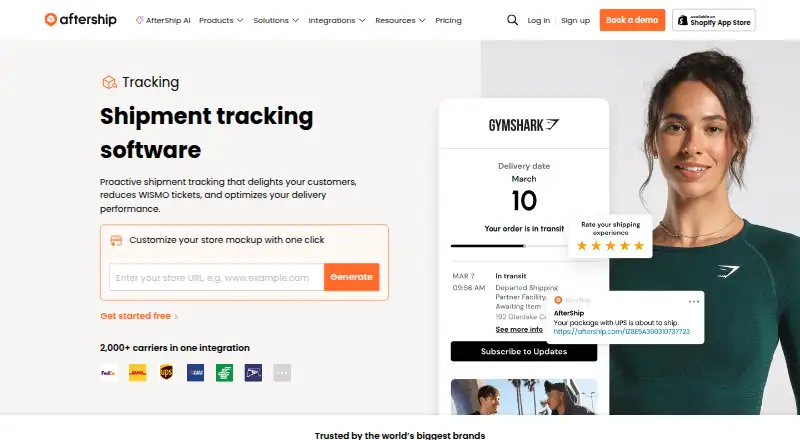
What AfterShip Tracking is
AfterShip Tracking helps businesses follow orders and shipments, monitor delivery performance, and keep customers updated. It connects to 2,000+ carriers through one integration and includes shipment reporting, delivery metrics, and exception monitoring. AfterShip says tracking status updates are available by webhook and API, with API updates arriving in around 60 minutes or less. The Essentials tier includes email and SMS notices for shipment milestones and estimated-delivery-date changes. All listed tiers include a branded tracking page; Premium and Enterprise add custom layouts, styles, and domains. Those two plans also include AI-powered estimated delivery dates and product recommendations on tracking pages. Listed connections include Shopify, Salesforce Commerce Cloud, Magento 2, Klaviyo, Gorgias, BigCommerce, eBay, Amazon Seller Central, NetSuite, and WooCommerce. A Free tier is listed, while Essentials starts at $29 a month and Premium at $59 a month. Enterprise uses custom pricing. The pricing page positions these tiers for stores and brands at different GMV levels, from below $1M to above $10M.
Who it suits
AfterShip Tracking suits online stores and brands that need shipment visibility, delivery reporting, and customer notifications. The listed tiers are aimed at businesses ranging from new stores below $1M GMV to enterprises above $10M GMV.
What it does well
- Connects to 2,000+ carriers in one integration
- Includes shipment reporting and exception monitoring
- Essentials provides email and SMS milestone notices
- All listed tiers include a branded tracking page
- SOC 2 Type II report and ISO 27001 certification
What to know first
- Essentials and Premium include 6,000 shipments per year
- Extra shipments cost $0.08 or $0.12 each on paid tiers
- Premium API limit is 10 requests per second
- Enterprise pricing is custom
Limits
Essentials and Premium include 6,000 shipments per year. Additional shipments cost $0.08 each on Essentials and $0.12 each on Premium. Premium has a 10 requests-per-second API limit; Enterprise has a custom limit.
Plans
| Plan | Billed and limits | Price |
|---|---|---|
| Free | 983 carriers · branded tracking page · order lookup widget · shipment visibility dashboard | Free |
| Essentials | Starting at; 6,000 shipments per year · $0.08 per extra shipment · branded page · carrier detection/correction · email and SMS notifications · status/reporting dashboard | $29 a month |
| Premium | Starting at; 6,000 shipments per year · $0.12 per extra shipment · custom domain and CSS · AI EDD and recommendations · advanced analytics · API/webhooks at 10 requests/sec · order edits | $59 a month |
| Enterprise | Custom · dedicated CSM · enterprise SLAs and SSO · custom integrations · multi-organization management · custom API rate limit | On request |
As aftership.com lists them, read 19 Oct 2026. The maker's own page has the final word.
Getting started
- Visit https://www.aftership.com/tracking.
- Choose the Free, Essentials, Premium, or Enterprise tier.
- Use the web, Android, or iOS platform, or connect through the API.
- Connect the service to a listed integration such as Shopify or WooCommerce.
AfterShip Tracking is a shipment visibility and delivery-performance service for ecommerce stores coordinating parcels across carriers. It is a stronger fit for merchants that need branded customer updates and exception monitoring than for people tracking occasional personal deliveries.
Overview
One integration connects AfterShip to more than 2,000 carriers. Order and shipment tracking is paired with reports on delivery performance and tools for monitoring exceptions and delivery metrics, giving operations teams a way to spot shipments that need attention alongside routine tracking.
AfterShip says it sends status updates instantly through webhooks and provides API updates around 60 minutes or less. Its integrations include Shopify, Salesforce Commerce Cloud, Magento 2, Klaviyo, Gorgias, Attentive, BigCommerce, eBay, Amazon Seller Central, NetSuite, and WooCommerce. That makes it relevant to stores using those commerce, marketing, and support platforms, though the specific integration needs will depend on each store's setup.
Key features
Customer-facing tracking
Every listed tier includes a branded tracking page, while Premium and Enterprise add custom layouts, styles, and domains. The included page gives even lower-tier customers a branded destination; the extra design controls are better suited to brands for which a more tailored tracking experience matters.
Essentials includes email and SMS notifications for shipment milestones and changes to estimated delivery dates. Premium and Enterprise add AI-powered estimated delivery dates and product recommendations on tracking pages, extending the offer beyond basic status communication.
Operational visibility and safeguards
AfterShip states that it holds a SOC 2 Type II report, ISO 27001 certification, and GDPR compliance. Its Trust Centre describes TLS 1.2 encryption in transit and AES-256 encryption at rest, with services hosted on AWS and Google Cloud in the United States. The pricing page also states a 99.9% monthly uptime guarantee; if it misses that mark, it refunds 10% of the amount paid for the downtime period.
Pricing
AfterShip uses a freemium model and offers a free trial. The Free tier is priced at $0, but the plan comparison does not state its shipment quota. The entry also gives a 100 /mo monthly shipment limit, so merchants should verify which allowance applies to the plan they intend to use before relying on a free tier for store volume.
Essentials starts at $29 /month, with 6,000 shipments per year and $0.08 per extra shipment. It is positioned for new stores below $1M GMV. It includes the branded page and email and SMS notifications, but does not include the custom page controls or AI features reserved for higher tiers. The annual shipment ceiling and per-shipment overage make volume planning important even at this entry price.
Premium starts at $59 /month, also with 6,000 shipments per year, but extra shipments cost $0.12 each. It targets growing brands with $1M-$10M GMV and adds custom tracking-page layouts, styles, and domains, AI-powered estimated delivery dates and recommendations, and a 10 req/sec API rate limit. The same annual base allowance as Essentials means the higher tier is primarily for added capabilities, not more included shipment volume.
Enterprise has custom pricing and is aimed at enterprises above $10M GMV. It offers custom volume and SLA terms, as well as the Premium-level page customization and AI features; its API limit is custom. This is the tier for businesses whose scale or service requirements call for negotiated terms rather than the published allowances.
Platforms
AfterShip Tracking supports Android, iOS, web, and API access. That combination can serve teams working from mobile devices as well as businesses connecting tracking into software workflows.
Who it's for
AfterShip is best suited to ecommerce operators handling enough shipments across multiple carriers to benefit from centralized tracking, customer notifications, and delivery reporting. Essentials aligns with newer stores below $1M GMV, while Premium is positioned for brands from $1M to $10M GMV that want more control over tracking pages and AI features. Enterprises above $10M GMV can consider custom volume and SLA terms.
It is less compelling for low-volume or personal tracking needs: the paid tiers center on 6,000 annual shipments, with charges for overages, and the free plan's quota is not established alongside the 100 /mo monthly limit.
Pros and cons
- Pros: Connection to 2,000+ carriers through one integration can simplify visibility across a varied delivery network.
- Pros: Branded tracking pages are included at every listed tier, with customer email and SMS notifications on Essentials.
- Pros: Reporting and exception-monitoring tools bring delivery performance into the same product as shipment tracking.
- Pros: Premium and Enterprise offer custom page design and AI-powered delivery estimates and product recommendations.
- Cons: Essentials and Premium both include 6,000 shipments per year, so growing volume can trigger overage charges rather than a larger base allowance.
- Cons: Premium's overage rate is $0.12 per shipment, higher than Essentials' $0.08, making the capability upgrade worth weighing against actual volume.
- Cons: Free-tier shipment allowance is unclear against the separate 100 /mo limit, which makes it harder for merchants to judge free-plan fit.
Alternatives
Order Tracking Software and Shipping Software are useful starting points for comparing products in those categories. Choose 17TRACK Business if its free plan of 50 shipments per month, 3,500 carrier integrations, tracking-page customization, and tracking-number redirection better match your needs. ParcelTracking offers a free personal-tracking plan with no card needed, making it an option for individuals rather than store operations.
Route Track has a $0/month Standard plan described as the full Route platform with consumer-funded pricing and custom configuration; consider it if that model suits your operation. CWILL Post-Purchase starts its Order Tracking Essential plan at $11 a month for 200 credits/month, averaging $0.055 per order, while Professional is $59 a month for 2,000 credits/month; compare those credit allowances against AfterShip's shipment-based tiers.
FreightCake Tracking has a $0 platform-fee plan currently free during beta while metered billing is developed, with the first 25 shipments covered. Loop Order Tracking pairs tracking with returns software and includes US and Canada domestic return labels on its free Core Tracking / Checkout+ Free plan, so it may be preferable when returns are also a priority. Postship offers a free plan for 100 shipments/month with FedEx, USPS, and UPS integrations, email notifications, and a branded tracking page; it may fit merchants whose volume and carrier needs align with that allowance.
Sendcloud offers a free plan for up to 20 parcels/month with no subscription fee and no courier contract required, an option for very low parcel volumes.
Verdict
Choose AfterShip Tracking if your store needs broad carrier connectivity, branded tracking, and shipment-performance visibility in one service. Its strongest case is operational breadth; the main reason to look elsewhere is the 6,000-shipment annual allowance on both published paid tiers, with per-shipment charges beyond it and an unclear free-plan quota.
Verdict
AfterShip Tracking combines carrier connectivity, tracking pages, and shipment performance tools, with features varying by tier. Compare shipment allowances and notification needs before choosing a paid plan.
Questions
Is AfterShip Tracking free?
A Free tier is listed as free. The pricing facts also say a free plan and free trial are available.
How much do the paid plans cost?
Essentials costs $29 a month and Premium costs $59 a month. Enterprise uses custom pricing.
Which platforms does it support?
The listed platforms are web, Android, iOS, and API.
How many carriers can it connect to?
AfterShip says it connects to more than 2,000 carriers through one integration.
What shipment allowance do Essentials and Premium include?
Each includes 6,000 shipments per year. Extra shipments cost $0.08 each on Essentials and $0.12 each on Premium.
Which integrations are available?
Listed connections include Shopify, Salesforce Commerce Cloud, Magento 2, Klaviyo, Gorgias, BigCommerce, eBay, Amazon Seller Central, NetSuite, and WooCommerce.
Facts from AfterShip Tracking's own pages
- AI features
- Premium and Enterprise include AI-powered estimated delivery dates and product recommendations on tracking pages. · aftership.com, 9 Oct 2026
- AI standardization
- AfterShip says historical-data models standardize shipment statuses and improve tracking-data accuracy. · aftership.com, 19 Oct 2026
- Analytics
- Reporting covers shipment volume, processing and transit times, exceptions, on-time rates, tracking-page visits, click-through rates, and reviews. · aftership.com, 19 Oct 2026
- API limit
- The pricing comparison lists a 10 requests-per-second API rate limit for Premium and a custom limit for Enterprise. · aftership.com, 9 Oct 2026
- Branded pages
- Merchants can publish tracking pages using their branding, custom domains, layouts, CSS, tracking clips, and custom shipment statuses depending on plan. · aftership.com, 19 Oct 2026
- Carrier coverage
- The tracking product advertises access to data from more than 2,000 global carriers and up to 50 new carriers monthly. · aftership.com, 19 Oct 2026
- Carrier detection
- Its AI checks tracking numbers to identify the correct carrier and correct mismatches. · aftership.com, 19 Oct 2026
- Company size
- LinkedIn lists AfterShip as privately held, founded in 2012, headquartered in Toronto, with 201–500 employees. · linkedin.com, 19 Oct 2026
- Customer notifications
- Essentials includes email and SMS notifications for shipment milestones and estimated delivery date changes. · aftership.com, 9 Oct 2026
- Data protection
- The Trust Centre lists TLS 1.2 encryption in transit and AES-256 encryption at rest, and says services are hosted on AWS and Google Cloud in the United States. · aftership.com, 9 Oct 2026
- Documentation depth
- AfterShip publishes API quickstarts, object and status references, webhook specifications, changelogs, and separate Tracking, Commerce, Shipping, Returns, Protection, Parser, Members, Address, Warranty, and Personalization APIs. · aftership.com, 19 Oct 2026
- Estimated delivery dates
- The product provides carrier-based delivery estimates on all listed plans and AI-modeled estimates on Premium and Enterprise. · aftership.com, 19 Oct 2026
- Founded
- 2012 · aftership.com, 28 Sept 2026
- Free trial
- An AfterShip Tracking account setup article says new accounts receive a 14-day trial without a credit card. · support.aftership.com, 9 Oct 2026
- Funding news
- FreightWaves reported on April 23, 2021 that AfterShip raised a $66 million Series B led by Tiger Global, bringing reported total funding to $69 million. · freightwaves.com, 19 Oct 2026
- Integrations
- Official integration listings include Shopify, Salesforce Commerce Cloud, Magento 2, BigCommerce, Amazon Seller Central, Klaviyo, Attentive, Gorgias, Yotpo, and ShipBob. · aftership.com, 19 Oct 2026
- Legal name
- Crunchbase identifies the legal name as AfterShip Ltd. and lists Andrew Chan, Dante Tsang, and Teddy Chan among the founders. · crunchbase.com, 19 Oct 2026
- Licence
- The terms classify the software, site, API, documentation, and related tools as proprietary materials owned by AfterShip; source access, redistribution, reverse engineering, and sublicensing are restricted. · aftership.com, 19 Oct 2026
- Limit: analytics
- A G2 reviewer asked for a more robust analytics dashboard in the merchant portal. · g2.com, 19 Oct 2026
- Limit: pricing complexity
- GetApp reviewers report confusing add-ons and plan jumps, with some features restricted to higher tiers and total costs exceeding expectations for smaller businesses. · getapp.com, 19 Oct 2026
- Limit: reliability and support complaints
- Trustpilot reviews include complaints about inaccurate delivery notifications, stale tracking, difficulty reaching human support, and alleged unexpected charges. · trustpilot.com, 19 Oct 2026
- Notifications
- The service supports automated customer communications when shipment statuses or estimated delivery dates change, including email and SMS. · aftership.com, 19 Oct 2026
- Order tracking
- Users can filter and view orders and shipments in one portal, monitor delivery exceptions, and investigate delays. · aftership.com, 19 Oct 2026
- Praise: shopper app
- Apple and Google Play reviewers commonly praise automatic email import, consolidated multi-carrier tracking, fast notifications, and overseas shipment visibility. · apps.apple.com, 19 Oct 2026
Where AfterShip Tracking stands on Freedom251
- Order Tracking Software#2 of 28
- Shipping Software#3 of 32