Freedom251 › Experimentation Platforms
ado
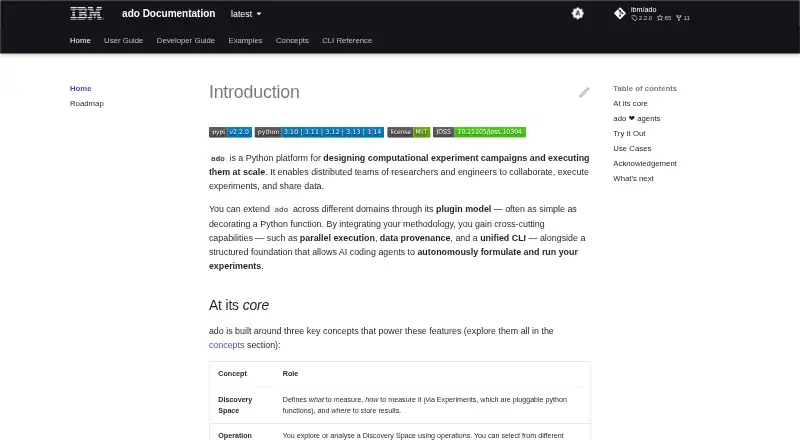
What ado is
ado is a free, open-source Python platform for planning computational experiment campaigns and running them at scale. Its workflow guides researchers through selecting experiments, defining parameter spaces, choosing a strategy, executing runs, and analysing results. Teams of researchers and engineers can collaborate across locations, run experiments, and share data. Python functions can extend experiments and operators through ado’s plugin model. The sample store keeps measurement results and can reuse existing results through memoization.
The documentation describes validated schemas, dry runs, structured results, and provenance records that track resource relationships and plugin versions. It also covers remote execution on Ray clusters, deployment of backends with Kubernetes or OpenShift, and a distributed MySQL setup for project data. Example applications include benchmarking fine-tuning and inference performance, and creating predictive performance models. Bundled agent skills can help AI coding assistants build research campaigns, execute experiments, query data, and analyse findings. The user guide is intended for researchers and benchmarkers exploring parameter spaces and results. The project welcomes contributions and directs feature proposals and bug reports to its GitHub issue tracker.
Who it suits
ado suits researchers and benchmarkers who need to explore parameter spaces, run computational experiments, and analyse results. Distributed research or engineering teams can use it to collaborate and share experiment data.
What it does well
- Free and open source.
- Guides users from experiment selection through result analysis.
- Python plugin model extends experiments and operators.
- Sample store can reuse results through memoization.
- Supports Ray execution and Kubernetes or OpenShift deployment.
- Provenance records resource relationships and plugin versions.
What to know first
- Requires a Python-based workflow.
- Listed platforms are API and self-hosted.
Getting started
- Open the ado documentation at https://ibm.github.io/ado/.
- Use the documented workflow to choose experiments and define a parameter space.
- Configure a strategy, then execute experiments and analyse results.
- Extend experiments or operators with Python functions if needed.
Verdict
Choose ado for research and benchmarking campaigns that need a documented workflow, reusable results, and extensibility through Python. Its listed platforms are API and self-hosted, so it suits teams prepared to work with those deployment options.
Questions
Is ado free?
Yes. It is listed as free and open source.
What platforms does ado support?
Its listed platforms are API and self-hosted.
Can teams collaborate using ado?
Yes. Researchers and engineers on distributed teams can run experiments and share data.
Can ado reuse experiment results?
Yes. Its sample store can reuse existing measurement results through memoization.
What can ado integrate with for remote execution and deployment?
The documentation describes remote execution on Ray clusters and backend deployment with Kubernetes or OpenShift.
Who maintains ado, and where can users raise issues?
The project welcomes contributions and directs users to its GitHub issue tracker for feature proposals and bug tracking.
Facts from ado's own pages
- Agent workflows
- Bundled agent skills can help AI coding assistants formulate research campaigns, run experiments, query data, and analyse results. · ibm.github.io, 4 Oct 2026
- Data backend
- The backend guide covers a distributed MySQL setup and onboarding projects to it. · ibm.github.io, 4 Oct 2026
- Examples
- Listed use cases include fine-tuning and inference performance benchmarking and predictive performance model creation. · github.com, 4 Oct 2026
- Extensibility
- Experiments and operators can be extended through a plugin model using Python functions. · ibm.github.io, 4 Oct 2026
- Integrations
- The documentation describes remote execution on Ray clusters and backend deployment with Kubernetes or OpenShift. · ibm.github.io, 4 Oct 2026
- Intended users
- The user guide is aimed at researchers and benchmarkers who want to run experiments, explore parameter spaces, and analyse results. · ibm.github.io, 4 Oct 2026
- Purpose
- ado is a Python platform for designing computational experiment campaigns and executing them at scale. · ibm.github.io, 4 Oct 2026
- Research workflow
- Its documented workflow covers choosing experiments, defining a parameter space, configuring a strategy, executing experiments, and analysing results. · ibm.github.io, 4 Oct 2026
- Result storage
- The sample store saves measurement results and can reuse existing results through memoization. · ibm.github.io, 4 Oct 2026
- Support and contributions
- The project welcomes contributions and directs users to its GitHub issue tracker for feature proposals and bug tracking. · ibm.github.io, 4 Oct 2026
- Team collaboration
- ado enables distributed teams of researchers and engineers to collaborate, run experiments, and share data. · ibm.github.io, 4 Oct 2026
- Validation and provenance
- The documentation says ado supports validated schemas, dry runs, structured results, and provenance that records resource relationships and plugin versions. · ibm.github.io, 4 Oct 2026
Where ado stands on Freedom251
- Experimentation Platforms#22 of 23