Freedom251 › AI Data Analysis Tools
ADA: Automated Data Analyst
What ADA: Automated Data Analyst is
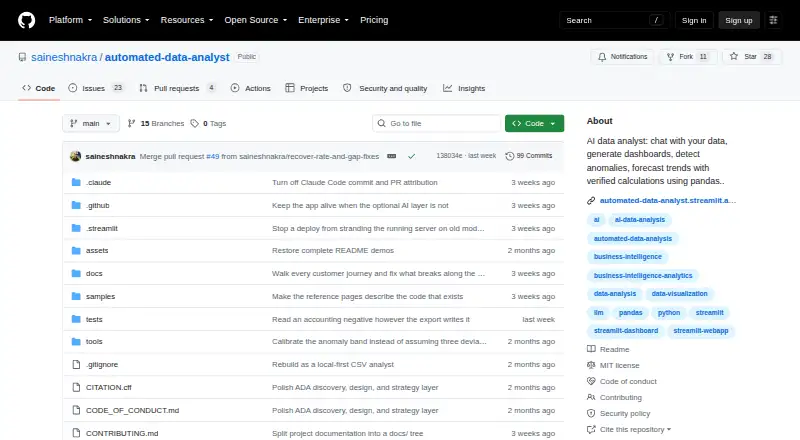
ADA: Automated Data Analyst analyzes CSV and Excel files and turns them into a dashboard, an executive brief, anomaly flags, forecasts, and answers to plain-English questions. Its dashboard includes trends, segment breakdowns, movement waterfalls, and segment-by-period heatmaps. Ask ADA uses pandas calculations and shows the calculation behind each answer. It can flag periods outside a calibrated band; for a stable series, the band is sized to produce about one false alarm per twenty analyses. Forecasting uses a guarded baseline that may decline to forecast when there is too little history, and reports when it does not improve on assuming no change. You can download a Markdown executive brief and a cleaned CSV.
ADA accepts .csv, .xlsx, and .xlsm files up to 25 MB and 250,000 analyzed rows. It can run locally as a Streamlit app from its source repository without an API key. In that setup, file parsing, cleaning, schema detection, charts, forecasting, and supported questions are computed locally. Optional AI calls require a key and receive schema and computed evidence rather than uploaded rows; that evidence may include segment labels. ADA is MIT licensed, with commercial use and modification allowed when the copyright notice is retained. The repository credits Sainesh Nakra as its maker.
Who it suits
ADA suits people who want to analyze CSV or Excel data through dashboards and plain-English questions, with calculations shown alongside answers. It may also suit users who want local processing, downloadable reports, or an MIT-licensed project they can modify and use commercially.
What it does well
- Shows pandas calculations behind plain-English answers.
- Includes trend, segment, waterfall, and heatmap views.
- Exports a Markdown brief and cleaned CSV.
- Can process files locally without an API key.
- MIT license permits commercial use with notice retained.
What to know first
- Files are limited to 25 MB and 250,000 analyzed rows.
- Accepts only .csv, .xlsx, and .xlsm imports.
- Optional AI calls require a key.
Limits
Files are limited to 25 MB and 250,000 analyzed rows, with .csv, .xlsx, and .xlsm supported. Forecasting may decline to run when history is thin. Optional AI calls require a key.
Getting started
- Open the project repository at https://github.com/saineshnakra/automated-data-analyst.
- Run ADA as a Streamlit app from the source repository for local use.
- Provide a .csv, .xlsx, or .xlsm file within the stated size and row limits.
- Ask a plain-English question or review the dashboard, flags, and forecast.
- Download the Markdown brief or cleaned CSV when needed.
Verdict
Choose ADA if you want to explore CSV or Excel data with dashboards, visible calculations, and downloadable outputs. Its local mode and MIT license may suit users who need local processing or commercial modification. Forecasting can decline on thin history, and the stated file size and row limits may constrain larger datasets.
Questions
Is ADA free?
Yes. ADA is listed as free, with a free plan and no free trial.
Which file formats does ADA accept?
It accepts .csv, .xlsx, and .xlsm files. The maximum stated file size is 25 MB, and the row limit is 250,000 analyzed rows.
Can ADA run locally?
Yes. It can run as a Streamlit app from its source repository. The README says no API key is required, and local processing runs without a network call.
What can ADA export?
It can download a Markdown executive brief and a cleaned CSV.
Is ADA open source?
ADA is MIT licensed. The README allows use, modification, and commercial distribution with the copyright notice retained.
Who makes ADA?
The repository credits Sainesh Nakra as the maker.
Facts from ADA: Automated Data Analyst's own pages
- AI safeguards
- ADA validates model output against a typed schema and the actual data, and it never executes model-generated code. · github.com, 7 Oct 2026
- Anomaly detection
- Anomaly flags identify periods outside a calibrated band, sized so a stable series false-alarms about once in twenty analyses. · github.com, 7 Oct 2026
- Ask ADA
- Plain-English questions are answered with pandas calculations, and the calculation is shown with the answer. · github.com, 7 Oct 2026
- Calculations
- ADA shows the calculation behind its findings and labels recommendations as interpretation rather than cause. · github.com, 7 Oct 2026
- Dashboard
- The dashboard includes trends, segment breakdowns, a movement waterfall, and a segment-by-period heatmap. · github.com, 7 Oct 2026
- Downloads
- ADA can download a Markdown executive brief and a cleaned CSV. · github.com, 7 Oct 2026
- Exports
- Users can download a Markdown executive brief and a cleaned CSV. · github.com, 7 Oct 2026
- File limits
- The stated limits are 25 MB per file and 250,000 analyzed rows; supported formats are .csv, .xlsx, and .xlsm. · github.com, 7 Oct 2026
- Forecasting
- Forecasting uses a guarded baseline that declines to run on thin history and reports when it does no better than assuming no change. · github.com, 7 Oct 2026
- Hosted demo privacy
- The hosted demo holds uploaded files in session memory and does not write them to a database. · github.com, 7 Oct 2026
- Integration
- The maker describes an optional OpenAI integration for planning questions the rule parser cannot handle; pandas executes the resulting calculation locally. · saineshnakra.medium.com, 7 Oct 2026
- License
- ADA is MIT licensed, and the README says it may be used, changed, and shipped commercially with the copyright notice retained. · github.com, 7 Oct 2026
- Local processing
- When self-hosted, file parsing, cleaning, charts, forecasting, and supported question answering run locally with pandas and no network call. · github.com, 7 Oct 2026
- Local use
- ADA can be run as a Streamlit app from its source repository, and the README says no API key is required. · github.com, 7 Oct 2026
- Maker
- The repository credits Sainesh Nakra as the maker, and his site lists San Jose, California as his location. · github.com, 7 Oct 2026
- Optional AI
- Optional, button-triggered AI calls require a key and receive schema and computed evidence rather than uploaded rows; the README notes evidence may include segment labels. · github.com, 7 Oct 2026
- Privacy
- When run locally without an API key, file parsing, cleaning, schema detection, charts, anomaly detection, forecasting, and Ask ADA are computed locally. · github.com, 7 Oct 2026
- Purpose
- ADA analyzes CSV and Excel files to create a dashboard, executive brief, anomaly flags, forecast, and answers to plain-English questions with calculations shown. · github.com, 7 Oct 2026
- Security
- The security policy says hosted infrastructure processes network traffic and application memory, and cautions that the public hosted app is not thereby approved for regulated data. · github.com, 7 Oct 2026
- Security limitation
- The maker says the hosted app is not thereby an approved environment for regulated data. · github.com, 7 Oct 2026
- Support
- The README directs users to documentation, contributing guidance, GitHub issues, and the project roadmap. · github.com, 7 Oct 2026
Where ADA: Automated Data Analyst stands on Freedom251
- AI Data Analysis Tools#4 of 27