Traditional industrial robots are usually the better value for stable, high-volume work with fixed parts, fixtures and motion sequences. AI-enabled robots become worthwhile when a cell must perceive variation, locate unknown parts, adapt to changing conditions or plan actions. Compare complete installed solutions—not an arm against an “AI” label—and include integration, tooling, safety, training, maintenance and the cost of future changeovers.
What “AI robot” means in an industrial setting
An industrial robot is not automatically an AI robot. A conventional cell follows programmed coordinates, trajectories, logic and interlocks. Once commissioned, it repeats those instructions with high consistency. A teach-and-playback system can achieve sub-millimeter repeatability, although creating or changing the program consumes robot and worker time, according to the National Institute of Standards and Technology (NIST): NIST’s CRCL overview.

As an Amazon Associate I earn from qualifying purchases.
In this article, an AI-enabled robot means a robot system that uses machine learning or other AI methods alongside conventional controls to interpret sensor data, recognize objects, estimate poses, detect process variation, plan actions or adjust behavior. The arm, controller, safety system, gripper and production software may still be conventional. AI is therefore a capability added to an automation system, not a replacement for every established robotics technology.
Capabilities that can make a system “AI-enabled”
- Perception: cameras, 3D sensors or force sensors identify a part, estimate its position and distinguish acceptable from defective work.
- Planning: software selects a sequence or path when the exact location, orientation or obstacle arrangement is not known in advance.
- Adaptation: the system modifies speed, force, position or inspection criteria in response to measured variation.
- Learning: a model improves recognition or decision-making from representative data, subject to validation and change control.
NIST describes machine vision as useful for inspection and robot guidance, while the UK Government’s Rapid Technology Assessment: Robotics identifies AI as a driver of advances in autonomy. Those capabilities can reduce manual teaching, but they add sensors, calibration, software, data management and validation work.
#1 Best Overall

- BUILD, CODE & DRIVE YOUR OWN ROBOT CAR: Turn coding, electronics and engineering into a working programmable robot car you can assemble, program and drive; ideal for weekend family projects, STEM classrooms, coding clubs, robotics lessons and maker challenges
- EXPLORE FPV, LINE TRACKING & OBSTACLE AVOIDANCE: Control the robot with the ELEGOO app or IR remote, view live FPV video through the onboard camera, follow black lines, avoid obstacles with the ultrasonic sensor and explore multiple interactive driving modes
- BEGINNER-FRIENDLY BUILD WITH GUIDED WIRING: Keyed XH2.54 connectors help reduce wiring mistakes, while the illustrated tutorial and example programs guide beginners step by step from chassis assembly and module connection to programming and the first successful run
- GO BEYOND ASSEMBLY WITH CREATIVE CODING: Program with Arduino IDE to explore movement, sensors and control logic, then modify example code to create custom routes, reactions and robotics experiments that develop coding, problem-solving and engineering skills
- COMPLETE RECHARGEABLE STEM ROBOTICS KIT: Includes an ELEGOO UNO R3 controller board, ESP32-WROVER-based camera and Wi-Fi module, line-tracking and ultrasonic sensors, motors, IR remote and a 2000 mAh rechargeable lithium-ion battery; recommended for ages 8+ with adult guidance for first-time builders
Traditional and AI-enabled robots compared
| Decision axis | Traditional programmed robot | AI-enabled or adaptive system |
|---|---|---|
| Environment | Structured cell with known fixtures, poses and sequence | Can handle more variation in part pose, surroundings or process conditions |
| Programming | Teach points, trajectories, PLC logic and fixed recipes | Conventional programming plus perception, models, planning or adaptive rules |
| Best production pattern | Long runs and repeatable cycles | Mixed products, variable inputs or frequent changeovers where adaptation has value |
| Repeatability | Very high when fixtures and inputs remain stable; sub-millimeter repeatability is possible with teach-and-playback | Can achieve precise motion, but sensing and model errors must be controlled and validated |
| Changeover effort | Often requires re-teaching, fixture changes and program edits | May reduce manual teaching, but requires calibrated models, sensor setup and validation for each product or condition |
| Engineering burden | Usually predictable once the cell is defined | Includes data, vision, calibration, software integration and monitoring in addition to robot engineering |
| Typical risk | Limited flexibility if a part or fixture changes unexpectedly | Unreliable perception, model drift, edge cases or difficult fault diagnosis if validation is weak |
The choice is not binary. A fixed robot may use a vision camera for part location without machine learning, and an AI model may assist an otherwise conventional cell. Evaluate the required capability rather than the marketing label.
What an industrial robot cell really costs
No comparable broad price series establishes that AI-enabled robots cost a particular percentage more or less than traditional robots. The U.S. Census Bureau’s experimental dataset records plant-level robot presence, purchases and capital expenditures for 2018–2021, but it warns that the data may not meet all statistical quality standards and does not resolve the AI-versus-traditional price question: Annual Survey of Manufactures Industrial Robotic Equipment: 2018–2021.
Use a complete installed-system estimate for the same task. A robot arm’s catalogue price is only one line item.
What’s actually slowing this PC down?
Pick the symptom - the matching free tool is one click away.
| Cost category | What to include | Why it changes the comparison |
|---|---|---|
| Robot and controller | Arm, controller, software licenses and communications | Payload, reach, speed and controller features determine whether the unit can meet the cycle |
| End effector | Gripper, welder, torch, dispenser, tool changer and cabling | Tooling determines what the robot can physically handle and how quickly it can switch tasks |
| Sensing | 2D/3D vision, force/torque sensing, lighting, scanners and computing | AI and variable-part handling generally need more sensing and calibration than a fixed fixture |
| Fixtures and process equipment | Jigs, nests, conveyors, part-present sensors, weld equipment or machine interfaces | Stable fixtures can make a conventional robot economical; flexible fixtures can support more products but cost more |
| Safety | Fencing, guarding, scanners, mats, interlocks, emergency stops and safety-rated controls | Human access and task hazards determine the required design; a collaborative label does not remove this work |
| Integration and commissioning | Mechanical and electrical design, PLC/HMI work, network integration, calibration, testing and production ramp-up | AI cells add model deployment, sensor alignment, data collection and edge-case testing |
| Training and documentation | Operator, programmer and maintenance training; manuals and procedures | Traditional teaching requires skill and time; AI systems also need model and data-handling competence |
| Ownership | Planned maintenance, spares, software support, energy, downtime and re-tasking labor | A lower purchase price can be outweighed by difficult changeovers or longer troubleshooting |
What published case studies do—and do not—show
Two NIST Manufacturing Extension Partnership case studies illustrate possible outcomes, not standard prices or guaranteed returns. Ohio MEP reports that AMG Industries increased output on one repetitive exhaust-tip task from 200 manually produced parts per hour to 276 parts per hour after deploying a collaborative robot, a reported 38% increase. Its projected return-on-investment period changed from 11.5 months to 6.5 months: AMG Industries case study. The figures are specific to that product, process, staffing model and installation.
In a separate CNC-tending project, NIST MEP and MAGNET report $55,000 in new investment and $10,000 in cost savings for Rimeco: Rimeco automation case study. Those amounts describe that integration; they are not a universal robot price or expected saving.
Flexibility: where AI helps and where it does not
Flexibility has several meanings. A robot may be mechanically capable of many motions yet still be expensive to reconfigure because every new product needs fixture changes, new paths, a different gripper and a safety review.
Stable, dedicated production
When a part arrives in a known pose and the process sequence rarely changes, a conventional robot can deliver short, predictable cycles. NIST’s Agile Robotics for Industrial Applications editorial describes traditional industrial robots as successful in structured environments. Dedicated welding, spray-painting and material-handling cells can keep the robot productive for long runs without paying for perception that the process does not need.
Recommended Free Tools
Variable parts and locations
Vision or force sensing can locate a part, compensate for tolerances or verify contact before an operation. An AI model may classify mixed parts on a conveyor or identify a suitable grasp. This can reduce custom fixturing and manual sorting, but the system still needs lighting, sensor placement, calibration targets, representative training data, reject handling and a defined response when confidence is low.
Frequent product changes
Offline programming can reduce repeated teaching on the shop floor, but it does not make changeovers free. It may require accurate digital models, robot and fixture calibration, collision checking, post-processing, test runs and operator training. A conventional cell with well-designed quick-change tooling may beat an AI cell for a small number of predictable products; an adaptive system becomes more attractive as variation and changeover frequency rise.
Best option by application
| Application | Usually the first option to evaluate | When another approach is justified |
|---|---|---|
| High-volume welding | Traditional programmed robot with dedicated fixtures and process controls | Use vision or adaptive control when joint location, part fit-up or product mix varies enough to cause frequent stops or re-teaching |
| Spray-painting or coating | Traditional fixed paths when part geometry and presentation are stable | Perception and path planning can help with changing geometries, but overspray, finish quality and process validation remain critical |
| Machine tending | Conventional robot when the machine, stock position and cycle are fixed | Vision, force sensing or adaptive gripping helps with variable blanks, mixed parts, uncertain presentation or multiple machines |
| Inspection | Robot with deterministic sensors and programmed positions for repeatable checks | AI vision is useful for variable appearance, defect classification or locating features that are difficult to fixture consistently; validate false rejects and missed defects |
| Picking and depalletizing | Fixed tooling and programmed patterns for uniform cartons or trays | AI perception and grasp planning can handle random bins, mixed SKUs or changing orientations, provided the gripper and recovery logic are robust |
| Human-adjacent light-duty work | A properly assessed collaborative robot may simplify deployment where payload, reach and speed are modest | A guarded traditional robot may be safer and more productive for heavy, fast or hazardous operations |
Welding
Welding rewards repeatability, torch access and process stability. If fixtures locate every joint and the product mix is narrow, a traditional cell avoids unnecessary sensing and software complexity. If distortion, fit-up or product variants move the joint, seam tracking or vision may provide more value than a general-purpose AI layer.
Rank #3

- 35+ Guided Electronics Projects: Progress from LEDs and buttons to RFID access, real-time clocks, motion and distance sensing, environmental monitoring, motor control and interactive displays for STEM learning, coding clubs and maker projects
- More I/O and Memory for Larger Builds: The MEGA 2560 R3 provides 54 digital I/O pins, including 15 PWM outputs, 16 analog inputs, 4 hardware serial ports and 256 KB flash for projects that combine more sensors, controls and displays
- 200+ Components for Prototyping: Includes LCD1602, RC522 RFID, RTC, DHT11, HC-SR501 PIR, ultrasonic and water-level sensors, GY-521, MAX7219, keypad, joystick, rotary encoder, relay, SG90 servo, stepper motor, DC motor, breadboard and more
- Learn, Modify and Create: Follow 35+ guided lessons with example code, then adjust sensor thresholds, timing, display text, motor behavior and control logic to turn structured exercises into access systems, monitors, alarms and interactive projects
- Organized for Repeatable Learning: Pre-soldered modules, a solderless breadboard, storage case and small-parts box reduce setup time and keep sensors, LEDs, ICs, wires and other components easy to find between projects
Machine tending
For a single CNC and a known stock location, programmed loading and unloading are straightforward. Mixed raw material, variable orientation or several machines increases the value of perception and adaptive gripping. Include chip management, door and chuck interlocks, part-presence checks and recovery from a failed pick in the design.
Do these 3 things before closing this tab:
1Clear out junk files and repair common Windows errors2Fix the driver behind crashes, sound loss and screen glitches3Repair Windows errors before they cause bigger problemsInspection and quality control
AI can classify visual variation that is difficult to encode as a simple threshold, but quality engineers must define acceptable and unacceptable examples, measure false positives and false negatives, lock model versions and provide a manual disposition path. A model that performs well on training images may fail under new lighting, surface finish or supplier variation.
Picking and sorting
Random-bin picking is a genuine perception and planning problem. The end effector must tolerate uncertain grasp points, occlusion and collisions. Start with a constrained pilot that records pick success, cycle time, recovery rate and damage, rather than assuming a demonstration generalizes to production.
Collaborative robots are not automatically safe beside anyone
Collaborative robots are designed for potential operation near people, often with lower force, payload, working range and speed than traditional industrial robots. The European Agency for Safety and Health at Work explains that the actual application still requires risk assessment and appropriate safeguards: EU-OSHA’s collaborating-robots guidance.
“Collaborative” describes a design intent and operating mode, not a blanket permission to remove guarding. The risk assessment must consider the robot, tool, workpiece, pinch points, sharp edges, stored energy, speed, force, foreseeable misuse and every operating mode. A low-force arm carrying a sharp tool or heavy part can still create serious injury hazards.
Rank #4
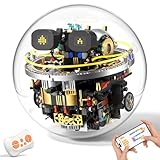
- 【Innovative Spherical Design with Expressions & Lights】:Our robotics kit contains 804 building blocks. Breaking away from traditional building block designs, it features a unique spherical body that supports 360°omnidirectional rolling. The upgraded robot kit comes with 12 fun expressions, and interactive 9-color mood lighting, providing kids aged 8–14+ with an immersive high-tech visual experience and engaging interactive fun.
- 【Smart Remote & APP Control】:The robotics kit can be controlled through dual control options: 2.4 GHz remote control and a feature-rich APP for maximum enjoyment. Kids can easily operate the robot to move in all directions, or switch dynamic expressions and lighting colors. And the APP integrates multiple creative play way including gyroscope control, voice control, custom path coding and STEM programming, guiding kids into the world of programming and unlocking more creative gameplay.
- 【STEM Learning & Coding Fun】:This STEM robot kit combines engineering, physics and creative assembly, perfectly integrating STEM educational concepts into building fun. With detailed illustrated instructions, it encourages children to engage in hands-on building and learn basic coding knowledge. Kids can develop their problem-solving, hand-eye coordination and critical thinking as well as coding skills, unlocking scientific exploration fun while enjoying screen-free play.
- 【STEM Learning & Coding Fun】:This STEM robot kit combines engineering, physics and creative assembly, perfectly integrating STEM educational concepts into building fun. With detailed illustrated instructions, it encourages children to engage in hands-on building and learn basic coding knowledge. Kids can develop their problem-solving, hand-eye coordination and critical thinking as well as coding skills, unlocking scientific exploration fun while enjoying screen-free play.
- 【Perfect Gifts for Kids】: Our STEM robot building sets are specially designed for children. Kids can build their own robots independently, or assemble, program, and play with their parents to strengthen parent-child bonding. Educational and fun, they make ideal STEM gifts for kids aged 8 9 10 11 12 13 14+, perfect for Children’s Day, birthdays, Christmas, and other gifting occasions.
- Define whether the task uses safety-rated monitored stop, hand guiding, speed-and-separation monitoring, power-and-force limiting or a combination.
- Measure the complete application, including the gripper and payload, rather than relying on the arm’s headline specification.
- Validate safe speeds, separation distances, restart behavior, access points and fault recovery.
- Train operators and maintenance staff on normal operation, bypass prevention and lockout procedures.
- Check the standards and legal requirements that apply in the installation’s jurisdiction. EU-OSHA notes that Regulation (EU) 2023/1230 applies to machinery from 20 January 2027; confirm current local requirements before commissioning.
Humanoid and general-purpose AI robots: promising but not a default substitute
Humanoid systems may eventually work in spaces designed for people without rebuilding every station. The International Federation of Robotics identifies humanoids and other AI-enabled developments among emerging trends, while warning that competing with established industrial automation requires industrial cycle time, energy efficiency and manageable maintenance costs: IFR’s 2026 robotics trends.
Treat a humanoid or general-purpose system as an application-specific emerging option. Require evidence for the exact task: sustained cycle time, payload at reach, uptime, recovery from errors, safety validation, energy use, service arrangements and total cost. Flexibility in a human-designed environment is valuable only if production performance and maintenance are adequate.
Independent reader supportYour contribution helps us test, update, and keep practical guides available for everyone.A practical selection process
- Define the job quantitatively. Record part dimensions and mass, tolerances, cycle time, shifts, annual volume, quality criteria, reach, payload, process forces and acceptable downtime.
- Measure variation. Document part position, orientation, surface appearance, supplier differences, product mix and how often the process changes. Separate true variability from problems that a better fixture would solve.
- Choose the simplest architecture that meets the requirement. Use programmed motion for stable inputs; add sensors or vision where they remove a measured source of labor or failure; add AI only where recognition, planning or adaptation is required.
- Design the complete cell. Specify tooling, fixtures, conveyors, machine interfaces, controls, safety devices, operator access, maintenance access and fault recovery before comparing robot quotations.
- Prototype the difficult step. Test the worst-case parts, lighting, contamination, tolerances and recovery scenarios. For AI, reserve separate data for validation and test conditions that were not used to tune the model.
- Calculate total cost of ownership. Include engineering, calibration, programming, training, maintenance, software support, energy, downtime and the labor and time needed for every expected re-tasking event.
- Validate production performance. Run representative shifts and record cycle time, first-pass yield, pick or detection success, unplanned stops, manual interventions and safety events.
- Plan ownership. Assign responsibility for backups, model updates, spare tooling, sensor cleaning, calibration intervals, cybersecurity, change approval and operator training.
Common failure modes and fixes
Comparing an arm with a complete AI cell
Symptom: the AI quotation appears dramatically more expensive or the conventional quotation appears artificially cheap. Fix: normalize both proposals to the same scope: tooling, sensing, fixtures, safety, controls, integration, commissioning, training and acceptance testing.
Assuming AI removes engineering
Symptom: a vision model works in a demonstration but fails with glare, dust, new suppliers or a crowded bin. Fix: specify lighting, data collection, confidence thresholds, reject handling, recalibration and a safe fallback before production.
Free tools Windows power users keep installed
One-click scans. No signup required.
Ignoring changeover labor
Symptom: a robot meets its nominal cycle but loses hours during every product switch. Fix: time the complete changeover, including fixture and gripper exchange, program selection, calibration, first-piece approval and troubleshooting.
Best Value

- Spark Your Creativity with LeArm Robotic Arm: LeArm is an elementary 6DOF desktop robot arm outfitted with 6 high-quality digital servos.It is capable of remote-control grasping, object transportation, custom actions, graphical programming, and more. It serves as the ideal platform for building and showcasing creative projects and for learning about bionic robotics.
- Anti-stall Protection: The robot arm end is equipped with 3 anti-blocking servos, complete with gear clutches that significantly extend the servos' lifespan.
- Premium Structure Design: The robot arm is constructed from exquisite metal bracket. The base is fortified with high-torque servos and industrial-grade bearings, guaranteeing exceptional stability.
- Various Control Methods: It supports PC, app, mouse and wireless handle control. Users can control the robot at your fingertips.
- Enjoy Robotic Arm Making: Enjoy the robot assembly process, LeArm is great for learning and building robot structures! Designed for students, engineers, university courses, and robot lovers. Comes with easy tutorials and simple programming software.
Overlooking the end effector
Symptom: the arm has adequate payload but drops, scratches or misorients parts. Fix: test the actual workpiece and specify grasp force, contact materials, compliance, sensing, utilities, tool-change interfaces and failure detection. Specialized end-of-arm tooling was part of the Rimeco integration described by NIST MEP; no single gripper is universally compatible.
Treating a cobot as a safety shortcut
Symptom: guarding is removed without evaluating the tool, payload or access paths. Fix: complete a task-specific risk assessment and validate the selected collaborative mode with a competent safety professional.
Using a case-study ROI as a promise
Symptom: a published payback period is copied into a business case without matching labor, volume or uptime assumptions. Fix: build a site-specific model and use published cases only as examples of what has been achieved in named deployments.
How to build a defensible ROI model
Start with the current process, not a vendor’s percentage improvement. For each option, calculate:
- productive parts per hour and planned operating hours;
- labor released, reassigned or still required for loading, inspection and recovery;
- scrap, rework and first-pass yield;
- planned and unplanned downtime;
- changeover frequency and duration;
- capital, integration, training and commissioning cost;
- maintenance, consumables, software support and energy;
- the cost of a failed sensor, gripper, controller or model update.
Then model conservative, expected and upside cases. Keep throughput gains separate from labor savings: a faster cell may create value by increasing capacity even when staffing does not fall. Include a ramp-up period and a manual fallback for quality or supply continuity.
What the available evidence can support
NIST’s robotics resources describe the technology and application challenges, but they do not publish a universal installed price comparison between AI-enabled and traditional systems: NIST Robotics and Manufacturing Automation and NIST Robotics. The Census experimental data provides a way to study industrial robot adoption and capital expenditure, not a definitive answer to the AI price question.
The reliable conclusion is conditional. Traditional robots remain compelling when the process is stable, volumes are high and a dedicated cell can run continuously. AI-enabled perception and planning earn their extra complexity when variation, inspection difficulty, random presentation or frequent changeovers impose a measurable cost. Collaborative robots can improve deployment and redeployment for suitable light-duty work, but their lower payload, reach and speed—and the need for a real safety assessment—must be part of the decision.
Quick Recap
Product prices and availability are accurate as of the date/time indicated and are subject to change. Any price and availability information displayed on Amazon at the time of purchase will apply.

