Recommended Free Tools
AI is already being used in clinical workflows, but the evidence supports three detailed hospital examples—not eight comparable, named deployments. Cleveland Clinic has reported sepsis-alert use, Advocate Health has described an imaging-triage pilot, and Mount Sinai has announced an ambient documentation rollout. These tools support clinical work in different ways; the announcements do not establish that they independently improve patient outcomes.
What these deployments do—and how mature they are
| Health system and tool | Clinical task | Status described by the organization | Reported scale |
|---|---|---|---|
| Cleveland Clinic and Bayesian Health | Detect and alert clinicians to sepsis risk | Platform expansion across U.S. hospitals; implementation reported at 13 hospitals | Fairview Hospital used it on more than 3,330 patients in 2024 and early 2025 |
| Advocate Health and Aidoc | Flag urgent imaging findings for prioritization | Pilot begun in October 2024; an agreement was announced to expand the platform | Pilot across 22 sites in Wisconsin and North Carolina |
| Mount Sinai and Dragon Copilot | Assist with clinical documentation using ambient listening and generative AI | Rollout announced | The announcement did not report a patient count |
These statuses are not interchangeable. Active use, a pilot, and an announced rollout each show that a health system is putting a tool into a workflow, but none by itself proves that the tool improves care. FDA-authorized device functions, funded development programs, and future implementation plans also should not be counted as completed hospital deployments.

As an Amazon Associate I earn from qualifying purchases.
How hospitals are using AI in patient care
Sepsis detection at Cleveland Clinic
Cleveland Clinic described expanding Bayesian Health’s clinical intelligence platform across its U.S. hospitals. At Fairview Hospital, the organization compared the system’s alerts with its pre-clinical alert process and reported a ten-fold decrease in false alerts, a 46% increase in identified cases, and a seven-fold increase in cases alerted before antibiotic administration. These are Cleveland Clinic’s reported pilot comparisons, not an independent evaluation or proof that the platform caused better patient outcomes.
The intended role is to surface real-time risk signals inside clinical workflows so care teams can assess them. An alert is a prompt for clinical attention, not a diagnosis or a substitute for a clinician’s judgment.
#1 Best Overall

- MULTIPURPOSE OVERBED TABLE - Helps disabled and handicapped individuals and anyone with physical limitations or injuries perform their daily tasks (e.g. eating, reading, working) without having to get out of bed. Highly recommended by physicians as the top selling overbed table in hospitals and clinics.
- ONE-HANDED INFINITE HEIGHT ADJUSTMENT- Its counterbalanced hydraulic mechanism allows users to smoothly raise or lower the table to the desired height between 29.5” – 40.5” using just one hand.
- HYGIENE & DURABILITY – Heavy-gauge, CHROME-plated (not silver-plated) welded tubular STEEL construction for enhanced stability and inhibit bacterial growth, making sanitation fast & efficient. The H-style base is also designed to slide easily under most beds, sofas or wheelchairs.
- SPILL-PROTECTED, EASY-CLEAN TOP - Beautiful mystic black-colored laminated top with raised perimeter lip to effectively contain liquid spills to help protect medical equipment and bed linens. DIMENSIONS – 30”(L) x 15”(W) x 29.5”-40.5” (H); Base Dimensions : 26.5” (L) x 15.5” (W); Tabletop Dimensions : 30” (L) x 15” (W) x 0.8” (H)
- STABLE & SMOOTH MOBILITY: Equipped with smooth-rolling, dual-wheel swivel casters for effortless maneuvering across various floor types. Its integrated locking mechanisms provide stability and prevent sliding during critical patient care. This product requires simple 4-step assembly.
Imaging triage at Advocate Health
Advocate Health said the initial algorithms in its Aidoc pilot flagged pulmonary embolisms, incidental pulmonary embolisms, and intracranial hemorrhages in imaging workflows. The system’s role is to help prioritize findings for review, rather than make a final diagnosis without human oversight.
Advocate projected that nearly 63,000 patients per year could benefit from faster prioritization and earlier diagnosis. That estimate was based on the health system’s internal modeling and early outcomes; it is a projection, not an observed annual result.
Rank #2
Ambient documentation at Mount Sinai
Mount Sinai announced a Dragon Copilot rollout for clinicians. The announced capabilities combine ambient listening with generative AI to help document care in the electronic health record. The announcement did not report measured time savings, changes in clinician burnout, or patient outcomes, so those benefits should not be treated as demonstrated at Mount Sinai.
How widespread is clinical AI?
The Office of the National Coordinator for Health Information Technology reported that 71% of U.S. hospitals had predictive AI integrated with electronic health records in 2024, up from 66% in 2023. Its analysis used the 2023 and 2024 American Hospital Association IT supplement data and described prediction of inpatient health trajectories or risks as a common use. Adoption lagged among small, rural, independent, government-owned, and critical-access hospitals. This is a measure of reported predictive-AI adoption, not a count of hospitals using the three tools above or proof that adoption improves outcomes.
Rank #3

- MULTIPURPOSE OVERBED TABLE - Helps disabled and handicapped individuals and anyone with physical limitations or injuries perform their daily tasks (e.g. eating, reading, working) without having to get out of bed. Highly recommended by physicians as the top selling overbed table in hospitals and clinics.
- ONE-HANDED INFINITE HEIGHT ADJUSTMENT- Its counterbalanced hydraulic mechanism allows users to smoothly raise or lower the table to the desired height between 29.5” – 40.5” using just one hand.
- HYGIENE & DURABILITY – Heavy-gauge, CHROME-plated (not silver-plated) welded tubular STEEL construction for enhanced stability and inhibit bacterial growth, making sanitation fast & efficient. The H-style base is also designed to slide easily under most beds, sofas or wheelchairs.
- SPILL-PROTECTED, EASY-CLEAN TOP - Beautiful walnut wood-grained laminated top with raised perimeter lip to effectively contain liquid spills to help protect medical equipment and bed linens. DIMENSIONS – 30”(L) x 15”(W) x 29.5”-40.5” (H); Base Dimensions : 26.5” (L) x 15.5” (W); Tabletop Dimensions : 30” (L) x 15” (W) x 0.8” (H)
- STABLE & SMOOTH MOBILITY: Equipped with smooth-rolling, dual-wheel swivel casters for effortless maneuvering across various floor types. Its integrated locking mechanisms provide stability and prevent sliding during critical patient care. This product requires simple 4-step assembly.
Device authorization is another distinct measure. The U.S. Food and Drug Administration’s AI-enabled medical-device page reported more than 1,600 such devices authorized for marketing in the United States as of September 2026. That total describes authorized device products, not the number of hospital deployments or their clinical effectiveness.
What the outcome evidence can—and cannot—show
Deployment announcements are useful evidence that an organization says it has launched, piloted, or plans to expand a system. They are not independent confirmation of clinical benefit. The three organizations’ announcements report different kinds of information: Cleveland Clinic gives internal pilot comparisons, Advocate Health gives a projection based partly on internal modeling, and Mount Sinai describes capabilities without reporting measured outcomes. Those figures cannot be compared as if they measured the same result.
Rank #4
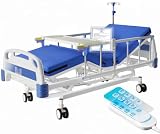
- Adjustable backrest, legrest, bed height & tilt - Three models of nursing beds are available for selection.4 Functions can be raised or lowered independently to suit personal comfort, 5 Functions and 5 Functions Pro also supports both Trendelenburg and Reverse-Trendelenburg positions, promoting better circulation, breathing, and overall patient care.
- Reliable comfort & full features — four quiet, smooth-running motors allow for effortless adjustments. 4 Functions comes with a detachable dining table for everyday convenience. 5 Functions includes lockable casters, 5 Functions Pro comes with integrated central locking and a breathable high-density foam mattress for enhanced comfort and secure care.
- Strong steel frame and adjustable IV pole — made from high-grade steel for lasting stability and strength, supporting up to 600 lb, and featuring an IV pole with adjustable height to accommodate medical needs.
- Easy assembly & simple operation — arriving about 95% pre-assembled, the bed can be set up in just minutes. Clear, step-by-step instructions make installation quick and stress-free.
- Versatile for multiple settings — perfect for home care, hospitals, nursing homes, rehabilitation centers, assisted-living, or any care environment. It provides adjustable support for recovery, elderly care, or anyone needing customizable rest.
Evidence for AI-enabled devices also varies. Stanford HAI’s 2026 AI Index reported that, among 1,016 device authorizations through December 2024 examined in a cited peer-reviewed study, only 2.4% of devices with clinical studies were supported by randomized controlled trial data. That statistic concerns the evidence base for those devices; it does not characterize every clinical AI tool or every hospital deployment.
For a specific tool, useful questions include:
- What task does it perform—predict, detect, prioritize, or document—and for which patients?
- Was it evaluated in the setting and population where it will be used?
- Who reviews the output, and what happens when an alert is missed, incorrect, or unclear?
- Which outcomes were measured, by whom, and against what comparison?
- How are false alerts, missed cases, workflow burden, bias, and safety events monitored after launch?
When is clinical AI regulated as a medical device?
Not every AI application used in a clinical setting is an FDA-regulated medical device. The FDA regulates qualifying AI-enabled device software functions under the Federal Food, Drug, and Cosmetic Act according to intended use and risk. Applicable pathways can include 510(k), De Novo, or premarket approval. The FDA’s examples include software for diabetic-retinopathy detection and automated insulin dosing based on continuous glucose monitor readings; these illustrate device functions, not additional named hospital deployments.
Best Value

- 【225lb Capacity】This medical cart supports up to 225 pounds, securely holding heavy medical equipment like monitors and infusion devices. It remains stable even when multiple items are placed simultaneously, meeting daily high-frequency storage demands
- 【Generous Storage Capacity】This beauty mobile trolley Featuring an open storage tray and dual-layer independent drawers, this cart keeps frequently used instruments within easy reach while organizing medications, supplies, and small items in separate compartments. This compartmentalized design prevents clutter and ensures ample space for diverse medical supplies
- 【Silent Swivel Casters】 This cart for clinic utilizes high-resilience swivel casters that not only pivot 360° for agile maneuvering in tight spaces but also incorporate a silent mechanism. They operate virtually noise-free during movement, ensuring patients remain undisturbed and clinical environments stay undisturbed
- 【ABS Material】This Salon mobile cart from medical-grade ABS plastic, the smooth surface facilitates easy wiping and disinfection. The lightweight material resists deformation and damage, balancing hygiene requirements in medical settings with long-term durability
- 【Multi-Scene Applications】This utility cart is suitable for a wide range of scenarios. Hospitals can use it to store medical instruments and transport medications; beauty salons can utilize it for organizing beauty equipment and care supplies; salons can employ it as a storage platform for hairdressing tools; laboratories can store experimental instruments and reagents. It flexibly meets the item carrying and circulation needs of different scenarios
Regulatory review is not a substitute for local oversight. The FDA emphasizes lifecycle activities such as validation, deployment, monitoring, maintenance, and modification. CMS identifies relevant guardrails including HIPAA privacy and security protections, FDA device-safety standards, clinical licensure, and scope-of-practice rules. Health systems also need to manage workflow fit and local performance after procurement, including changes to a model or its operating environment.
What about AI programs still being developed?
A funded program or prospective implementation plan is not the same as routine clinical use. ARPA-H’s ADVOCATE program, for example, is developing and evaluating patient-facing AI agents for heart failure and includes an implementation plan involving Kaiser Permanente. The described work includes shadow-mode deployments and trials, so it should be understood as development and evaluation—not evidence that an autonomous agent is already providing routine patient care.
Quick Recap
Product prices and availability are accurate as of the date/time indicated and are subject to change. Any price and availability information displayed on Amazon at the time of purchase will apply.
Do these 3 things before closing this tab:
1Repair Windows errors before they cause bigger problems2Scan for outdated or missing drivers - takes under a minute3Clear out junk files and repair common Windows errors
