Active (often called powered) speakers contain amplification in the speaker enclosure and need mains power. Passive speakers have no built-in power amplifier, so they need a separate amplifier or receiver and speaker cable. Choose an active pair for a simpler, integrated system when you do not already own amplification. Choose passive speakers when you have a suitable amplifier, want to select components separately, or expect to upgrade the amplifier and speakers independently.
The right comparison is the complete signal chain—source, inputs, amplifier, cables, room and power outlets—not the speaker boxes in isolation.
As an Amazon Associate I earn from qualifying purchases.
What active and passive speakers mean
Passive speakers
A passive speaker contains the drivers, cabinet and crossover but no power amplifier. An amplifier or receiver raises the source signal to speaker level, and dedicated speaker cable carries that amplified signal to the passive enclosure. A passive pair therefore cannot produce normal listening volume from a phone, computer or streamer by itself.
Because the amplifier is separate, the speaker and amplifier must be electrically compatible. Yamaha’s commercial-audio guidance points buyers to speaker size, impedance, power rating and sound-pressure level (SPL) when matching a passive speaker with an amplifier. The amplifier also needs outputs intended for speakers, not only a low-level line output.
#1 Best Overall

- 2 x AUX INPUT - Convenient connection to any device that has a 3.5mm headphone output or dual RCA output. Connect to two devices via AUX at the same time, no plugging and switching needed.
- STUDIO SOUND QUALITY - Natural sound reproduction from 13mm silk dome tweeter and 4 inch full range unit
- REMOTE CONTROL - Adjust volume at your figure tips. Bass and treble control located on the side of main speaker.
- CLASSIC WOOD FINISH - High quality MDF wood build finished with wood effect vinyl serves as a great compliment to any home decor.
- SIDE PANEL CONTROLS - Use the side panel knobs to adjust the EQ to your liking. The controls are located on the active/powered speaker.
Active speakers
An active speaker has amplification inside its enclosure. The source normally feeds a low-level, line-level input, while the built-in amplifier drives the drivers. The speaker still needs mains power; “active” does not mean wireless or battery-powered. Depending on the model, inputs may be analogue, digital or both, so use the manufacturer’s specification and the labels on the cabinet rather than assuming every active speaker accepts every source.
Some active pairs put the complete electronics in one cabinet and send a speaker-level or powered connection to the other cabinet. Others include amplification in both cabinets. That physical arrangement affects where power outlets are needed and which inter-speaker cable is supplied.
Why “active” and “powered” are not always identical
In strict technical usage, an active design places the crossover before amplification, allowing separate amplifier channels to feed the drivers. “Powered” can also describe a speaker with amplification in one cabinet while retaining a passive crossover and a speaker-wire link to its partner. Consumer products often use the two words loosely, so a product label alone does not prove the crossover topology. Check the maker’s technical specification if that distinction matters for a studio, installation or upgrade plan.
Free tools Windows power users keep installed
One-click scans. No signup required.
Rank #2
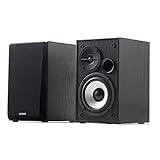
- 24 WATTS RMS POWER OUTPUT - Active bookshelf speaker system with 24W total power output with calibrated, flared bass reflex port in front.
- CLASSIC WOOD FINISH - 100% wooden enclosures to minimize acoustic resonance.
- CABLES INCLUDED - RCA and 3.5mm cables and speaker wire included. Universal 110V-240V power supply.
- 2 X AUX INPUT - Convenient connection to any device that has a 3.5mm headphone output or dual RCA output. Connect to two devices via AUX at the same time, no plugging and switching needed.
- IMMERSIVE SOUND - Fill your space with rich, immersive audio, creating a captivating listening environment for music, movies, and more.
How the two signal paths work
| System element | Active or powered pair | Passive pair |
|---|---|---|
| Amplification | Built into the speaker enclosure or pair | Separate stereo amplifier, integrated amplifier, AV receiver or PA amplifier |
| Speaker power | Mains power is required at the powered cabinet or cabinets | Amplifier supplies speaker power; the passive cabinet itself has no mains connection |
| Typical source signal | Low-level line signal or another input type listed by the manufacturer | Source connects to the external amplifier, which then sends speaker-level output |
| Speaker connection | Input cable to the powered speaker; a supplied link may connect the second cabinet | Dedicated speaker cable from amplifier output to each speaker |
| Upgrade model | Amplification remains tied to the speaker design | Amplifier and speakers can be selected and replaced separately |
The most important safety rule follows from that table: never connect an amplifier’s speaker output to an active speaker’s line-level input. Audioengine gives this warning for its active products because the high-power output can overload or damage a line input. Follow the exact input labels and manual for your model.
Which type fits your situation?
Choose active or powered speakers when simplicity is the priority
- You do not already own a suitable amplifier or receiver.
- You want fewer separate boxes, interconnects and compatibility decisions.
- Your source provides an input type the speaker explicitly supports.
- You can place the powered cabinet where a mains outlet is available, and you can route any required cable to the second cabinet.
- You prefer an integrated speaker-and-amplifier package rather than choosing electronics separately.
A powered bookshelf pair can be a practical desktop, television or small-room solution when the built-in inputs match the source. The trade-off is that the amplifier is part of the speaker system: replacing it later generally means replacing or bypassing the electronics built into the speaker.
Choose passive speakers when flexibility is the priority
- You already own a compatible stereo amplifier, integrated amplifier, AV receiver or PA amplifier.
- You want to choose amplification and speakers from different designs or manufacturers.
- You expect to upgrade the amplifier, speakers or both independently.
- You are comfortable allocating space and budget for an amplifier, speaker cable and possibly stands.
- You need an amplifier with particular source switching, room correction or multi-channel features.
Passive speakers are not automatically higher quality, and active speakers are not automatically better sounding. The documented difference is system architecture: integrated amplification and fewer components versus separately selected amplification and a more modular upgrade path. Room acoustics, speaker design, placement and source quality still matter.
Rank #3

- BLUETOOTH WIRELESS - Popular classic bookshelf speakers now can be enjoyed without the hassle of wires. Simply connection to an iPhone, Android, Tablet, PC or Mac.
- STUDIO SOUND QUALITY - Naturally fine tuned sound reproduction from 4 inch bass and 13mm silk dome tweeter.
- OPTICAL AND COAXIAL INPUTS - Digital inputs to enable lossless connection to most TV and computers.
- REMOTE CONTROL - Adjust the volume and toggle inputs at your fingertips. Bass and treble control located on the side of main speaker.
- SIDE PANEL CONTROLS - Use the side panel knobs to adjust the EQ to your liking. The controls are located on the active/powered speaker.
Compare the complete system before buying
Speaker-only prices can make a passive model look less expensive than a powered pair, or make a powered pair look costly compared with a bare passive cabinet. For a fair comparison, include every component required to make sound:
Do these 3 things before closing this tab:
1Clear out junk files and repair common Windows errors2Scan for outdated or missing drivers - takes under a minute3Repair Windows errors before they cause bigger problems- Active route: speaker pair, source cable or digital connection, and the required mains outlets. Add stands or isolation if your placement needs them.
- Passive route: speaker pair, suitable amplifier or receiver, two runs of speaker cable, source connections and any stands.
This is a system-cost method rather than a claim about current prices. Inventory, promotions and regional pricing change, and no universal price difference exists between the two categories.
Compatibility checks that prevent common mistakes
For an active pair
- Identify the source output. A phone, DAC, computer, television or streamer may provide analogue line output, headphone output, optical digital, USB or another format.
- Read the speaker’s input list. Fluance describes the basic active-speaker input as low-level line level, but individual products may add digital, phono, Bluetooth or other inputs.
- Check the power arrangement. Confirm whether one cabinet or both need mains power and whether the supplied cable between cabinets has a specified orientation.
- Keep levels safe. Start with the source and speaker volume low, then increase gradually. Do not use a speaker-level amplifier output as a substitute for the line input.
For a passive pair
- Confirm the amplifier has speaker outputs. A line output, pre-out or headphone jack cannot directly drive a passive speaker.
- Check impedance requirements. Use the speaker’s stated nominal or supported impedance and make sure the amplifier is rated for that load, especially if connecting more than one pair.
- Compare power ratings in context. Follow the speaker and amplifier makers’ guidance. Yamaha’s guides discuss speaker power ratings and amplifier matching; ratings should not be treated as a guarantee of identical loudness or sound quality.
- Consider speaker size and SPL. Larger rooms and louder listening may require a different speaker and amplifier combination than a desk or small office.
- Use dedicated speaker cable. Route the positive and negative conductors consistently from amplifier terminals to the matching terminals on each speaker.
- Allow amplifier ventilation. The external amplifier needs stable placement, airflow and a mains connection of its own.
Step-by-step setup
Active or powered speakers
- Place the left and right cabinets with the tweeters near ear height and aimed toward the listening position.
- Put the powered cabinet near a suitable mains outlet. If the second cabinet needs power, provide an outlet there too.
- With all equipment switched off or muted, connect the source to an input the speaker supports.
- Connect the supplied inter-speaker cable exactly as shown in the manual; do not substitute an amplifier’s speaker output.
- Turn the source volume down, power the speakers, select the correct input and raise the level slowly.
Passive speakers with an amplifier
- Position the amplifier where it has ventilation and where its mains lead can reach safely.
- Place the speakers far enough apart to create a stable stereo image, with the listening position centered between them.
- Switch the amplifier off before wiring. Connect the amplifier’s left positive and negative terminals to the left speaker’s matching terminals, then repeat for the right channel.
- Keep bare conductors from touching each other or the amplifier chassis. Banana plugs, spades or bare wire are acceptable only when the equipment terminals support them.
- Connect the source to the amplifier’s appropriate input, not directly to the passive speakers.
- Power on with the volume low, select the source and increase the level gradually.
Room, placement and use-case decisions
Small office or desktop
Denon uses bookshelf speakers with a compact amplifier as an example for a small office. That arrangement can work when you have room for the amplifier and want its source switching or other controls. A powered pair may occupy less equipment space, but it still needs mains access and may place the volume control or inputs on one cabinet.
Rank #4

- 5-Inch Powered Bookshelf Speakers: Active bookshelf speakers pair dual 5-inch woofers and dual 1-inch silk-dome tweeters with a built-in 36W RMS amp for 2.0 stereo without a separate amplifier
- USB Computer Speakers for Desktop PC: USB Digital Audio connects directly to computers; designed as desktop speakers for roomy desks and near-field listening to upgrade a weak computer audio system
- Record Player Speakers & Turntable Speakers: BT bookshelf speakers use BT5.4 and RCA/AUX inputs for a vinyl record player or turntable with a built-in or external phono preamp
- Independent Bass & Treble Controls: Fine-tune bass and treble with physical knobs on the speaker; the included remote adds convenient everyday control from your listening position
- Walnut Wood Grain Speakers for Fixed Setups: Each speaker measures 5.9 x 6.1 x 9.7 inches (W x D x H); fits roomy desks, record-player cabinets and shelves with space for a stereo pair
Television and living room
Check the television’s actual output before choosing. An active pair must accept that output directly or through a compatible converter. A passive pair needs a receiver or amplifier that accepts the television connection and provides speaker outputs. If you plan to add a center channel, surround speakers or a subwoofer later, an AV receiver and passive speakers may offer a more expandable architecture; verify the receiver’s channels and outputs before buying.
PA or larger-room use
Yamaha’s PA guidance distinguishes active PA components from passive speakers that rely on an external amplifier. For this use, compare SPL capability, speaker size, impedance and power handling, and account for cable runs and mains access. A powered cabinet can simplify a small rig, while a separate amplifier can centralize control for multiple passive cabinets.
What’s actually slowing this PC down?
Pick the symptom - the matching free tool is one click away.
Upgrade paths and long-term trade-offs
Active systems
Amplifier, crossover and drivers are designed as a package. That can simplify setup and preserve the maker’s intended integration. The limitation is modularity: if the built-in amplifier fails, lacks a desired input or no longer suits your room, the replacement decision may involve the whole speaker system.
Best Value

- 【SMALL HIFI BOOKSHELF SPEAKERS】With its modern aesthetic and compact design, this stylish black speaker complements contemporary home or office décor. The space-saving design fits seamlessly into any environment, maximizing desktop space. Ideal for desktop setups or small room audio systems like home offices or gaming stations.
- 【Experience powerful sound】Unleash powerful 30Wx2 distortion-free sound. Featuring a 0.75-inch carbon fiber silk dome tweeter and a 3-inch carbon fiber full-range driver, this speaker delivers crystal-clear highs and rich mid-bass. The rear bass port amplifies low-end depth, while the integrated independent sound card ensures smooth, detailed audio playback for the ultimate listening experience.
- 【Durable Performance】Built with a premium MDF wooden enclosure, this computer speakers with subwoofer effectively reduces box resonance for clearer, stream studio-quality,more precise sound. The easy-to-reach volume control knob on the front panel allows for quick adjustments during gaming or music sessions. Crafted from high-quality materials, it’s designed for long-lasting durability, providing consistent, stable performance even during intense gaming use.
- 【Multiple Input Options】These speakers are designed to offer versatile connectivity, featuring Bluetooth 5.3 along with RCA, AUX, and USB inputs. This variety ensures compatibility with a wide range of devices, giving you the flexibility to connect seamlessly to your preferred audio source.
- 【Versatile Use】The computer speakers for desktop pc Ideal for gaming, music streaming, and enhancing your computer audio experience, these speakers are compatible with smartphones, turntables, desktop or laptop computers, TVs, audio mixers, streaming devices , gaming pc, media players , subwoofers, audio receivers, and more. No matter your setup, these speakers meet all your audio needs with ease.
Passive systems
You can replace the amplifier while keeping the speakers, or replace the speakers while keeping an amplifier that remains suitable. This flexibility adds decisions and creates more ways to mismatch impedance, power capability or connection types. Keep the amplifier manual and speaker specifications so future upgrades remain within the supported limits.
Troubleshooting by symptom
No sound from an active speaker
- Verify the speaker is receiving mains power and that its power indicator is on.
- Confirm the selected input matches the cable and source output.
- Check source mute, output selection and volume.
- Make sure the inter-speaker cable is connected as the manual specifies.
No sound from a passive speaker
- Confirm the amplifier is powered and set to the correct source.
- Check that both speaker wires are connected at the amplifier and speaker ends, with positive to positive and negative to negative.
- Inspect for loose strands or a short between terminals; switch off before correcting wiring.
- Verify the amplifier is not in a protection mode caused by an unsuitable load or wiring fault.
Distortion or unexpected shutdown
- Reduce volume and check whether the source is clipping.
- For passive systems, confirm the amplifier is suitable for the speakers’ impedance and power requirements.
- For active systems, make sure the input is line level or another explicitly supported format, never an amplified speaker output.
- Improve ventilation around an external amplifier or powered cabinet.
A practical buying checklist
- Do I already own a suitable amplifier or receiver?
- Which exact output does my source provide?
- Does the speaker accept that signal without an extra converter?
- Where will each cabinet and any external amplifier receive mains power?
- For passive speakers, have I checked impedance, power rating, speaker size and SPL against the amplifier?
- Have I budgeted for speaker cable, stands and required source cables?
- Do I want an integrated system or the ability to replace amplification and speakers separately?
- Does the product manual confirm the connection I intend to make?
Use the answers to choose the architecture first, then compare individual models within that category. The safest purchase is the one whose inputs, power requirements, amplifier match and placement all fit your actual room and equipment.
Quick Recap
Product prices and availability are accurate as of the date/time indicated and are subject to change. Any price and availability information displayed on Amazon at the time of purchase will apply.

