Free tools Windows power users keep installed
One-click scans. No signup required.
Neither DTS Neo:6 nor Dolby Pro Logic II is a universal winner. Both are legacy matrix upmixers that turn two-channel audio into multichannel playback, and the better choice depends on the source, receiver, speakers, calibration and your taste.
As a practical starting point, use Dolby Pro Logic II Movie for Dolby Surround-encoded films, ordinary stereo television and many retro games. Try DTS Neo:6 Cinema when you want a more pronounced, spacious surround presentation. For music, Pro Logic II Music usually offers more useful adjustment controls, while Neo:6 Music can sound broader and more diffuse. If the source is already Dolby Digital, DTS, Dolby TrueHD, DTS-HD, Dolby Atmos or DTS:X, use native decoding or the receiver’s current compatible upmixer instead.
The short answer by source
| Source | First choice | Why |
|---|---|---|
| Dolby Surround-encoded stereo film | Dolby Pro Logic II Movie | Designed to steer matrixed Dolby cues into the center and surrounds. |
| Ordinary stereo television | Pro Logic II Movie, then compare Neo:6 Cinema | Choose the mode that keeps dialogue stable without making ambience unnaturally directional. |
| Retro console with two-channel output | Pro Logic II Game, when available | Useful for games designed around matrix surround. |
| Stereo music | Pro Logic II Music or Neo:6 Music | Use Pro Logic II for adjustment flexibility; choose Neo:6 for a wider presentation. Stereo/direct may sound more faithful. |
| Dolby Digital, DTS, Dolby TrueHD, DTS-HD, Atmos or DTS:X | Native decoding | Do not apply a legacy matrix decoder to audio that is already discrete multichannel. |
What these decoders actually do
Pro Logic II and Neo:6 are matrix surround decoders, not discrete multichannel codecs. They analyze a two-channel signal for amplitude, phase and spatial relationships, then distribute likely center and surround information to your speakers. The process can create convincing movement and ambience, but it cannot restore an unavailable discrete mix with certainty.
Dolby says Pro Logic II derives five full-range channels—left, right, center, left surround and right surround—from stereo material and targets television, movies, games and music: Dolby Pro Logic II. Sony describes Neo:6 as expanding stereo to 5.1 or 6.1 surround: Sony support explanation.
Recommended Free Tools
#1 Best Overall
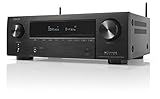
- HIGH-PERFORMANCE 7-CHANNEL AMPLIFIER WITH NEXT-GEN MOVIE IMMERSION - Enjoy Denon sound in movies, games, and music with full 3D audio support, Dynamic HDR, QMS, HDCP 2.3 & advanced video processing for the best 4K home theater (8K ready when you are)
- ADVANCED 8K HDMI VIDEO SECTION - 3 dedicated 8K inputs and 1 output (8K/60Hz and 4K/120Hz pass-through; 8K upscaling on all 6 inputs). Supports 4:4:4 Pure Color Sub Sampling, HDR10, HDR10+, Dolby Vision & HLG for exceptional color, contrast, and clarity
- MULTI-DIMENSIONAL AUDIO - In addition to Dolby Atmos, DTS:X and DTS Virtual:X, the AVR-X1700H also supports Dolby Atmos Height Virtualization Technology that creates virtual height effects even without the height channels for a truly immersive experience
- AWARD-WINING ON-SCREEN QUICK SETUP GUIDE walks you through simple, clear instructions to connect your TV, specify EQ settings and helps you optimize your surround sound. The back-panel is laid out with color-coded connections that makes organizing simple
- MULTI-ROOM, MULTI-SOURCE STREAMING, watch a movie in one room while another family member streams music from popular services like Spotify, Pandora, Amazon Music HD, and more via Wi-Fi, AirPlay 2, or Bluetooth in a different zone, without interruption
Dolby Pro Logic II
Movie mode
Pro Logic II Movie is the safest first try for Dolby Surround-encoded films, stereo broadcasts, VHS, LaserDisc, DVD-era material and dialogue-heavy television. It generally aims for stable dialogue in the center and predictable front-to-surround steering. Exact behavior varies by receiver.
Music mode
Pro Logic II Music is often the most adjustable option for albums and two-channel concert videos. Many receivers expose Center Width, which controls whether center information stays in the center speaker or is shared across the front three speakers; Dimension, which shifts the perceived stage forward or backward; and Panorama, which widens the front image and can feed more ambience to the surrounds. These controls are receiver-dependent, not guaranteed specifications.
Game mode
Pro Logic II Game is a compatibility feature rather than an automatic quality advantage. It can suit older consoles outputting analog or PCM stereo, especially games designed for Pro Logic II. Do not select it when the game is already sending Dolby Digital or DTS.
Receiver manuals illustrate this implementation dependence: Yamaha lists separate DPL Movie, DPL Music and DPL Game modes, but warns that a selected decoder may not work with every input: Yamaha manual.
Rank #2

- Beyond the basics - This 5.2-channel home theater AV receiver delivers standout performance and value with Dolby Atmos, 4K120/8K60 HDMI, Bluetooth Multipoint and effortless setup. Delivers 70W of authoritative power and flexible speaker layouts including 3.1.2-ch. with up-firing or in-ceiling heights.
- Step into lifelike sonic worlds - Dolby Atmos and DTS Virtual:X for deeply dimensional, lifelike sound that draws you into every moment of your favorite entertainment, plus crystal-clear dialogue so you can hear every word.
- Stunning visual realism - Supports ultra-high definition 4K/120 and 8K/60 video, high-performance HDMI switching, advanced Dolby Vision and HDR10+ dynamic range technologies, HDMI eARC/ARC and next-gen gaming features like ALLM and VRR.
- Room Correction - Experience perfect sound in any room. An included setup microphone measures your room’s acoustics and speaker characteristics, allowing the receiver to automatically optimize sound performance.
- Easy streaming with Bluetooth Multipoint - Stream all your favorite music, podcasts and audiobooks wirelessly. Built-in Bluetooth Multipoint lets you pair two source devices and instantly switch between them.
DTS Neo:6
Cinema mode
Neo:6 Cinema is intended for stereo film and television. On some systems it sounds more spacious or more strongly separated than Pro Logic II, which can help when a soundtrack feels too front-heavy. Those are listening impressions, not universal measurements; steering depends on the receiver and room.
Music mode
Neo:6 Music is intended for ordinary two-channel recordings rather than a known matrix-encoded soundtrack. It can provide an enveloping presentation while retaining more of the original stereo character than an aggressively processed cinema mode. It remains an upmix, not lossless recovery of a hidden surround master.
Five or six channels?
Output depends on the receiver and speaker layout. One documented implementation derives five channels in a 5.1 arrangement and can add a sixth channel when surround-back speakers are present; that rear-surround output may be mono. It is therefore inaccurate to call Neo:6 inherently 7.1: Mark Levinson No. 502 manual.
Technical comparison
| Criterion | Dolby Pro Logic II | DTS Neo:6 |
|---|---|---|
| Basic function | Matrix-decodes stereo to multichannel | Matrix-decodes stereo to multichannel |
| Common modes | Movie, Music, often Game | Cinema and Music |
| Typical layouts | 5.1; IIx is a later, different extension | 5.1 or 6.1 depending on receiver |
| Music flexibility | Often includes Center Width, Dimension or Panorama | Usually simpler, though implementation varies |
| Typical listening impression | Stable dialogue and conventional Dolby Surround compatibility | Often more spacious or separated |
| Gaming relevance | Strong, especially for compatible older consoles | Less associated with dedicated game modes |
| Main limitation | Can sound narrow or center-focused | Can over-separate ambience or make music sound processed |
Pioneer’s descriptions of Pro Logic II Movie, Pro Logic II Music and Neo:6 Cinema reflect these intended roles, but they describe one manufacturer’s implementation rather than a universal specification: Pioneer manual.
What’s actually slowing this PC down?
Pick the symptom - the matching free tool is one click away.
Rank #3

- 210 W/Ch THX Certified Select Dynamic Audio Amplification system
- 5.2.2-channel Dolby Atmos and DTS:X playback
- 8K with HDMI 2.1 40Gbps (3 ins)
- THX Select Certification
- Discrete Zone 2 Audio and Video
Choose by listening priority
Movies and television
Start with Pro Logic II Movie for Dolby Surround material and conventional stereo broadcasts. Compare Neo:6 Cinema if the result sounds too restrained. Keep the mode that anchors speech while making pans and ambience smooth rather than attention-grabbing.
Music
Listen in stereo/direct first, particularly with carefully mastered recordings. If you want room-filling sound, try Pro Logic II Music and adjust Center Width or Panorama if your receiver provides them. Choose Neo:6 Music when its broad, diffuse character suits the recording. Neither is automatically higher fidelity than stereo.
Retro games
Use Pro Logic II Game when the console or title supports matrix surround and is outputting two-channel audio. If the system supplies discrete Dolby Digital or DTS, let the receiver decode that signal instead.
When neither mode is appropriate
- Already-discrete audio: Dolby Digital, DTS, Dolby Digital Plus, Dolby TrueHD, DTS-HD Master Audio, Atmos and DTS:X should normally be decoded natively.
- Modern immersive systems: current receivers increasingly provide Dolby Surround and DTS Neural:X instead of the legacy modes.
- Deliberately precise stereo: upmixing can make vocals wander or ambience sound artificial.
Do not confuse DTS Neo:6 with DTS Neo:X. Neo:X is a later rendering and upmixing technology; many current receivers use DTS Neural:X instead. Likewise, Pro Logic II, Pro Logic IIx, Pro Logic IIz and modern Dolby Surround are related generations, not interchangeable names.
PC Slower Than It Used to Be?
A free scan shows the junk files, broken settings and background clutter dragging Windows down - then fixes them in one click.Free scan · Windows 10 & 11Crashes, No Sound, or Screen Glitches?
Random freezes, missing sound and display glitches usually trace back to one bad driver. Find and replace yours safely.Free scan · under a minuteRank #4

- STATE OF THE ART ROOM CORRECTION: Dirac Live take the room out of the equation, automatically calibrating sound in your room using either your smartphone and the included wired mic, or the Dirac Live PC or MacOS* application and a 3rd party USB mic (not included). You’ll get a more accurate measurement to position your surround sound speakers for more precise and balanced audio.
- ULTRA CONNECTED: Offering 9 channels of processing with three HDMI-out options, the TX-NR7100 AV receiver delivers uncompressed HDMI 8K/4K transfer at 40 Gbps. You can even set up different high-definition entertainment options with up to an 8K60 resolution using discrete zone 2 HDMI switching. Watch a movie in the home theater, while the kids watch cartoons in their playroom. That plus access to Spotify, TIDAL, Deezer, TuneIn, and Pandora make the TX-NR7100 an excellent choice for your movies, music and streaming.
- WORKS WITH SONOS CERTIFIED: This receiver can join your existing Sonos Home Sound System, or be the start of a new one, just by pairing it with a Sonos Port.* This works with Sonos Certified AVR offers a best-in-class tie-in to the Sonos ecosystem, waking, changing inputs, and playing at the volume you want using the Sonos Volume-Pass Through feature from the Sonos app. The TX-NR7100 can work with up to three Sonos Ports—one for each of three independent zones—each playing a completely different streaming service from Sonos Radio.
- ULTIMATE 4K GAMING EXPERIENCE: Own your opponents with HDMI 2.1 enhancements for gamers: 4K/120Hz HDR pass-through enables ultra-fast motion -VRR (Variable Refresh Rate) eliminates lag, stutter, and frame-tearing for fluid gameplay. - ALLM (Auto Low Latency Mode) optimizes latency from source to screen - QFT (Quick Frame Transport) limits lag for a smoother experience.
- DOLBY ATMOS: Dolby Atmos and DTS:X wrap the audience in the latest films and games by moving effects from effects moving from speaker to speaker. No surrounds, no problem – use the Dolby Atmos Height Virtualizer to ensure a more immersive listening experience, creating a virtual surround and height effect from traditional speaker layouts.
Why comparisons disagree
- Receiver brands use different steering algorithms, filters and mode parameters.
- Speaker distance, phase, crossover, level calibration and room correction change the result.
- A 5.1 system cannot reproduce the same output as a 6.1 or 7.1 system.
- The input may be analog stereo, PCM, Dolby Digital 2.0 or a compressed stream, each with different processing options.
- Some receivers automatically disable legacy modes when they detect a multichannel Dolby or DTS bitstream.
Current Denon models show the generational change: the AVR-S770H lists Dolby Surround and DTS Neural:X but not Dolby Pro Logic II or DTS Neo:6, while the AVR-S670H lists both legacy decoders. Check the exact model page and manual: AVR-S770H and AVR-S670H.
Independent reader supportYour contribution helps us test, update, and keep practical guides available for everyone.How to compare them fairly
- Confirm the receiver is receiving a genuine two-channel signal.
- Disable loudness or volume-level changes where possible and match output levels; louder often sounds better.
- Listen in stereo/direct before enabling processing.
- Compare Pro Logic II Movie with Neo:6 Cinema using a dialogue-heavy scene.
- Check dialogue stability, front-stage width, surround smoothness, panning continuity and misplaced phantom sounds.
- Repeat with Pro Logic II Music and Neo:6 Music on a dense music passage.
- Keep the mode that improves the source without making the processing obvious.
Troubleshooting common problems
The mode cannot be selected
The input may already be Dolby Digital or DTS, the receiver may restrict that decoder for the selected signal path, the speaker layout may not qualify, or the receiver may use Dolby Surround or DTS Neural:X instead. Yamaha documents input-specific restrictions in its manual: Yamaha manual.
The center is too loud
Check calibration, dialogue-enhancement settings and center-channel trim. For ordinary stereo, try Music mode or reduce Center Width if available. This symptom alone does not prove either decoder is defective.
Surrounds sound like random noise
The source may contain little ambience, the mode may be extracting unintended phase information, or the speakers may be miswired or out of phase. Try a less aggressive mode and verify wiring.
Best Value

- WATCH YOUR MOVIES IN 8K - At 70W x 5, Denon AVR-S570BT home theater receiver features (4) HDMI 2.1 8K inputs, (1) HDMI output, eARC up to 40 Gbps, successor to AVR-S540BT, ensuring HD audio playback, enhanced gaming, Power 310 W, Standby 0.1 W
- TRUE-TO-LIFE CINEMATIC EXPERIENCE - The AVR-S570BT supports HDR, HLG, Dolby Vision, HDR10+, Dynamic HDR for realistic display, VRR and QFT for lag-free exceptional gaming, DTS HD Master, Dolby TrueHD immersive audio, and 5.1 surround sound receiver
- YOUR FAVORITE MUSIC AT YOUR FINGERTIPS - With built-in Bluetooth stereo receiver, play tracks from various audio sources and create an integrated multi-room audio system. Allows wireless streaming from Spotify, TIDAL, Pandora, and more
- OUR EASY ON-SCREEN HD SETUP ASSISTANT walks you through clear, intuitive instructions to connect your TV and stereo receiver with bluetooth, while specific EQ settings help optimize surround sound so you make the most of movies, music, TV, or gaming
- CONVENIENT CONTROL - Connect Denon receiver to your Smart TV remote and access speaker sources & surround selections using just one handset, or download Denon Remote App for iOS and Android to control receiver through the phone
Music sounds hollow
Return to stereo/direct, reduce Panorama, narrow Center Width, try Neo:6 Music instead of Cinema, and recheck room-correction tonal settings.
No subwoofer output
Bass routing depends on speaker-size, crossover and listening-mode settings. Check bass management before assuming the decoder has failed.
Buying advice in 2026
Pro Logic II and Neo:6 are legacy receiver features, not normally standalone software products. Do not buy an expensive modern AVR solely for either logo. Prioritize HDMI/eARC, current Dolby and DTS formats, room correction, required speaker outputs and input compatibility.
If these specific decoders and analog connectivity are the goal, a receiver whose manual explicitly lists both—such as the Denon AVR-S670H—fits better than a newer model that omits them. Its official page is Denon AVR-S670H. Used receivers can work well for retro consoles, but verify the manual, analog/optical/coaxial inputs, remote, ventilation, output condition and video limitations. Buyers needing 4K/8K switching, eARC, Atmos, DTS:X, modern streaming or warranty coverage should favor current equipment.
The Bottom Line
Dolby Pro Logic II is the better all-rounder because of its broad source compatibility and music controls. DTS Neo:6 is the better alternative when its more spacious or separated presentation suits your material and system. For discrete multichannel sources, use native decoding; for high-quality stereo, stereo/direct remains a valid—and often preferable—choice.
Quick Recap
Product prices and availability are accurate as of the date/time indicated and are subject to change. Any price and availability information displayed on Amazon at the time of purchase will apply.



