Freedom251 › Image Annotation Software
Xtreme1
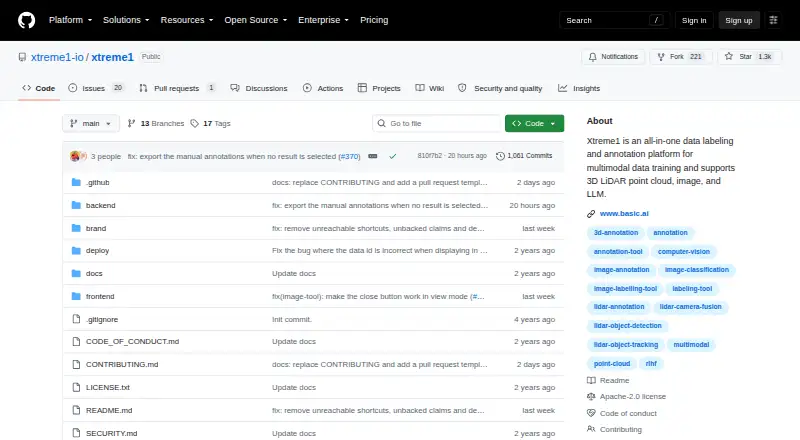
What Xtreme1 is
Xtreme1 is an open-source platform for preparing multimodal training data, with tools to annotate and curate datasets and manage the ontology used for model training. It works with images, 3D LiDAR, and 2D/3D sensor-fusion data. Annotation capabilities include bounding boxes, polygons, polylines, classification, 2D/3D object detection, 3D segmentation, and LiDAR-camera fusion. Data quality monitoring and model-result visualization are also included. Built-in pre-labeling and interactive models assist with detection, segmentation, and classification. The configurable Ontology Center lets teams arrange classes into hierarchies and add attributes. Image annotation links to YOLOR and RITM; fusion workflows link to OpenPCDet and AB3DMOT. RLHF annotation for large language models is a beta feature. The project is Apache 2.0 licensed and identified as an LF AI & Data Foundation project. It can be deployed with Docker Compose on Linux, Windows, or MacOS, or used through web and self-hosted platforms. It exports datasets in COCO, JSON, and Xtreme1 annotation formats. BasicAI is identified in the documentation as the cloud version; its private-cloud deployment starts from $6,600/y, with seats, storage, and model calls customizable.
Who it suits
Xtreme1 suits teams preparing image, LiDAR, or sensor-fusion datasets for model training, especially those needing configurable ontologies and model-assisted labeling. It can also suit organizations seeking open-source software they can deploy themselves.
What it does well
- Open-source under the Apache 2.0 license.
- Supports image, LiDAR, and sensor-fusion datasets.
- Pre-labeling and interactive models assist with labeling.
- Exports to COCO, JSON, and Xtreme1 formats.
- Provides API access and model-result visualization.
What to know first
- Built-in model containers require Linux, NVIDIA CUDA, and a T4 or similar GPU.
- BasicAI private-cloud deployment starts from $6,600/y.
- RLHF annotation is identified as a beta feature.
Limits
The built-in model containers require a Linux server with NVIDIA CUDA and a T4 or similar GPU. BasicAI private-cloud deployment starts from $6,600/y, with seats, storage, and model calls customizable.
Plans
| Plan | Billed and limits | Price |
|---|---|---|
| Private-Cloud Deployment | Starting from $6,600/y · Customizable payment cycle, seats, storage and model calls · On-premise deployment options | $6,600 a year |
As github.com lists them, read 9 Oct 2026. The maker's own page has the final word.
Getting started
- Open the Xtreme1 GitHub project.
- Check that your system has an AMD64 or ARM64 CPU, at least 2GB RAM, and 10GB or more of free disk space.
- Install the project with Docker Compose on Linux, Windows, or MacOS.
- Use the web or self-hosted platform to work with annotation and ontology tools.
- For built-in model containers, use a Linux server with NVIDIA CUDA and a T4 or similar GPU.
- For cloud use, see BasicAI; private-cloud deployment starts from $6,600/y.
Verdict
Choose Xtreme1 for multimodal dataset annotation when open-source licensing, ontology management, and self-hosted deployment matter. Consider the BasicAI private-cloud option if you want that deployment model, but its listed starting price is $6,600/y.
Questions
Is Xtreme1 free?
The project is free and open source under the Apache 2.0 license.
What data types and annotations does it support?
It supports images, 3D LiDAR, and 2D/3D sensor-fusion datasets. Annotation types include bounding boxes, polygons, polylines, and classification, alongside detection, segmentation, and fusion capabilities.
Which platforms can run Xtreme1?
It supports Linux, Windows, MacOS, web, and self-hosted use. The project is installed with Docker Compose.
What are the system requirements?
The README lists AMD64 or ARM64 CPUs, at least 2GB RAM, and 10GB or more free disk space. Built-in model containers require Linux, NVIDIA CUDA, and a T4 or similar GPU.
Does it offer a cloud version?
The documentation identifies BasicAI as the cloud version. Its private-cloud deployment starts from $6,600/y, with seats, storage, and model calls customizable.
What export formats and integrations are listed?
Dataset export supports COCO, JSON, and Xtreme1 annotation format. Image workflows link to YOLOR and RITM, while LiDAR-camera fusion workflows link to OpenPCDet and AB3DMOT.
Facts from Xtreme1's own pages
- Annotation features
- Its listed capabilities include 2D/3D object detection, 3D segmentation, LiDAR-camera fusion, data quality monitoring and model-result visualization. · docs.xtreme1.io, 9 Oct 2026
- Cloud version
- The documentation identifies BasicAI as the cloud version and the GitHub README links to a free enterprise demo request. · docs.xtreme1.io, 9 Oct 2026
- Data types
- The project says it supports labeling images, 3D LiDAR and 2D/3D sensor-fusion datasets. · github.com, 9 Oct 2026
- Deployment
- The open-source project is installed with Docker Compose and can be run on Linux, Windows or MacOS. · github.com, 9 Oct 2026
- Integrations
- The feature page links image annotation with YOLOR and RITM, and LiDAR-camera fusion workflows with OpenPCDet and AB3DMOT. · docs.xtreme1.io, 9 Oct 2026
- License
- The software is licensed under Apache 2.0, and the README identifies Xtreme1 as an LF AI & Data Foundation project. · github.com, 9 Oct 2026
- LLM support
- The GitHub README lists RLHF annotation for large language models as a beta feature. · github.com, 9 Oct 2026
- Ontology
- The configurable Ontology Center supports classes with hierarchies and attributes for model training. · docs.xtreme1.io, 9 Oct 2026
- Pre-labeling
- Built-in pre-labeling and interactive models support 2D/3D object detection, segmentation and classification. · docs.xtreme1.io, 9 Oct 2026
- Pricing limits
- The BasicAI platform pricing page lists private-cloud deployment starting from $6,600/y, with seats, storage and model calls customizable. · basic.ai, 9 Oct 2026
- Requirements
- The README lists AMD64 or ARM64 CPUs, at least 2GB RAM and 10GB or more free disk space; built-in model containers require a Linux server with NVIDIA CUDA and a T4 or similar GPU. · github.com, 9 Oct 2026
- Security reporting
- The project security policy says it follows the Linux Foundation process for reporting vulnerabilities to LF projects and foundations. · github.com, 9 Oct 2026
- What it does
- Xtreme1 is an open-source platform for multimodal training data that supports data annotation, curation and ontology management. · docs.xtreme1.io, 9 Oct 2026
Where Xtreme1 stands on Freedom251
- Image Annotation Software#13 of 28