Freedom251 › WAN Optimization Software
XipOS
What XipOS is
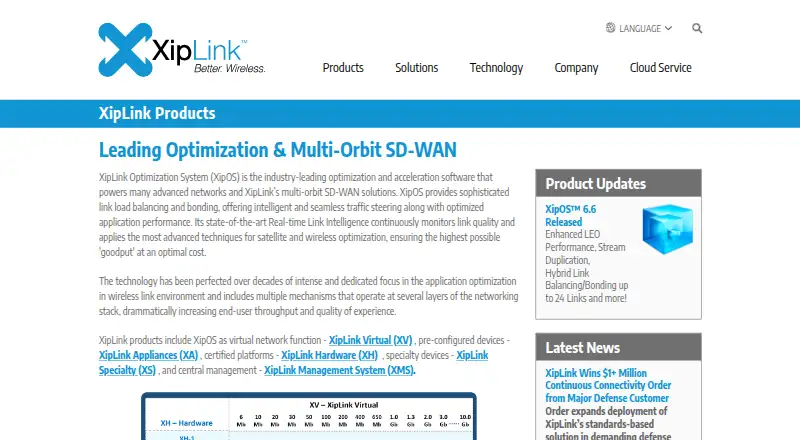
XipOS is network optimization software for satellite and wireless links, supporting link balancing, bonding, traffic steering, and application performance optimization. Its networking tools include SCPS-TP TCP acceleration, header and payload compression, packet coalescing, byte caching, and adaptive QoS. Real-time link intelligence supports load rebalancing, failover, and traffic overflow. XipACE uses deep packet inspection for Layer 7 visibility and application-based traffic analytics. Organizations can deploy XipOS as a virtual network function or in integrated XipLink appliance hardware. The virtual function supports KVM/QEMU and VMware ESXi or Player and scales from 1,000 to 300,000 TCP sessions; aggregate throughput beyond 3 Gbit/s is available through a virtualized blade server. License options include the complete feature set or SCPS-only, with optional ROHCv2 header compression and AES-256 IPSec encryption. XipOS supports SNMP and Netconf and can be managed through a GUI or XipLink Management System. UX-Probe measures download times, web page load times, and video playback quality on a defined schedule. Pricing and free-trial terms are not public. A bracketed solution requires XipLink instances at both hub and remote sites for all optimization features.
Who it suits
XipOS suits organizations optimizing satellite or wireless networks, including multi-orbit SD-WAN and military or government environments. It supports virtual and appliance deployments and centralized management of edge nodes.
What it does well
- Supports TCP acceleration, compression, and link bonding.
- Virtual deployment supports KVM/QEMU and VMware hypervisors.
- XMS provides centralized configuration and license management.
- UX-Probe measures download, page-load, and video quality.
What to know first
- Pricing and free-trial terms are not public.
- Bracketed deployments need instances at both hub and remote sites.
- Optimized traffic is limited to the instance's rated throughput.
- Upgrade is free only for customers on paid TAC support.
Limits
Optimized traffic is limited to the instance's rated throughput; bypassed traffic may reach twice that rate. A bracketed solution requires XipLink instances at both hub and remote sites to get all optimization features.
Getting started
- Visit the XipLink products page.
- Choose virtual network function deployment or integrated XipLink appliance hardware.
- For virtual deployment, use KVM/QEMU or VMware ESXi or Player.
- Contact a XipLink representative for custom requirements, design assistance, and pricing.
- Choose a license option and any required optional features.
Verdict
XipOS offers traffic optimization and link management for satellite and wireless deployments, with virtual and appliance options. Buyers should clarify licensing, throughput limits, and whether their deployment needs instances at both ends.
Questions
How much does XipOS cost?
Pricing is on request. XipLink directs custom requirements to a representative.
Is there a free trial?
Free-trial terms are not public.
Which hypervisors does the virtual function support?
It supports KVM/QEMU and VMware ESXi or Player.
What license options are available?
Listed options include the complete feature set and SCPS-only, with optional ROHCv2 header compression and AES-256 IPSec encryption.
How can XipOS integrate with existing management systems?
It supports SNMP and Netconf and can also be centrally managed through XipLink Management System.
What is required for all optimization features in a bracketed solution?
The FAQ says XipLink instances are required at both the hub and remote sites.
Facts from XipOS's own pages
- Application classification
- XipACE uses the R&S PACE 2 deep packet inspection engine for real-time IP traffic visibility through Layer 7 and application-based traffic analytics. · xiplink.com, 4 Oct 2026
- Capacity
- XipOS Virtual scales from 1,000 to 300,000 TCP sessions, with aggregate throughput beyond 3 Gbit/s available through a virtualized blade server. · xiplink.com, 4 Oct 2026
- Central management
- XMS provides configuration profiles, over-the-air updates, license management, statistics, security features, graphs, and dashboards for managing hundreds of XipOS edge nodes. · xiplink.com, 4 Oct 2026
- Deployment
- XipOS is offered as a virtual network function and can also be supplied in integrated XipLink appliance hardware. · xiplink.com, 4 Oct 2026
- Deployment requirement
- The FAQ says a bracketed solution requires XipLink instances at both hub and remote sites to get all optimization features. · xiplink.com, 5 Oct 2026
- Headquarters
- Montreal, Quebec, Canada · xiplink.com, 28 Sept 2026
- Hypervisors
- The virtual function supports KVM/QEMU and VMware ESXi or Player. · xiplink.com, 5 Oct 2026
- Integrations
- XipOS supports SNMP and Netconf for integration with existing management systems. · xiplink.com, 5 Oct 2026
- License options
- Listed options include the complete feature set, SCPS-only, and optional ROHCv2 header compression and AES-256 IPSec encryption. · xiplink.com, 5 Oct 2026
- Licensing
- The vendor lists complete-feature and SCPS-only license options, with optional ROHCv2 header compression and IPSec AES 256-bit encryption; custom requirements are handled through a XipLink representative. · xiplink.com, 4 Oct 2026
- Link management
- XipOS provides link load balancing and bonding, traffic steering, and real-time link quality monitoring. · xiplink.com, 5 Oct 2026
- Management
- XipOS can be managed through a GUI or centrally with XipLink Management System, which supports configuration profiles, over-the-air updates, licensing, statistics, and security features. · xiplink.com, 5 Oct 2026
- Monitoring
- UX-Probe measures file download time, web page load times, and video playback quality on a user-defined schedule and URLs. · xiplink.com, 4 Oct 2026
- Networking features
- The complete feature set includes SCPS acceleration, optimization, GTP transparency, application-aware QoS, firewall, link bonding, and XipLink Real-time. · xiplink.com, 5 Oct 2026
- Network optimization
- Features include SCPS-TP TCP acceleration, header and payload compression, packet coalescing, byte caching, and adaptive QoS. · xiplink.com, 4 Oct 2026
- Purpose
- XipOS is optimization and acceleration software for wireless networks and powers XipLink’s multi-orbit SD-WAN solutions. · xiplink.com, 5 Oct 2026
- QoE monitoring
- UX-Probe measures file download time, web page load times, and video playback quality on a user-defined schedule. · xiplink.com, 5 Oct 2026
- Security
- XipOS supports IPSec AES-256 encryption and CMPv2-based X.509 certificate management on WAN and LAN interfaces. · xiplink.com, 5 Oct 2026
- Standards
- XipOS uses SCPS-based TCP optimization and states that its technology complies with SCPS and U.S. Department of Defense military standards. · xiplink.com, 5 Oct 2026
- Support and pricing
- The product pages provide no public price or free-trial terms; XipLink directs custom requirements to its representative and offers contact for design assistance. · xiplink.com, 4 Oct 2026
- Support and upgrades
- The XipOS 6.6 announcement says the release is a free upgrade for customers on paid TAC support and directs customers without support to contact XipLink about upgrade options. · xiplink.com, 5 Oct 2026
- Target environments
- XipLink describes its technology for satellite and wireless optimization, including multi-orbit SD-WAN and military and government use cases. · xiplink.com, 4 Oct 2026
- Throughput limit
- Optimized traffic is limited to the instance’s rated throughput; bypassed traffic may reach twice that rate. · xiplink.com, 5 Oct 2026
- Virtual deployment
- XipOS is available as a virtual network function that scales from 1,000 to 300,000 TCP sessions. · xiplink.com, 5 Oct 2026
Where XipOS stands on Freedom251
- WAN Optimization Software#16 of 19