Freedom251 › API Integration Platforms
WrapAPI
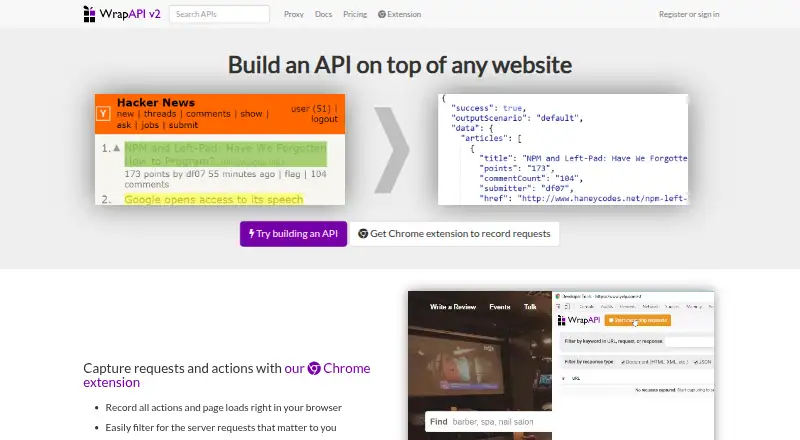
What WrapAPI is
WrapAPI builds APIs on top of existing websites. Its visual Builder turns captured browser requests and selected response data into endpoints: a Chrome extension records browser actions and page loads, filters server requests, and uses chosen requests as templates. In the Builder, users can select data in HTML, JSON, and XML responses, including across multiple layouts and error cases. It can identify changing URL or request-body parts as parameters, and define outputs through selected elements or regular expressions.
The Builder supports URLs, query strings, POST data, and file uploads. Published endpoints can be called with regular HTTP requests, and its interface lists GET, POST, PUT, DELETE, HEAD, OPTIONS, PATCH, and TRACE methods. WrapAPI also offers a Proxy to record Android app and webview requests, inspect desktop app requests, and save and replay requests for debugging. The site says Proxy captures are not saved on WrapAPI's server. The free Community plan costs nothing and includes 30,000 API calls per month, shared infrastructure, and community support without an SLA; APIs on that plan must be shared publicly. Business options include cloud, self-hosted, and fully managed plans, with private API options and support with SLAs. WrapAPI was created by Peter Xu with help from Harry Yu, and Myrtlelime Inc. is its operator.
Who it suits
WrapAPI suits people who want to build endpoints from requests and data on existing websites, using a visual workflow. The free Community plan may suit users who can work within 30,000 API calls per month and share APIs publicly; private API and self-hosted options are listed in business plans.
What it does well
- Visual Builder extracts data from HTML, JSON, and XML responses.
- Supports parameters based on changing URL or request-body parts.
- Published endpoints accept regular HTTP requests.
- Proxy can record app and webview requests and replay them for debugging.
- Self-hosted deployment and reusable workflows are available.
- Free Community plan includes 30,000 API calls per month.
What to know first
- Request capture extension works only with Chrome.
- Community plan requires APIs to be shared publicly.
- Community support has no SLA.
- Prices for the listed business plans are not given.
Limits
The free Community plan costs nothing and allows 30,000 API calls per month. It requires public APIs to be shared with the community, uses shared infrastructure, and provides support without an SLA.
Plans
| Plan | Billed and limits | Price |
|---|---|---|
| Community | 30,000 API calls per month · Public APIs must be shared with community · Shared infrastructure · Community support without SLA | Free |
| Business - Cloud | Unlimited API calls · Private APIs · Dedicated infrastructure · Support with SLAs | On request |
| Fully managed | Custom-built APIs · Unlimited API calls · Private or self-hosted hosting · Support with SLAs | On request |
| Business - Self-hosted | Private APIs · Hosted on your own infrastructure · Support with SLAs | On request |
As wrapapi.com lists them, read 9 Oct 2026. The maker's own page has the final word.
Getting started
- Open wrapapi.com in a browser; the site works with any browser.
- Install and use the Chrome extension to capture browser actions and page loads.
- Select requests as templates and choose response data in the Builder.
- Set parameters, outputs, and any URLs, query strings, POST data, or file uploads.
- Choose a plan; the free Community plan requires public API sharing.
- Call a published endpoint with a regular HTTP request.
Verdict
Pick WrapAPI if you want a visual way to build APIs on top of existing websites, or need a listed self-hosted option. Look elsewhere if you need the capture extension in a browser other than Chrome, private APIs on the free plan, or Community support with an SLA.
Questions
What does WrapAPI do?
It builds APIs on top of existing websites, using captured requests and selected response data to create endpoints.
Is there a free plan?
Yes. Community costs nothing and includes 30,000 API calls per month.
Does the free plan allow private APIs?
No. The Community plan requires APIs to be shared publicly; private APIs are listed under Business - Cloud and Business - Self-hosted.
Which browsers work with WrapAPI?
The request capture extension is compatible only with Chrome. The rest of the site works with any browser.
Can WrapAPI be self-hosted?
Yes. Business - Self-hosted is hosted on your own infrastructure, and self-hosted deployment is listed as available.
Who made WrapAPI?
WrapAPI was created by Peter Xu with help from Harry Yu. The site identifies Myrtlelime Inc. as its operator.
Facts from WrapAPI's own pages
- API methods
- The API Builder interface lists GET, POST, PUT, DELETE, HEAD, OPTIONS, PATCH, and TRACE methods. · wrapapi.com, 9 Oct 2026
- Browser compatibility
- The request capture extension is compatible only with Chrome, while the rest of the site works with any browser. · wrapapi.com, 9 Oct 2026
- Data collection
- The privacy policy says capture and test case pages collect only requests users specifically save to an API element, while API-use request and response content may be retained in part. · wrapapi.com, 9 Oct 2026
- Data extraction
- The Builder lets users visually select data and extract from HTML, JSON, and XML responses, with support for multiple layouts and error cases. · wrapapi.com, 9 Oct 2026
- HTTP requests
- The Builder supports setting URLs, query strings, POST data, and file uploads, and published endpoints can be called with regular HTTP requests. · wrapapi.com, 9 Oct 2026
- Inputs and outputs
- WrapAPI can identify changing URL or request body parts as parameters and lets users define outputs by selecting elements or writing regular expressions. · wrapapi.com, 9 Oct 2026
- Maker
- WrapAPI was created by Peter Xu with help from Harry Yu, and the site identifies Myrtlelime Inc. as its operator. · wrapapi.com, 9 Oct 2026
- Proxy
- WrapAPI Proxy can record Android app and webview requests, inspect desktop app requests, and save and replay requests for debugging. · wrapapi.com, 9 Oct 2026
- Proxy privacy
- The Proxy page states that request captures are not saved on WrapAPI's server. · wrapapi.com, 9 Oct 2026
- Purpose
- WrapAPI builds APIs on top of existing websites. · wrapapi.com, 9 Oct 2026
- Request capture
- Its Chrome extension records browser actions and page loads, filters server requests, and uses requests as API templates. · wrapapi.com, 9 Oct 2026
- Security
- The privacy policy says WrapAPI uses physical, electronic, and procedural safeguards and limits information access to authorized employees and contractors who need it. · wrapapi.com, 9 Oct 2026
- Sharing
- Users can share and build on APIs from other WrapAPI members; the Community plan requires APIs to be shared publicly. · wrapapi.com, 9 Oct 2026
- Support
- The Community plan has support without an SLA; Business plans list support with SLAs, and the docs provide [email protected] for bug reports. · wrapapi.com, 9 Oct 2026
Where WrapAPI stands on Freedom251
- API Integration Platforms#12 of 37