Freedom251 › AI Video Caption Generators
Whisparr
What Whisparr is
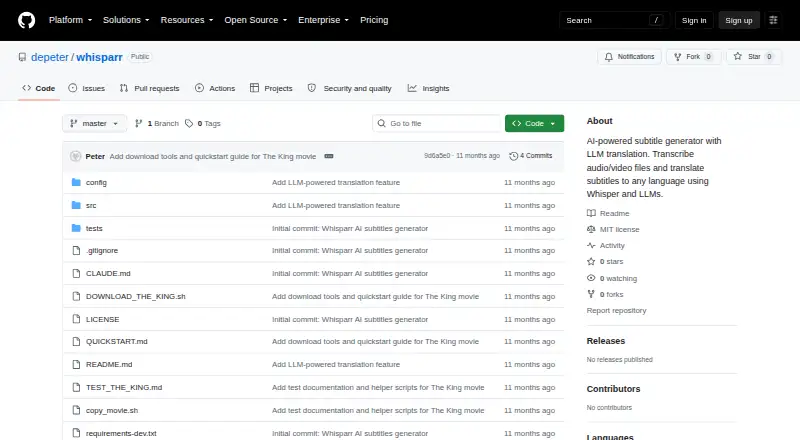
Whisparr is free, MIT-licensed software for generating subtitles from video and audio with OpenAI’s Whisper model. It transcribes speech using selectable tiny, base, small, medium, or large models, then creates SRT or WebVTT files. The command line can process directories recursively and overwrite existing subtitles when requested. Supported video inputs include MP4, MKV, AVI, MOV, WMV, FLV, and WebM; audio inputs include MP3, WAV, FLAC, AAC, M4A, and OGG. Translation can use OpenAI or Anthropic models when API keys are supplied through environment variables. Whisparr runs on Linux, macOS, or a self-hosted setup. CPU processing is available, with optional CUDA acceleration. Installation requires Python 3.8 or newer and FFmpeg. JSON configuration and command-line overrides are supported. The project directs issues and requests to its repository. Watch mode, a web interface, Docker deployment, media-server integration, and speaker diarization are future enhancements.
Who it suits
Whisparr suits users who need local or self-hosted subtitle generation from common video and audio formats. It is useful for batch transcription, optional translation, and CPU or CUDA processing.
What it does well
- Free and MIT licensed
- Selectable Whisper model sizes
- SRT and WebVTT subtitle output
- Recursive batch directory processing
- CPU operation with optional CUDA acceleration
What to know first
- Translation requires an OpenAI or Anthropic API key
- Installation requires Python 3.8 or newer and FFmpeg
- No web interface is currently listed
- Docker deployment is a future enhancement
Plans
| Plan | Billed and limits | Price |
|---|---|---|
| Free | MIT licensed software · translation requires an OpenAI or Anthropic API key | Free |
As github.com lists them, read 5 Oct 2026. The maker's own page has the final word.
Verdict
Whisparr provides command-line subtitle transcription and translation with flexible model, format, and processing choices. It is a practical fit for self-hosted workflows, while several convenience features remain planned.
Facts from Whisparr's own pages
- Batch processing
- It can process directories of media files, including recursively, and can overwrite existing subtitles when requested. · github.com, 5 Oct 2026
- Configuration
- It supports JSON configuration files and command-line overrides. · github.com, 5 Oct 2026
- GPU support
- Optional CUDA support can accelerate processing; the CLI also supports CPU operation. · github.com, 5 Oct 2026
- License
- The repository states that Whisparr is released under the MIT License. · github.com, 5 Oct 2026
- Media formats
- Documented video inputs include MP4, MKV, AVI, MOV, WMV, FLV, and WebM; audio inputs include MP3, WAV, FLAC, AAC, M4A, and OGG. · github.com, 5 Oct 2026
- Notable limitations
- The README lists watch mode, a web interface, Docker deployment, media-server integration, and speaker diarization as future enhancements. · github.com, 5 Oct 2026
- Purpose
- Whisparr is an automated subtitle generation tool for video and audio files, powered by OpenAI’s Whisper model. · github.com, 5 Oct 2026
- Requirements
- Installation requires Python 3.8 or newer and FFmpeg. · github.com, 5 Oct 2026
- Subtitle export
- srt and vtt · github.com, 22 Sept 2026
- Subtitle formats
- It generates SRT and WebVTT subtitle files. · github.com, 5 Oct 2026
- Support
- The project directs users to open a repository issue for issues, questions, or feature requests. · github.com, 5 Oct 2026
- Transcription
- It transcribes speech and supports selecting tiny, base, small, medium, or large Whisper models. · github.com, 5 Oct 2026
- Translation
- It can translate subtitles using OpenAI or Anthropic models, with API keys supplied as environment variables. · github.com, 5 Oct 2026
Where Whisparr stands on Freedom251
- AI Video Caption Generators#51 of 99