Freedom251 › Audience Response Systems
Weclare
What Weclare is
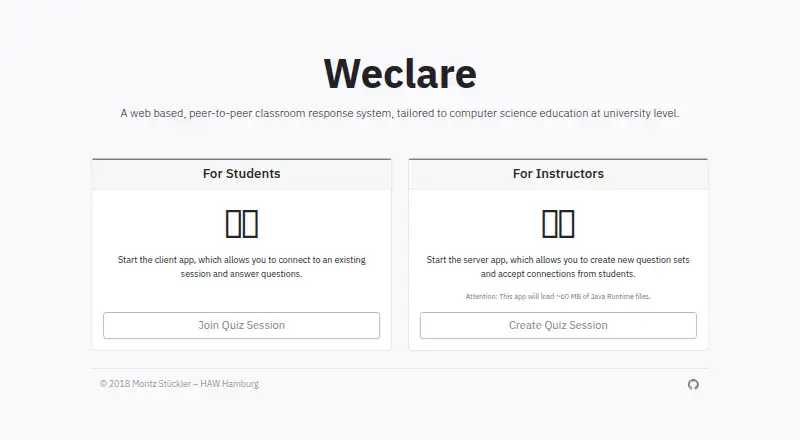
Weclare is a free, open-source web classroom response system made for university computer science education. Instructors send questions, and students answer interactively in their browsers without downloading an app. Participating browsers connect directly, while the server mainly handles signalling. Questions can include Java code snippets that students compile and run in the browser. Java snippets support indentation and syntax highlighting. An executable Java example can appear only once in a question and remains separate from the question text. Free-text questions are not supported. The project describes classroom response systems as usable on computers, tablets, and smartphones. Weclare is available through the web, although its official site requires JavaScript. The repository identifies a GPL-3.0 license and gives a local setup using npm install, npm start, and localhost:3000. The project came from Moritz Stückler’s bachelor thesis at HAW Hamburg. Its focus is interactive questioning for university-level computer science classes rather than broad classroom surveying.
Who it suits
Weclare suits university computer science instructors who want browser-based interactive questions, especially questions containing executable Java examples. It also fits learners using computers, tablets, or smartphones without downloads.
What it does well
- Free and open-source GPL-3.0 project
- Runs in web browsers without downloads
- Compiles and executes Java snippets
- Supports indentation and syntax highlighting
- Works across computers, tablets, and smartphones
What to know first
- Prototype focused on university computer science
- Free-text questions are unsupported
- Only one executable Java example per question
- Official site requires JavaScript
Verdict
Weclare offers a focused browser classroom tool for interactive university computer science questions. Its executable Java support is useful for code-based teaching, while the prototype scope and unsupported free-text format limit broader uses.
Facts from Weclare's own pages
- Browser access
- Students and instructors can use the web based system without downloading software. · github.com, 12 Oct 2026
- Classroom responses
- Instructors can direct questions to students, who can answer interactively. · github.com, 4 Oct 2026
- Classroom use
- Instructors direct questions to students, who can answer interactively. · github.com, 12 Oct 2026
- Code formatting
- Java snippets support indentation and syntax highlighting. · github.com, 12 Oct 2026
- Devices
- The project describes classroom response systems as usable on computers, tablets, or smartphones. · github.com, 4 Oct 2026
- Java execution
- Java code snippets in questions can be compiled and executed in the browser. · github.com, 12 Oct 2026
- Java formatting
- The project supports indentation and syntax highlighting for Java code snippets. · github.com, 4 Oct 2026
- License
- The repository identifies the project as GPL-3.0 licensed. · github.com, 4 Oct 2026
- Local setup
- The repository instructions say to install npm, run npm install and npm start, then open localhost:3000. · github.com, 12 Oct 2026
- Origin
- The project resulted from Moritz Stückler’s bachelor thesis at HAW Hamburg. · github.com, 12 Oct 2026
- Peer-to-peer
- Participating browsers connect directly, with server interaction limited to signalling. · github.com, 12 Oct 2026
- Product
- Weclare is a prototype classroom response system designed for computer science education at university level. · github.com, 12 Oct 2026
- Question limitation
- An executable Java example can appear only once per question and is separate from the question text. · reposit.haw-hamburg.de, 12 Oct 2026
- Unsupported question type
- The thesis says Weclare does not support free-text questions. · reposit.haw-hamburg.de, 12 Oct 2026
- Website availability
- The official site page opened for this research says JavaScript must be enabled to run the app. · weclare.de, 4 Oct 2026
Where Weclare stands on Freedom251
- Audience Response Systems#118 of 118