Freedom251 › Online Voting Software

VoteHost Elections
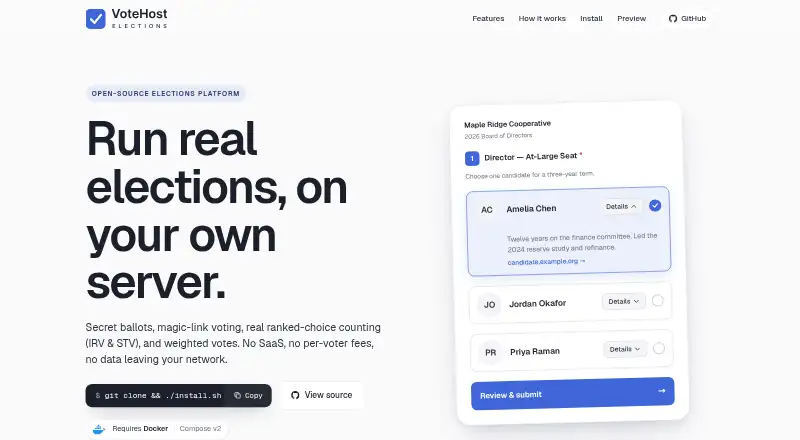
What VoteHost Elections is
VoteHost Elections is a free, open-source platform for running organizational elections on infrastructure you manage. It supports single-choice, multiple-choice, ranked-choice voting using IRV or STV, and open-text comments. Votes can be weighted by shares, membership class, or unit while preserving ballot anonymity. The site says ballots are stored without a link to voters, so database access does not reveal individual choices. Election tools include write-in nominations, quorum tracking, candidate-order randomization for each voter, reminders, and results emails. Voters use a unique email magic link and need no account or password. Results can be exported as CSV, XLSX, or PDF, with an anonymized JSON audit package also available. Email integrations include standard SMTP providers and Resend. Deployment options include a Raspberry Pi, mini PC, VPS, or Proxmox LXC. Requirements include Linux, Docker Engine, and Docker Compose v2; the minimum is 2 GB RAM and 12 GB disk, with 4 GB RAM and 20 GB disk recommended. The listed Free plan costs nothing.
Who it suits
VoteHost Elections suits organizations that want to run elections on infrastructure they manage, including HOAs, co-ops, unions, clubs, nonprofits, and student governments. It may also suit groups needing weighted or ranked-choice ballots.
What it does well
- Ballots are recorded without a link to voters.
- Supports single, multiple, ranked, and open-text ballots.
- Voters need no account or password.
- Exports include CSV, XLSX, PDF, and anonymized JSON.
- Free and open source.
What to know first
- Requires Linux, Docker Engine, and Docker Compose v2.
- Minimum requirements include 2 GB RAM and 12 GB disk.
- Organizations must manage their own deployment.
Limits
The free plan is self hosted and requires Docker Compose v2. The stated minimum is 2 GB RAM and 12 GB disk; 4 GB RAM and 20 GB disk are recommended.
Plans
| Plan | Billed and limits | Price |
|---|---|---|
| Free | Open source · self-hosted · requires Docker Compose v2 | Free |
As votehostelections.org lists them, read 4 Oct 2026. The maker's own page has the final word.
Getting started
- Visit https://www.votehostelections.org/ and review the project deployment instructions.
- Prepare a Linux host with Docker Engine and Docker Compose v2.
- Provide at least 2 GB RAM and 12 GB disk; 4 GB RAM and 20 GB disk are recommended.
- Deploy on a Raspberry Pi, mini PC, VPS, or Proxmox LXC.
- Configure access using Cloudflare Tunnel, Tailscale Funnel, or a user managed reverse proxy.
- Connect standard SMTP or Resend for election emails.
Verdict
VoteHost Elections provides varied ballot formats, anonymous voting, and election tools for organizations running their own deployment. Its technical requirements and self-hosted setup are important considerations.
Questions
Is VoteHost Elections free?
Yes. The plan is listed as free, and the project is open source and self hosted.
What does it cost?
The listed Free plan costs nothing.
What voting methods does it support?
It supports single choice, multiple choice, ranked choice using IRV or STV, and open text comments.
Are ballots anonymous?
Yes. The site says ballots are recorded without a link to the voter, including for an administrator with database access.
What does deployment require?
It requires Linux, Docker Engine, and Docker Compose v2. The stated minimum is 2 GB RAM and 12 GB disk.
How do voters access an election?
Voters receive a unique email magic link and do not need an account or password.
Facts from VoteHost Elections's own pages
- Ballot privacy
- The site says ballots are recorded without a link to the voter, so even an admin with database access cannot tell who voted for what. · votehostelections.org, 4 Oct 2026
- Deployment options
- The README describes deployment on a Raspberry Pi, mini PC, VPS, or Proxmox LXC, with Cloudflare Tunnel, Tailscale Funnel, or a user-managed reverse proxy for access. · github.com, 4 Oct 2026
- Election features
- The site lists write-in nominations, quorum tracking, per-voter candidate randomization, automated reminders, and results emails. · votehostelections.org, 4 Oct 2026
- Email integrations
- The README says VoteHost supports standard SMTP providers and Resend for invitations, reminders, and results announcements. · github.com, 4 Oct 2026
- Exports
- The site says election results can be exported as CSV, XLSX, or PDF, with an anonymized JSON audit package available. · github.com, 4 Oct 2026
- Intended users
- The site names HOAs and condo boards, co-ops and member associations, unions, clubs, nonprofits, student governments, and leagues as intended users. · votehostelections.org, 4 Oct 2026
- Maker
- The repository identifies Christopher Dewald as the copyright holder and says he created the project for an organization seeking electronic elections. · github.com, 4 Oct 2026
- Purpose
- VoteHost Elections is a self-hosted, open-source platform for running organizational elections. · votehostelections.org, 4 Oct 2026
- Requirements
- The README lists Linux, Docker Engine, and Docker Compose v2 as requirements, with 2 GB RAM and 12 GB disk minimum and 4 GB RAM and 20 GB disk recommended. · github.com, 4 Oct 2026
- Voter access
- Voters receive a unique email magic link and do not need an account or password. · votehostelections.org, 4 Oct 2026
- Voting methods
- It supports single choice, multiple choice, ranked choice using IRV or STV, and open-text comments. · votehostelections.org, 4 Oct 2026
- Weighted voting
- Votes can be weighted by shares, membership class, or unit while preserving anonymity. · votehostelections.org, 4 Oct 2026
Where VoteHost Elections stands on Freedom251
- Online Voting Software#14 of 31