Freedom251 › Text-to-speech tools
VoiceCraft
What VoiceCraft is
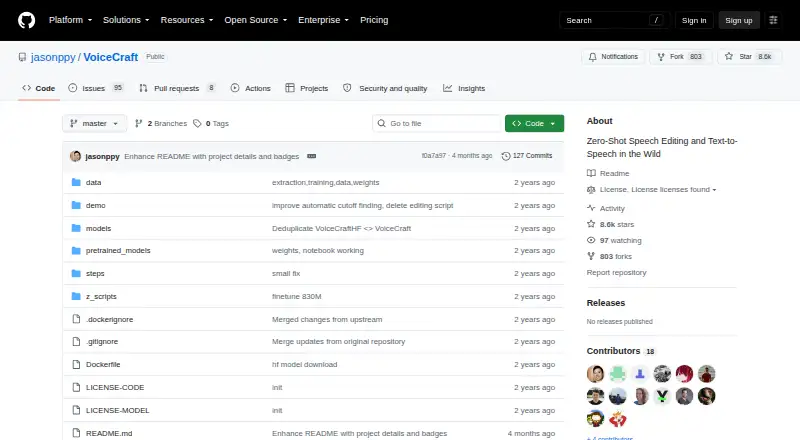
VoiceCraft is a free, open-source project for zero-shot speech editing and text-to-speech on real-world audio such as audiobooks, internet videos, and podcasts. Its token-infilling neural codec language model can edit or clone an unseen voice from a few seconds of reference audio. Modes include speech editing, zero-shot TTS, and long-text TTS. A Gradio interface provides smart transcripts, allowing users to enter the words they want generated. Inference can run through Google Colab, Docker, a local environment, or a standalone command-line script. The script is intended for integration into other projects, and Gradio can run locally. Documentation also covers dataset preparation, training, and fine-tuning. Docker instructions assume NVIDIA container support and GPU access. Enhanced TTS models are recommended for prompt-plus-generation lengths of 16 seconds or less. The code uses CC BY-NC-SA 4.0, while model weights use the Coqui Public Model License 1.0.0; commercial use is not permitted.
Who it suits
It suits developers and researchers who want local or hosted speech editing, zero-shot TTS, or model training. Users need to follow the project’s consent guidance and non-commercial licensing terms.
What it does well
- Speech editing and zero-shot TTS
- Clones unseen voices from seconds of audio
- Gradio and command-line options
- Training and fine-tuning guidance
- Runs on Windows and Linux hosts
What to know first
- Commercial use not permitted
- Requires NVIDIA setup for Docker path
- Enhanced TTS length guidance is 16 seconds
- No API access
Limits
Enhanced TTS models were trained with utterances no longer than 16 seconds, and the project recommends keeping prompt plus generation at or below 16 seconds. Commercial use of the code, model, and model outputs is not permitted.
Getting started
- Open the VoiceCraft project website on GitHub
- Choose Google Colab, Docker, a local environment, or the command-line script
- For Docker, install Docker with NVIDIA Container Toolkit support
- Check GPU visibility with nvidia-smi when following the Docker examples
- Run the Gradio interface locally or use the standalone script
- Provide a few seconds of reference audio for an unseen voice
- Use the smart transcript to enter the words to generate
Verdict
VoiceCraft provides multiple ways to run speech editing and synthesis, plus tools for training and integration. Its licensing, consent requirement, and model-length guidance are central considerations.
Questions
Is VoiceCraft free?
Yes. The project is free and open source, with no free trial because it is not presented as a trial-based service.
Can VoiceCraft be used commercially?
No. Commercial use is prohibited; the code and model weights have non-commercial licensing terms.
Which platforms can run VoiceCraft?
The listed platforms are Linux, Windows, web, and self-hosted environments. Documented routes include Google Colab, Docker, local use, and a command-line script.
Does VoiceCraft provide an API?
No API access is listed. The repository does provide a standalone script intended for integration into other projects.
What licensing applies?
The code is under CC BY-NC-SA 4.0, while model weights use the Coqui Public Model License 1.0.0.
What does VoiceCraft require for voice cloning?
The project says an unseen voice can be cloned or edited with only a few seconds of reference audio, and consent is required.
Facts from VoiceCraft's own pages
- API access
- No · github.com, 20 Sept 2026
- Code license
- The codebase is licensed under CC BY-NC-SA 4.0, with some identified components under separate licenses. · github.com, 9 Oct 2026
- Commercial use
- No · github.com, 20 Sept 2026
- Compute requirement
- The Docker instructions assume Docker with NVIDIA Container Toolkit and pass GPUs into the container. · github.com, 10 Oct 2026
- Consent guidance
- The project says people must not use the technology to generate or edit someone's speech without that person's consent. · github.com, 9 Oct 2026
- Dataset access
- The training instructions say downloading GigaSpeech requires signing an agreement and using an authentication token. · github.com, 10 Oct 2026
- Editing and TTS
- The Gradio interface offers zero-shot TTS, speech editing, and long-text TTS modes. · github.com, 10 Oct 2026
- Hardware requirements
- The Docker instructions assume Docker and NVIDIA container support, and the examples check GPU visibility with nvidia-smi. · github.com, 9 Oct 2026
- Integrations
- The repository provides scripts for integrating VoiceCraft into other projects and documents demos on Hugging Face Spaces and Replicate. · github.com, 10 Oct 2026
- Intended users
- The repository documents inference use as well as model training and fine-tuning for developers preparing their own datasets. · github.com, 10 Oct 2026
- License
- The repository states that the code is under CC BY-NC-SA 4.0 and the model weights are under the Coqui Public Model License 1.0.0. · github.com, 10 Oct 2026
- Model length limit
- For the giga330M TTS model described in its news section, the repository says maximum prompt plus generation length should be 16 seconds. · github.com, 10 Oct 2026
- Model license
- The model weights use Coqui Public Model License 1.0.0, which permits only non-commercial use of the model and its outputs. · github.com, 9 Oct 2026
- Model limits
- The README says the enhanced TTS models were trained with utterances no longer than 16 seconds and recommends keeping prompt plus generation length at or below 16 seconds for those models. · github.com, 9 Oct 2026
- Purpose
- VoiceCraft is a token-infilling neural codec language model for zero-shot speech editing and text-to-speech on in-the-wild data such as audiobooks, internet videos, and podcasts. · github.com, 10 Oct 2026
- Training
- Training requires utterances and transcripts, encoded audio codes, phoneme sequences, and a manifest; the project includes preparation guidance. · github.com, 10 Oct 2026
- Transcript control
- Its smart transcript feature lets users write only the text they want to generate. · github.com, 10 Oct 2026
- Voice cloning
- To clone or edit an unseen voice, VoiceCraft needs only a few seconds of reference audio. · github.com, 9 Oct 2026
- Voice consent
- The project disclaimer prohibits generating or editing someone’s speech without their consent. · github.com, 10 Oct 2026
- Voice reference
- The project says cloning or editing an unseen voice requires only a few seconds of reference audio. · github.com, 10 Oct 2026
- Ways to run
- The project documents inference through Google Colab, Docker, local setup, and standalone command-line scripts. · github.com, 10 Oct 2026
- Windows and Linux
- The Docker quick start says it was tested on Linux and Windows and should work on hosts with Docker installed. · github.com, 10 Oct 2026
Where VoiceCraft stands on Freedom251
- Text-to-speech tools#116 of 232
- Text-to-Speech Software#148 of 223
- AI Voice Cloning Software#25 of 29