Freedom251 › PC benchmark tools
vkpeak
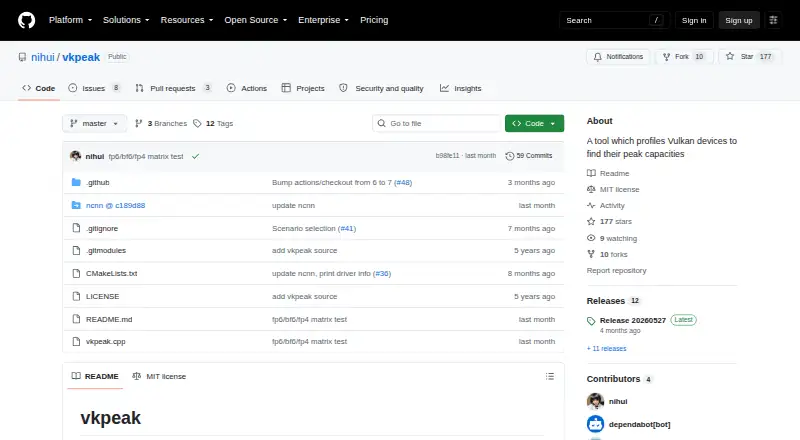
What vkpeak is
vkpeak is free, MIT-licensed software that uses synthetic Vulkan workloads to measure peak device capabilities. It covers floating-point arithmetic, integer arithmetic, matrix operations, and memory-copy bandwidth. Scenarios include scalar and vector tests for several data types, matrix and dot-product operations, and transfers between host and device. Users can run every scenario or choose one scenario or a comma-separated list. An optional device ID selects the target Vulkan device; the default value, 0, selects the default device. Executables are offered for Intel, AMD, Nvidia, and Apple GPUs, with Linux, macOS, and Windows support. The project can be built from source with CMake after cloning its submodules, and its macOS instructions include linking the static MoltenVK library. The README states that vector-based peak measurements are not real-world workloads. It credits Tencent’s ncnn as other open-source code used. If a run crashes or reports an error, the guidance is to upgrade the GPU driver. The January 2026 Linux package supports glibc 2.17 and later.
Who it suits
vkpeak suits developers and system users who need command-line Vulkan peak-capability measurements. It is useful when synthetic arithmetic, matrix, and transfer scenarios are the intended workload.
What it does well
- Free MIT-licensed software
- Measures arithmetic, matrix, and copy bandwidth
- Selectable benchmark scenarios
- Executables for Intel, AMD, Nvidia, and Apple GPUs
- Linux, macOS, and Windows support
What to know first
- Synthetic results do not represent real-world workloads
- Requires Vulkan-capable drivers and devices
- Source builds require CMake and submodules
Limits
vkpeak reports synthetic peak metrics produced with vector operations, so its results do not describe real-world workloads. The Linux package in the January 2026 release requires glibc 2.17 or later.
Plans
| Plan | Billed and limits | Price |
|---|---|---|
| MIT-licensed open-source software | Synthetic Vulkan device benchmarking | Free |
As github.com lists them, read 11 Oct 2026. The maker's own page has the final word.
Getting started
- Open the vkpeak repository at https://github.com/nihui/vkpeak
- Use a provided executable for your Intel, AMD, Nvidia, or Apple GPU
- Or clone the repository with its submodules
- Build from source with CMake
- On macOS, enable linking of the static MoltenVK library if needed
- Run all scenarios or select one or a comma-separated list
- Optionally set a device ID; 0 selects the default Vulkan device
Verdict
vkpeak provides configurable Vulkan benchmarking across major desktop operating systems and GPU vendors. Its results describe vector-based peak capability rather than application performance.
Questions
How much does vkpeak cost?
The MIT-licensed open-source software is free: free.
Which platforms are supported?
vkpeak supports Windows, Linux, and macOS.
What does it benchmark?
It measures floating-point and integer arithmetic, matrix operations, and memory-copy bandwidth on Vulkan devices.
Can I choose specific tests or devices?
Yes. Run every scenario by default or select one or a comma-separated list. An optional device ID selects the target device, with 0 as the default.
Can I automate vkpeak?
Yes. It provides command-line operation for automation.
Is vkpeak open source?
Yes. The repository identifies it as MIT-licensed and credits Tencent's ncnn as other open-source code used.
Facts from vkpeak's own pages
- Benchmark caveat
- The README says it measures peak metrics achievable using vector operations and does not represent a real-world use case. · github.com, 11 Oct 2026
- Benchmark scenarios
- Scenarios include scalar and vector tests for several data types, matrix and dot-product tests, and host/device copy tests. · github.com, 11 Oct 2026
- Build
- The project can be built from source with CMake after cloning it with its submodules. · github.com, 11 Oct 2026
- CLI or automation
- Yes · github.com, 23 Sept 2026
- Dependency
- The README credits Tencent's ncnn as other open-source code used by the project. · github.com, 11 Oct 2026
- Device selection
- The optional device ID defaults to 0, which selects the default Vulkan device. · github.com, 11 Oct 2026
- Driver troubleshooting
- The README advises upgrading the GPU driver if a crash or error occurs. · github.com, 11 Oct 2026
- Free plan
- Yes · github.com, 23 Sept 2026
- GPU support
- The README offers executables for Intel, AMD, Nvidia, and Apple GPUs. · github.com, 11 Oct 2026
- License
- The repository identifies its license as MIT. · github.com, 11 Oct 2026
- Linux compatibility
- The January 2026 release says its Linux package supports glibc 2.17 and later, including Debian 8+, Ubuntu 13.10+, Fedora 19+, and RHEL 7+. · github.com, 11 Oct 2026
- macOS build
- The README documents an option to link the static MoltenVK library on macOS. · github.com, 11 Oct 2026
- Operating systems
- Windows; Linux; macOS · github.com, 23 Sept 2026
- Purpose
- vkpeak is a synthetic benchmarking tool that profiles Vulkan devices to measure peak capabilities. · github.com, 11 Oct 2026
- Scenario selection
- Users can run all scenarios by default or select one or a comma-separated list of scenarios. · github.com, 11 Oct 2026
- Third-party code
- The project lists Tencent's ncnn as other open-source code used. · github.com, 11 Oct 2026
- Workload areas
- floating-point arithmetic; integer arithmetic; matrix operations; memory-copy bandwidth · github.com, 23 Sept 2026
Where vkpeak stands on Freedom251
- PC benchmark tools#44 of 70
- PC Benchmark Software#48 of 73