Freedom251 › JavaScript Testing Frameworks

Vitest
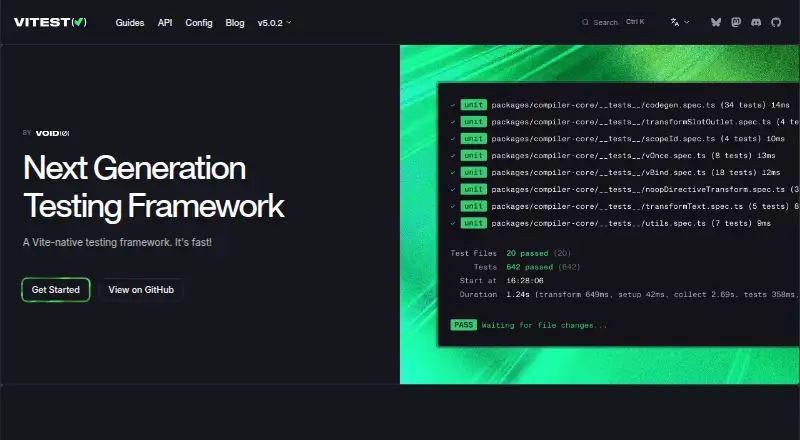
What Vitest is
Vitest is a testing framework powered by Vite for JavaScript and TypeScript projects. It can reuse Vite configuration, plugins, resolvers, and transform pipelines, or run without Vite. Its Jest-compatible APIs cover assertions, snapshots, and mocking, which can help teams moving from Jest. Watch mode reruns tests related to changed source or test files, and TypeScript, JSX, and ES modules work out of the box. Browser Mode runs tests in a browser with Playwright and WebdriverIO providers. The framework also supports component testing for Vue, React, Svelte, Lit, Marko, and other frameworks, plus code coverage through V8 or Istanbul and benchmarking powered by Tinybench. Vitest offers an official Visual Studio Code extension and can be tried in a browser through StackBlitz without local installation. It is free and open source. The listed requirements are Vite 6.4.0 or later and Node 22.12.0 or later. Users seeking help can turn to the Vitest Discord community or GitHub Discussions.
Who it suits
Vitest suits JavaScript and TypeScript developers who want testing integrated with Vite or a framework that can run independently. It may also suit teams seeking Jest-compatible APIs or browser and component testing options.
What it does well
- Free and open source.
- Can reuse Vite configuration and plugins.
- Jest-compatible APIs cover assertions, snapshots, and mocking.
- Coverage supported through V8 or Istanbul.
- Can try it in StackBlitz without local installation.
What to know first
- Requires Vite 6.4.0 or later.
- Requires Node 22.12.0 or later.
Plans
| Plan | Billed and limits | Price |
|---|---|---|
| Free and open source | No plan limits stated | Free |
As vitest.dev lists them, read 30 Sept 2026. The maker's own page has the final word.
Getting started
- Open the Vitest website or try it through StackBlitz in a browser.
- For local use, ensure Vite 6.4.0 or later and Node 22.12.0 or later are available.
- Choose whether to use Vitest with Vite or run it without Vite.
- Use the official Visual Studio Code extension if you want IDE integration.
- For help, visit the Vitest Discord community or GitHub Discussions.
Overview
Vitest is a testing framework built around Vite’s tooling for JavaScript and TypeScript projects. It suits Vite teams, modern front-end projects, and Jest users seeking familiar test APIs. The main qualification is version compatibility: current projects need Vite 6.4.0 or newer and Node 22.12.0 or newer.
Key features
Vitest can reuse Vite configuration, plugins, resolvers, and transformation pipelines, keeping test behavior closer to the application’s development setup. It can also run without Vite, so adopting it does not require rebuilding a non-Vite project around that toolchain. Jest-compatible assertion, snapshot, and mocking APIs make it a sensible migration candidate, although compatibility should not be treated as a guaranteed drop-in replacement.
Watch mode reruns tests connected to changed source or test files, which concentrates feedback on the code being edited rather than repeatedly running an unrelated suite. TypeScript, JSX, and ES modules work without separate language setup. Built-in mocks, parameterized cases, property-based checks, snapshots, and parallel execution cover routine unit-test patterns and larger suites.
Browser Mode executes tests natively in a browser and supports Playwright and WebdriverIO providers. That is useful when browser behavior matters more than a simulated environment. Component testing spans Vue, React, Svelte, Lit, Marko, and other frameworks, extending Vitest beyond isolated functions. Coverage can use V8 or Istanbul, and Tinybench powers benchmarking. An official Visual Studio Code extension supports editor workflows, while StackBlitz provides a browser-based way to try the framework without local installation.
The principal trade-off is operational rather than feature breadth. Teams on older Vite or Node releases must upgrade before adoption, and Jest API compatibility still leaves room for migration adjustments. Help is directed to the Vitest Discord community and GitHub Discussions.
Pricing
Vitest is free and open source. Its “Free and open source” plan costs nothing and has no stated plan limits. There are no paid tiers, seat charges, usage quotas, trial periods, or renewal terms to weigh, making it suitable for individual developers and teams that want the full framework without a subscription.
Platforms
Vitest supports Linux, macOS, Windows, and the web. Its browser execution option is particularly relevant to front-end teams, while the ability to run without Vite broadens its usefulness beyond Vite-based applications.
Who it's for
Choose Vitest for a Vite application that should share configuration and transforms between development and testing, or for a JavaScript and TypeScript team moving from Jest APIs. It also fits teams needing browser and component testing, code coverage, benchmarking, and editor support in one free tool. It is a poor immediate fit for projects that cannot meet the Vite 6.4.0 and Node 22.12.0 minimums, or for organizations seeking a paid vendor plan with stated enterprise terms.
Pros and cons
Pros
- Vite-aware execution: Reusing configuration, plugins, resolvers, and transforms can reduce differences between application and test environments.
- Broad testing scope: Browser Mode, component testing, coverage, benchmarking, snapshots, mocks, and parallel execution support more than basic unit tests.
- Jest familiarity: Compatible assertion, snapshot, and mocking APIs give Jest teams a recognizable migration path.
- No subscription cost: The free open-source plan has no stated limits or seat fees.
Cons
- Modern runtime requirement: Vite 6.4.0 and Node 22.12.0 are required, which can block older projects.
- Compatibility is not identical behavior: Jest-style APIs may ease migration but do not promise that every existing suite will move unchanged.
- No commercial plan terms: Teams wanting paid support, contractual service levels, or published enterprise pricing have no such tier to select.
Alternatives
Browse JavaScript Testing Frameworks or Unit Testing Frameworks for a wider shortlist. Pick Karma only if its deprecated, MIT-licensed open-source status is acceptable and you need its broader platform listing. Choose QUnit for an open-source JavaScript framework distributed through CDN, npm, and Yarn. Web Test Runner is an alternative from Modern Web focused on browser-centered modern web development tools. Choose Cucumber.js when an npm-module workflow and development-dependency installation suit your project. Jasmine is another free JavaScript testing option without stated pricing or usage limits. Pure Test fits readers seeking Apache-2.0 open-source software with no paid plans stated. Testem is a free MIT-licensed JavaScript test runner. Choose Mocha for a free open-source framework installed as a development dependency.
Verdict
Vitest is a strong recommendation for Vite-based JavaScript and TypeScript teams that want integrated configuration, Jest-compatible APIs, and browser or component coverage at no cost. Look elsewhere when the project cannot upgrade to its required Vite and Node versions, or when a commercial support and pricing structure is a priority.
Verdict
Vitest combines Vite-aware workflows with options for browser, component, and coverage testing. Check the stated Vite and Node versions before adopting it.
Questions
How much does Vitest cost?
Vitest is free and open source; its listed plan is free.
Does Vitest require Vite?
No. It can reuse Vite configuration and related tooling, but it can also run without Vite.
Which languages does it support?
Its listed supported languages are JavaScript and TypeScript. It also provides out-of-the-box support for JSX and ES modules.
Can Vitest run tests in a browser?
Yes. Browser Mode runs tests in a browser and supports Playwright and WebdriverIO providers.
Can I try Vitest without installing it?
Yes. It can be tried in a browser through StackBlitz.
What is required for local use?
The getting started guide states that Vitest requires Vite 6.4.0 or later and Node 22.12.0 or later.
Facts from Vitest's own pages
- Benchmarking
- Vitest lists benchmarking support powered by Tinybench. · vitest.dev, 30 Sept 2026
- Browser testing
- Browser Mode runs tests natively in a browser and supports Playwright and WebdriverIO providers. · vitest.dev, 30 Sept 2026
- Component testing
- The features guide lists component testing for Vue, React, Svelte, Lit, Marko, and other frameworks. · vitest.dev, 30 Sept 2026
- Coverage
- Vitest supports code coverage through V8 or Istanbul. · vitest.dev, 30 Sept 2026
- IDE integration
- The getting started guide says Vitest provides an official Visual Studio Code extension. · vitest.dev, 30 Sept 2026
- Jest compatibility
- Vitest offers Jest-compatible APIs for assertions, snapshots, and mocking to support migration from Jest. · vitest.dev, 30 Sept 2026
- Languages
- Vitest provides out-of-the-box support for TypeScript, JSX, and ES modules. · vitest.dev, 30 Sept 2026
- Maintainer
- VoidZero's About page identifies Evan You as Founder and CEO. · voidzero.dev, 30 Sept 2026
- Product
- Vitest is a Vite-powered testing framework. · vitest.dev, 30 Sept 2026
- Requirements
- The getting started guide says Vitest requires Vite 6.4.0 or later and Node 22.12.0 or later. · vitest.dev, 30 Sept 2026
- Security
- The maker's announcement says it plans an enterprise JavaScript tooling solution designed for scale and security requirements; it does not state a Vitest security certification. · voidzero.dev, 30 Sept 2026
- Support
- The guide directs users needing help to the Vitest Discord community and GitHub Discussions. · vitest.dev, 30 Sept 2026
- Try online
- Vitest can be tried in the browser through StackBlitz without installing it locally. · vitest.dev, 30 Sept 2026
- Vite integration
- Vitest can reuse Vite configuration, plugins, resolvers, and transform pipelines, and can also run without Vite. · vitest.dev, 30 Sept 2026
- Watch mode
- Watch mode reruns tests related to changed source or test files. · vitest.dev, 30 Sept 2026
Where Vitest stands on Freedom251
- JavaScript Testing Frameworks#11 of 23
- Unit Testing#19 of 32
- Unit Testing Frameworks#26 of 32