Freedom251 › JavaScript Testing Frameworks

QUnit
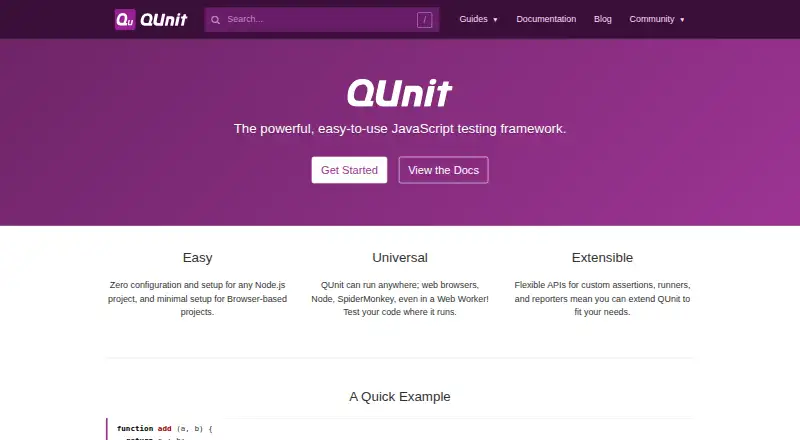
What QUnit is
QUnit is a JavaScript testing framework that began in the jQuery project. It lets developers test JavaScript in web browsers, Node.js, SpiderMonkey, and Web Worker threads. Its APIs can be extended with custom assertions, test runners, and reporters. Browser releases have no runtime dependencies, while the project describes Node.js setup as requiring no configuration and browser setup as minimal. For DOM tests, QUnit restores fixture markup after each test. Its browser runner presents results and can show expected and actual values, assertion details, and failure stack traces. Developers can rerun selected tests or modules and put previously failing tests first. Plugins can add or change capabilities, with examples including DOM assertions, themes, and JUnit XML reporting. Browser automation integrations listed by the project include Karma, Web Test Runner, Testem, and WebdriverIO’s QUnit service. QUnit 3.0 is available through the jQuery CDN, npm, and Yarn. For its ESM version, the compatibility guide lists Node.js 18+ and browser versions including Chrome 61+, Firefox 60+, and Safari 10.1+.
Who it suits
QUnit suits JavaScript developers who want to test code in the runtime where it runs, including browsers, workers, and servers. It is also relevant to teams using browser automation integrations or custom test runners and reporters.
What it does well
- Runs in browsers, Node.js, SpiderMonkey, and Web Workers.
- Browser releases have no runtime dependencies.
- Resets DOM fixtures after each test.
- Supports plugins and custom assertions.
- Browser runner can rerun selected tests or modules.
What to know first
- QUnit 3 ESM requires Node.js 18+.
- ESM browser support lists minimum browser versions.
- Project work is done by volunteers.
Plans
| Plan | Billed and limits | Price |
|---|---|---|
| QUnit | Open-source JavaScript testing framework · distributed via CDN, npm, and Yarn | Free |
As qunitjs.com lists them, read 5 Oct 2026. The maker's own page has the final word.
Getting started
- Install QUnit 3.0 through npm or Yarn, or use the jQuery CDN.
- For offline work, install or download QUnit within your project.
- Add QUnit tests using its modules, assertions, and asynchronous test support.
- For browser testing, set up the browser project with minimal configuration.
- Connect a listed browser automation integration if it fits your test workflow.
QUnit is a JavaScript test framework for developers who want to check code in browsers, workers, or server-side runtimes. It is strongest for projects that need DOM tests and browser-based failure details; teams using QUnit 3’s ESM version must meet its runtime requirements.
Overview
QUnit began in the jQuery project and has been around since 2008. It runs in web browsers, Node.js, SpiderMonkey, and Web Worker threads, making it a focused choice for JavaScript projects that cross those environments. It is not a fit for teams looking for one framework across several programming languages: its supported language is JavaScript.
QUnit describes Node.js setup as requiring no configuration and browser setup as minimal. Its browser releases have no runtime dependencies. QUnit 3.0 is distributed through the jQuery CDN and npm, and can also be installed with Yarn. For offline development, the project recommends installing or downloading it into the project rather than relying on a remote CDN.
The framework covers test modules, asynchronous tests and callbacks, assertions, and parameterized cases. It supports parallel execution. The project is maintained by volunteers, and help channels include GitHub issues, Stack Overflow, and a Matrix chat room.
Key features
Browser runner and DOM isolation
QUnit resets fixture markup after each test, which helps DOM cases start from a predictable state instead of inheriting changes made by earlier tests. The browser reporter can show expected and actual values, assertion details, and stack traces for failures. It can also prioritize tests that failed before or rerun selected tests and modules, useful when investigating a regression without repeating an entire suite.
Extensibility and automation
Custom assertions, test runners, and reporters let teams adapt QUnit to their own test conventions. Plugins can extend or modify the framework and its developer experience; examples include DOM assertions, themes, and JUnit XML reporters. Browser automation integrations include Karma, Web Test Runner, Testem, and WebdriverIO’s QUnit service. These options make QUnit adaptable, though teams that need a specific workflow should confirm that its integrations and plugins cover it.
Compatibility
QUnit 3’s ESM version requires Node.js 18 or later. Its browser compatibility guide includes Chrome 61+, Firefox 60+, and Safari 10.1+. Those thresholds are worth checking before adoption, particularly for projects that must support older environments.
Pricing
QUnit is free. Its QUnit plan costs nothing and covers the open-source JavaScript testing framework distributed through the jQuery CDN, npm, and Yarn. There is no free trial because the plan itself is free. No paid tier or seat-based pricing is part of this offer, so it suits individual developers and teams that want a no-cost framework without a commercial plan decision.
Platforms
QUnit is listed for Android, iOS, Linux, macOS, self-hosted environments, web, and Windows. Its runtime environments are more specific: web browsers, Node.js, SpiderMonkey, and Web Worker threads. Browser releases are standalone, while local installation supports offline development.
Who it's for
QUnit suits JavaScript developers testing code in the environment where it runs, especially when browser DOM behavior, fixture isolation, or browser failure diagnostics are important. It is also a sensible option for teams seeking a free framework with custom assertion and reporting hooks. It is less suitable for projects written in other languages or users whose Node.js version falls below 18 when using QUnit 3’s ESM version.
Pros and cons
- Pros: Browser fixture resets reduce cross-test DOM contamination, and the reporter can expose assertion details and stack traces to aid debugging.
- Pros: It spans browser, server, and worker JavaScript environments, with custom runners, reporters, and assertions for tailored workflows.
- Pros: The framework is free, and browser releases have no runtime dependencies.
- Cons: QUnit is limited to JavaScript, so projects in other languages need another framework.
- Cons: QUnit 3’s ESM version sets a Node.js 18+ floor, which can rule it out for older runtime environments.
- Cons: Volunteer project staffing may matter to teams weighing long-term support expectations.
Alternatives
For a different language or testing ecosystem, consider these free alternatives:
- Unit Testing Frameworks and JavaScript Testing Frameworks are broader directories for comparing options.
- Kotest is a free test framework and assertions library whose property-testing tools are standalone projects; choose it when that project structure better suits your needs.
- NUnit is a free alternative with a stated MIT license for NUnit 3 and later, permitting commercial and noncommercial use.
- Pest is a free PHP testing framework; its Pest 5 release requires PHP 8.4 or later.
- PHPUnit is a free PHP testing framework distributed as a PHAR or installable per project with Composer.
- ScalaTest is free, open-source software under the Apache 2.0 license.
- Vitest is free and open source; consider it as another JavaScript testing option.
- Go testing is a free option for developers working with the Go programming language.
- GoogleTest is free, open-source software under the BSD 3-clause license.
Verdict
Choose QUnit if you need free JavaScript tests across browsers, Node.js, or workers and value isolated DOM fixtures with useful browser failure reports. Its extension points and flexible runtimes are compelling for that focused job. Look elsewhere if you need a multi-language framework or cannot meet the Node.js 18+ requirement for QUnit 3’s ESM version.
Verdict
QUnit covers browser, server, and worker JavaScript testing, with reporting, fixture isolation, and extension options. Check its ESM compatibility requirements against the Node.js and browser versions you use.
Questions
Does QUnit cost anything?
No. QUnit is free and open source.
Which environments can run QUnit?
It can run in web browsers, Node.js, SpiderMonkey, and Web Worker threads.
How can I install QUnit?
QUnit 3.0 is distributed through the jQuery CDN and npm, and it can also be installed with Yarn. The project recommends a local installation or download for offline development.
What versions are required for QUnit 3 ESM?
The compatibility guide lists Node.js 18+ and browsers including Chrome 61+, Firefox 60+, and Safari 10.1+.
Can QUnit test DOM behavior and asynchronous code?
Yes. Its guides cover DOM fixtures, asynchronous tests, and asynchronous callbacks. It resets fixture markup after each test.
Which browser automation tools integrate with QUnit?
Listed integrations include Karma, Web Test Runner, Testem, and WebdriverIO’s QUnit service.
Facts from QUnit's own pages
- Browser runner
- The browser runner reports test results and resets fixture markup after each test. · qunitjs.com, 5 Oct 2026
- Browser setup
- QUnit releases are standalone and have no runtime dependencies when used in a browser. · qunitjs.com, 4 Oct 2026
- Compatibility
- The compatibility guide lists QUnit 3 support for Node.js 18+ and browser versions including Chrome 61+, Firefox 60+, and Safari 10.1+ for its ESM version. · qunitjs.com, 5 Oct 2026
- Compatibility limit
- The compatibility guide lists Node.js 18+ for QUnit 3’s ESM version. · qunitjs.com, 4 Oct 2026
- Debugging
- The browser runner can prioritize previously failing tests and rerun selected tests or modules. · qunitjs.com, 5 Oct 2026
- Distribution
- QUnit 3.0.0 is available as JavaScript and CSS files from the jQuery CDN and as an npm package. · qunitjs.com, 5 Oct 2026
- DOM fixtures
- QUnit resets fixture markup after each test to keep DOM tests isolated. · qunitjs.com, 4 Oct 2026
- Environments
- QUnit can run in web browsers, Node.js, SpiderMonkey, and Web Workers. · qunitjs.com, 5 Oct 2026
- Extensibility
- Its APIs support custom assertions, test runners, and reporters. · qunitjs.com, 4 Oct 2026
- Extensions
- QUnit plugins can extend or modify the framework and developer experience; listed examples include DOM assertions, themes, and JUnit XML reporters. · qunitjs.com, 5 Oct 2026
- Founded
- 2008 · qunitjs.com, 28 Sept 2026
- Integrations
- Documented browser automation integrations include Karma, Web Test Runner, Testem, WebdriverIO, and TestCafe. · qunitjs.com, 5 Oct 2026
- Intended users
- QUnit is intended for developers testing JavaScript in the environment where the code runs, including browsers, workers, and servers. · qunitjs.com, 4 Oct 2026
- Maintainers
- The QUnit team says project work is done by volunteers. · qunitjs.com, 5 Oct 2026
- Offline use
- The project recommends installing or downloading QUnit within the project for local or offline development. · qunitjs.com, 5 Oct 2026
- Project staffing
- The QUnit team says project work is done by volunteers. · qunitjs.com, 4 Oct 2026
- Purpose
- QUnit is a JavaScript testing framework originally developed for jQuery and now used by JavaScript libraries and applications. · qunitjs.com, 5 Oct 2026
- Runtime environments
- QUnit can run in web browsers, Node.js, SpiderMonkey, and Web Worker threads. · qunitjs.com, 4 Oct 2026
- Security and compliance
- The official pages reviewed do not state security certifications or compliance claims. · qunitjs.com, 5 Oct 2026
- Setup
- The project describes QUnit as requiring zero configuration for Node.js projects and minimal setup for browser projects. · qunitjs.com, 5 Oct 2026
- Support
- The project directs users to GitHub issues, Stack Overflow, and its Matrix chat room for questions and help. · qunitjs.com, 5 Oct 2026
- Testing features
- Its guides cover test modules, asynchronous tests, DOM fixtures, asynchronous callbacks, and assertions. · qunitjs.com, 5 Oct 2026
- Test reports
- The browser reporter displays test results and can show expected and actual values, assertion details, and stack traces for failures. · qunitjs.com, 4 Oct 2026
Where QUnit stands on Freedom251
- JavaScript Testing Frameworks#6 of 23
- Unit Testing#10 of 32
- Unit Testing Frameworks#17 of 32