Freedom251 › AI Singing Voice Generators

UtaiSynthesizer
What UtaiSynthesizer is
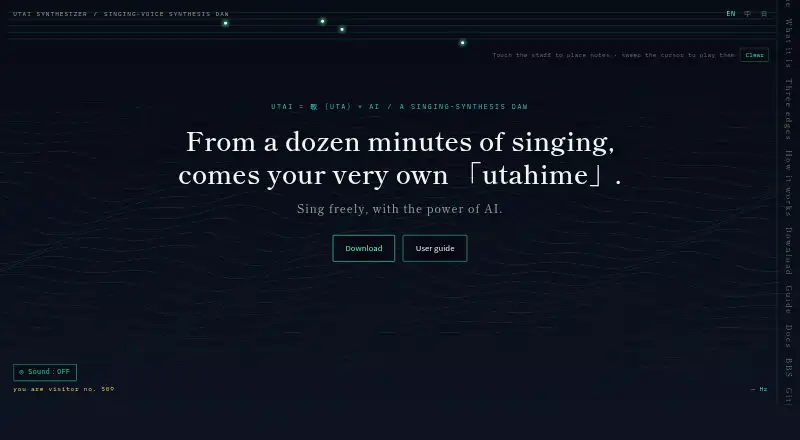
UtaiSynthesizer is a Windows singing-voice synthesis DAW that turns written scores into vocals using voice-conversion models. Its Score2ConVec model maps notation into features an SVC model can sing from, without an intermediate human vocal recording. It supports RVC and So-VITS-SVC backends, shallow diffusion, and multi-speaker voice blending. For arranging, it includes a piano roll, multi-track timeline, per-clip node workflow, vocal separation, training monitor, and vocal-range extension. Lyrics can use dictionaries in Chinese, English, Japanese, German, French, Spanish, and Italian. The app imports USTX, UST, MIDI, audio, and voice-model packages, and exports audio, UST, USTX, and MIDI; audio formats include WAV, FLAC, MP3, OGG, OPUS, and M4A. Model training runs on-device with downloadable runtime packs, and inference does not require Python. The maker says roughly twelve minutes of dry vocals and one to two hours of training can create a voice model. Singer models are not included, so users must import or train their own. It is open source under AGPL-3.0 for Windows 10 or 11 x64.
Who it suits
UtaiSynthesizer suits Windows users who want to create singing vocals from notation with voice-conversion models. It is for users prepared to import or train their own singer models and work with one of its seven supported lyric languages.
What it does well
- Converts notation into singing without a human guide vocal.
- Supports RVC and So-VITS-SVC backends.
- Supports lyrics in seven languages.
- Imports and exports UST, USTX, and MIDI.
- Training is on-device; inference does not require Python.
What to know first
- Singer voice models are not included.
- Limited AMD runtime coverage is stated.
- Intel XPU support is experimental and unverified on real hardware.
- Windows 10 or 11 x64 is specified.
Limits
Singer voice models are not included, so users must import or train their own. AMD runtime support is limited to gfx1103-class integrated GPUs, while Intel XPU support is experimental and not verified on real hardware.
Getting started
- Visit the official UtaiSynthesizer website.
- Download the Windows version for Windows 10 or 11 x64.
- Import a voice-model package or prepare vocals to train a model.
- Enter lyrics and notation, then arrange them in the piano roll or timeline.
- Export audio, UST, USTX, or MIDI.
Verdict
UtaiSynthesizer connects score-based composition with voice-conversion models and includes arranging, training, and vocal tools. Users need to bring or create singer models, and some hardware support has stated limits.
Questions
Is UtaiSynthesizer free?
Yes. It is free and open source under the AGPL-3.0 license.
Which operating systems does it support?
The official download and project README specify Windows 10 or 11 x64.
Does it include singer voice models?
No. Users import models or train their own.
Which languages can its lyric dictionaries support?
Chinese, English, Japanese, German, French, Spanish, and Italian.
What can it import and export?
It imports USTX, UST, MIDI, audio, and voice-model packages. It exports audio, USTX, UST, and MIDI.
Does it require Python to run inference?
No. The maker says inference runs without requiring Python; model training is on-device using downloadable runtime packs.
Facts from UtaiSynthesizer's own pages
- DAW features
- Features include a piano roll, multi-track timeline, node workflow, vocal separation, training monitor, and vocal-range tools. · github.com, 5 Oct 2026
- Download integrity
- The security policy says downloads are SHA-256 verified and updates are minisign verified. · github.com, 5 Oct 2026
- Downloads
- The official site links to a Windows download, and the repository specifies Windows 10 or 11 x64. · utaisynthesizer.net, 4 Oct 2026
- Import and export
- It exports audio, UST, USTX, and MIDI, and imports USTX, UST, MIDI, audio, and voice-model packages. · github.com, 5 Oct 2026
- Integrity
- The repository says downloads are SHA-256 verified and auto-updates are minisign signed. · github.com, 4 Oct 2026
- Languages
- The app has a trilingual Chinese, English, and Japanese interface and supports lyric pronunciation in seven languages. · github.com, 5 Oct 2026
- License
- The project repository is licensed under AGPL-3.0. · github.com, 5 Oct 2026
- Limitations
- The README says AMD runtime coverage is limited to gfx1103-class integrated GPUs and Intel XPU support is experimental and unverified on real hardware. · github.com, 5 Oct 2026
- Local processing
- The maker describes voice-model training as on-device and says inference runs without requiring Python. · github.com, 4 Oct 2026
- Models
- The repository and official installer do not include singer voice models; users import or train their own. · github.com, 4 Oct 2026
- Offline operation
- The app runs locally and says it connects only for update checks, model and asset downloads, and an optional mirror connectivity test. · github.com, 5 Oct 2026
- Platform
- The official site offers a Windows download, and the project README specifies Windows 10 or 11 x64. · utaisynthesizer.net, 5 Oct 2026
- Purpose
- UtaiSynthesizer is a singing-voice synthesis DAW that turns scores into vocals using voice-conversion models. · utaisynthesizer.net, 5 Oct 2026
- Recording and training
- The maker says a dozen minutes of dry vocals and about an hour or two of training can create a voice model. · utaisynthesizer.net, 4 Oct 2026
- Score-to-singing
- Its Score2ConVec model converts notation into features that let an SVC voice model sing without an intermediate human vocal recording. · github.com, 4 Oct 2026
- Security reporting
- The project asks users to report vulnerabilities through GitHub's private vulnerability reporting rather than public issues. · github.com, 5 Oct 2026
- Singing workflow
- Its Score2ConVec model maps a score into ContentVec features so an SVC model can sing from notation without a human guide vocal. · github.com, 5 Oct 2026
- Support
- The project directs bug reports and feature requests to GitHub Issues and links to QQ and Discord community groups. · github.com, 5 Oct 2026
- SVC backends
- It supports RVC and SoVITS backends, with shallow diffusion and multi-speaker voice blending. · utaisynthesizer.net, 4 Oct 2026
- Training
- Users can train voice models on-device using downloadable embedded runtime packs, with no Python required at inference time. · github.com, 5 Oct 2026
- Voice models
- The app supports RVC and So-VITS-SVC backends, with shallow diffusion and multi-speaker voice blending. · github.com, 5 Oct 2026
Where UtaiSynthesizer stands on Freedom251
- AI Singing Voice Generators#18 of 25
- AI Song Cover Generators#48 of 55