urpmi
What urpmi is
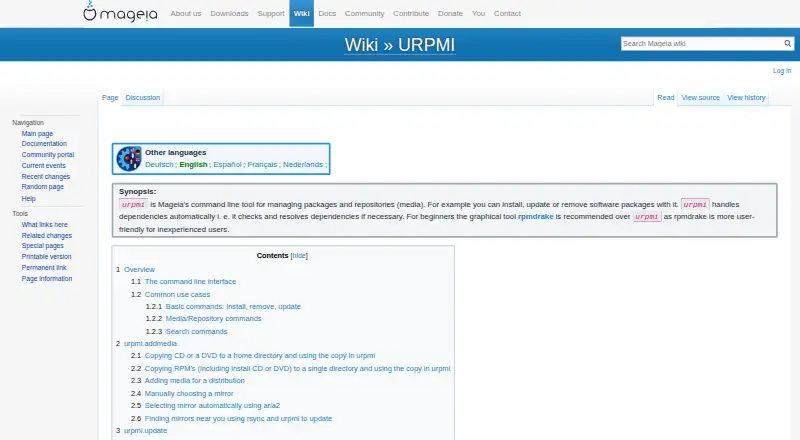
urpmi is Mageia Linux’s default package manager for RPM software. It installs, updates and removes applications, resolves dependencies and supports offline installation. The urpmi command installs packages, while urpme uninstalls them. urpmq searches repositories and the urpmi database, and urpmf finds packages containing particular files or matching RPM tags. urpmi.update refreshes the local database and updates applications or the Mageia distribution. Repository sources can be added with urpmi.addmedia and removed with urpmi.removemedia, including online HTTP, FTP and rsync sources or local media. URPMI underpins rpmdrake, Mageia’s graphical package tool, and drakx, its DVD or network installer. It supports Mageia Linux on i586 and x86_64 systems and is compatible with RPM versions 4.9 through 4.16. Mageia lists Core, Nonfree and Tainted repositories; Tainted is disabled unless selected and may raise legal concerns in some countries.
Who it suits
It suits Mageia users managing RPM applications, repositories and system updates from the command line or Mageia’s graphical tools. It can also support offline installation and installer workflows.
What it does well
- Free plan with no charge
- Resolves package dependencies
- Supports offline installation
- Searches repositories and package contents
- Works with graphical Mageia tools
What to know first
- Linux and Mageia-focused platform
- Tainted packages may raise legal concerns
- Finer weak-dependency handling remains planned
Plans
| Plan | Billed and limits | Price |
|---|---|---|
| urpmi | RPM package installation and system updates · Mageia media sources | Free |
As wiki.mageia.org lists them, read 12 Oct 2026. The maker's own page has the final word.
Verdict
urpmi provides Mageia’s package installation, update, removal and repository controls in one toolkit. Its command-line companions and integration with rpmdrake and drakx cover both direct administration and graphical workflows.
Facts from urpmi's own pages
- Current Mageia use
- A September 2026 Mageia community blog post describes urpmi as handling software dependencies during installation and removal in Mageia. · planet.mageia.org, 12 Oct 2026
- Dependency resolution
- Yes · wiki.mageia.org, 22 Sept 2026
- Free plan
- Yes · wiki.mageia.org, 22 Sept 2026
- Graphical interface
- Mageia describes rpmdrake as a simple interface for installing and removing RPM software packages. · mageia.org, 12 Oct 2026
- Installer use
- URPMI is a core application of drakx, the Mageia installer for DVD or network installation. · blog.mageia.org, 11 Oct 2026
- Maintenance
- Mageia says URPMI is maintained, stabilized, and improved as new versions are released. · blog.mageia.org, 11 Oct 2026
- Notable limitation
- Mageia’s page described using libdnf/libsolv for finer dependency handling, including weak dependencies, as a planned future direction awaiting stable programming interfaces. · blog.mageia.org, 11 Oct 2026
- Offline installation
- Yes · wiki.mageia.org, 22 Sept 2026
- Operating environment
- Mageia describes itself as a GNU/Linux-based free software operating system and identifies URPMI as its default package manager. · mageia.org, 11 Oct 2026
- Package formats
- RPM · wiki.mageia.org, 22 Sept 2026
- Package installation
- The urpmi command installs applications, while urpme removes them. · blog.mageia.org, 11 Oct 2026
- Package queries
- The urpmq tool queries the urpmi database and can check RPM packages in official repositories. · mageia.org, 12 Oct 2026
- Package removal
- The urpme companion tool uninstalls RPM packages and has multiple command-line options. · mageia.org, 12 Oct 2026
- Package search
- The urpmf companion can identify which package contains a file and search RPM tags in official repositories. · mageia.org, 12 Oct 2026
- Purpose
- Mageia describes urpmi as its default dependency resolver for installing RPM packages and updating the system. · mageia.org, 12 Oct 2026
- Repository categories
- Mageia lists Core, Nonfree and Tainted as its software repositories, with Tainted added by default but disabled unless users opt in. · mageia.org, 12 Oct 2026
- Repository controls
- urpmi.addmedia and urpmi.removemedia add and remove software repositories. · blog.mageia.org, 11 Oct 2026
- Repository removal
- The urpmi.removemedia tool removes media sources configured on the system. · mageia.org, 12 Oct 2026
- Repository search
- urpmq searches for applications by querying repositories, and urpmf searches for packages by the files they contain. · blog.mageia.org, 11 Oct 2026
- Repository sources
- The urpmi.addmedia tool adds Mageia media sources, including online HTTP, FTP and rsync sources and local sources. · mageia.org, 12 Oct 2026
- Repository updates
- The urpmi.update tool updates the local urpmi database and can disable configured media sources. · mageia.org, 12 Oct 2026
- RPM compatibility
- Mageia’s 2020 page says URPMI is compatible with RPM versions 4.9 through 4.16. · blog.mageia.org, 11 Oct 2026
- Support channel
- Mageia lists an IRC channel named #mageia-urpmi for urpmi development. · wiki.mageia.org, 12 Oct 2026
- Supported platforms
- Mageia Linux; i586; x86_64 · wiki.mageia.org, 22 Sept 2026
Where urpmi stands on Freedom251
- Package Managers#71 of 93