RPM
What RPM is
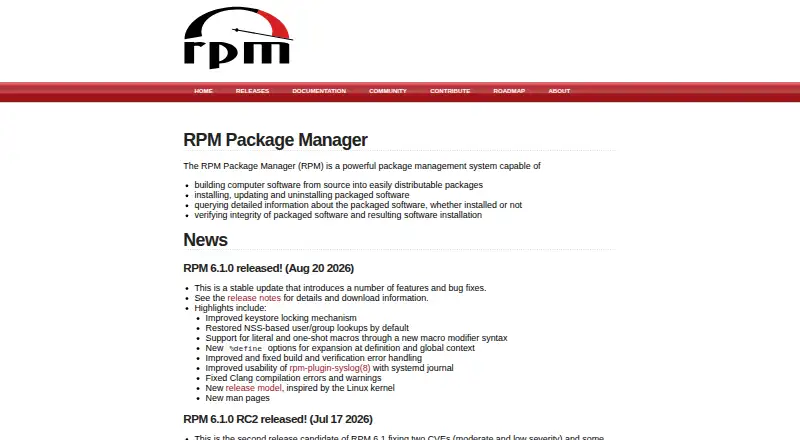
RPM is free, open-source, command-line package management software for Linux. It builds software from source into distributable packages, then installs, updates, uninstalls, queries, and verifies packaged software. Packages contain file archives plus information such as version and description. RPM can verify package integrity and the resulting installation, while its library API lets developers manage package transactions from languages such as C or Python. RPM supports RPM v4 and RPM v6 formats and is a core component of Red Hat Enterprise Linux, Fedora, SUSE Linux Enterprise, openSUSE, CentOS, Tizen, Mageia, and CBL-Mariner. RPM 6.0.0 defaults to enforcing signature checking and supports OpenPGP v6 keys and signatures; RPM 6.1.0’s rpmsign can sign files with PKCS11 tokens. RPM 6.0 removed support for installing RPM v3 packages. The project provides reference documentation for RPM 6.1.x, 6.0.x, and 4.20.x, plus community help through GitHub Discussions, mailing lists, Matrix rooms, and IRC. RPM is licensed under GPL-2.0-or-later, with lib and rpmio code also offered under LGPL-2.1-or-later.
Who it suits
RPM suits Linux administrators and developers who need command-line package creation, installation, verification, and transaction control through an API.
What it does well
- Free open-source Linux package manager
- Builds and verifies distributable packages
- Library API supports C and Python
- RPM v4 and v6 compatibility
- Signature checking enforced by default
What to know first
- No dependency resolution
- RPM v3 package installation removed
- Command-line interface required
Verdict
RPM provides package building, installation, querying, and integrity checks for Linux systems. Its current format and signature rules should be considered when working with older packages.
Facts from RPM's own pages
- Command line
- RPM is a command-line-driven package management system. · rpm.org, 12 Oct 2026
- Dependency resolution
- No · rpm.org, 21 Sept 2026
- Distribution use
- RPM is a core component of distributions including Red Hat Enterprise Linux, Fedora, SUSE Linux Enterprise, openSUSE, CentOS, Tizen, Mageia, and CBL-Mariner. · rpm.org, 12 Oct 2026
- Documentation
- The project provides reference documentation shipped with RPM for versions 6.1.x, 6.0.x, and 4.20.x. · rpm.org, 12 Oct 2026
- Integrity
- RPM can verify packaged software and the resulting software installation. · rpm.org, 12 Oct 2026
- Interface
- RPM is a command-line driven package management system. · rpm.org, 12 Oct 2026
- Latest release
- RPM 6.1.0 was released on August 20, 2026, as a stable update with features and bug fixes. · rpm.org, 12 Oct 2026
- Library API
- A library API lets developers manage package transactions from languages such as C or Python. · rpm.org, 12 Oct 2026
- License
- RPM is free software released under GPL-2.0-or-later, with code in the lib and rpmio subdirectories also offered under LGPL-2.1-or-later. · rpm.org, 12 Oct 2026
- Notable limit
- RPM 6.0 removed support for installing RPM v3 packages. · rpm.org, 12 Oct 2026
- Package building
- RPM can build computer software from source into distributable packages. · rpm.org, 12 Oct 2026
- Package format compatibility
- RPM 6.0 supports RPM v4 and v6 packages; support for installing RPM v3 packages was removed. · rpm.org, 12 Oct 2026
- Package formats
- RPM v4,RPM v6 · rpm.org, 21 Sept 2026
- Package information
- RPM packages contain an archive of files and information such as the package version and description. · rpm.org, 12 Oct 2026
- Package integrity
- RPM can verify the integrity of packaged software and the resulting software installation. · rpm.org, 12 Oct 2026
- Package management
- RPM builds software from source into distributable packages and installs, updates, uninstalls, queries, and verifies packaged software. · rpm.org, 12 Oct 2026
- Package signing
- RPM 6.0 supports multiple OpenPGP signatures per package and OpenPGP v6 keys and signatures. · rpm.org, 12 Oct 2026
- Project history
- The first version-control commit in the current source tree dates to 1995. · rpm.org, 12 Oct 2026
- Purpose
- RPM builds software from source into distributable packages and installs, updates, uninstalls, queries, and verifies packaged software. · rpm.org, 12 Oct 2026
- Release security
- RPM 6.0.0 defaults to enforcing signature checking and supports OpenPGP v6 and post-quantum cryptography keys and signatures. · rpm.org, 12 Oct 2026
- Security contact
- The project says it has no specific security personnel or processes and directs sensitive upstream security reports to Red Hat Product Security as its contact point. · rpm.org, 12 Oct 2026
- Security reporting
- The project says it has no specific security personnel or processes and directs sensitive upstream security reports to Red Hat Product Security. · rpm.org, 12 Oct 2026
- Signature checking
- RPM defaults to enforcing signature checking. · rpm.org, 12 Oct 2026
- Signing support
- RPM 6.1.0's rpmsign can sign files with PKCS11 tokens. · rpm.org, 12 Oct 2026
Where RPM stands on Freedom251
- Package Managers#70 of 93