Freedom251 › Address Verification Software
UPU POST*CODE API
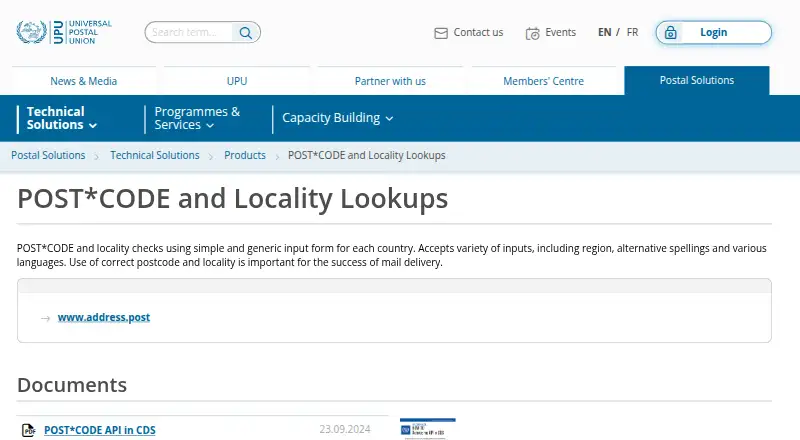
What UPU POST*CODE API is
UPU POST*CODE API checks international addresses against official locality names and postcode data from Universal Postal Union member countries. Its functions can validate a country’s postcode format, find postcodes for a locality, identify localities associated with a postcode, and check whether a postcode matches a locality. LocalityLike suggests official locality names and postal regions from a partial locality input.
The API is intended for designated postal operators, businesses and individuals handling international addresses. It can support address capture in customs declarations, web shops, user platforms and ERP systems. Integration options include postal websites and local applications, a CDS plugin, the CDS API gateway or other middleware. Developer guidance covers HTML, web applications and JavaScript form handling, with sample code for jQuery and Python. Documentation includes tutorials, quick-start guides and developer tooling. UPU says it guarantees response times under one second and can adjust server performance to expected call volume. Registered users can contact UPU to receive enough free calls to try the API. The Universal Postal Union was established in 1874 and is headquartered in Berne, Switzerland; questions about costs, documentation or a trial can be sent to [email protected].
Who it suits
This API suits postal operators, businesses and individuals who need to validate international addresses in forms or other address-capture workflows. It is relevant to teams working with customs declarations, web shops, user platforms or ERP systems and able to integrate an API.
What it does well
- Uses official locality and postcode data from UPU member countries.
- Checks postcode formats, locality names and postcode-locality matches.
- Suggests localities and postal regions from partial input.
- Can integrate with postal websites, local applications and middleware.
- Documentation includes tutorials, quick-start guides and sample code.
What to know first
- Pricing is available by request rather than as a listed price.
- Free trial calls require registration and contacting UPU.
- The listed platforms are API and web.
Limits
Pricing is available by request. Users must register and notify UPU to receive a sufficient number of free calls for a trial.
Plans
| Plan | Billed and limits | Price |
|---|---|---|
| Contact UPU for pricing | Costs and free-trial details are available by contacting UPU | On request |
As upu.int lists them, read 11 Oct 2026. The maker's own page has the final word.
Getting started
- Open the UPU POST*CODE product page.
- Register, then contact [email protected] to request free trial calls.
- Review the tutorials, quick-start guides and developer tooling.
- Choose an integration route: CDS plugin, CDS API gateway, other middleware, postal website or local application.
- Use the available HTML, JavaScript, jQuery or Python guidance to connect address capture.
- Contact [email protected] with questions about costs, documentation or the trial.
Verdict
Choose POST*CODE API if your workflow needs international postcode and locality validation from UPU member-country data. It offers several integration routes and developer resources, while pricing and trial-call details require contacting UPU. Look elsewhere if you need a published price before making an inquiry.
Questions
How much does POST*CODE API cost?
Pricing is on request. UPU directs cost questions to [email protected].
Is there a free trial?
Yes. Registered users can notify UPU to receive a sufficient number of free calls to try the API.
What address checks does it provide?
It checks postcode formats, finds postcodes for localities, finds localities for postcodes and verifies whether a postcode matches a locality. LocalityLike suggests official localities and postal regions from partial input.
How can it be integrated?
It can be used as a CDS plugin, through the CDS API gateway or other middleware, or integrated into postal websites and local applications.
What developer resources and languages are described?
The documentation includes tutorials, quick-start guides and developer tooling. The guide covers HTML and JavaScript and provides sample code for jQuery and Python.
Who makes POST*CODE API?
The Universal Postal Union makes it. UPU was established in 1874 and is headquartered in Berne, Switzerland.
Facts from UPU POST*CODE API's own pages
- Address data
- It provides official locality names and postcode data from UPU member countries. · upu.int, 11 Oct 2026
- CDS authentication
- CDS installations use an alphanumeric security token received from a regional support centre, and tokens are unique to countries. · upu.int, 11 Oct 2026
- Developer resources
- UPU says API documentation includes tutorials, quick-start guides, and developer tooling. · upu.int, 11 Oct 2026
- Development
- The guide describes HTML and web application use, JavaScript form handling, and sample code for JQuery and Python. · upu.int, 11 Oct 2026
- Documentation
- The API documentation includes tutorials, quick-start guides, and developer tooling. · upu.int, 11 Oct 2026
- Founded
- 1874 · upu.int, 28 Sept 2026
- Headquarters
- Berne, Switzerland · upu.int, 28 Sept 2026
- Integrations
- The API can be used as a CDS plugin, through the CDS API gateway or other middleware, or integrated into postal websites and local applications. · upu.int, 11 Oct 2026
- Intended users
- UPU describes the API as useful to designated operators, businesses, and individuals handling international addresses. · upu.int, 11 Oct 2026
- Locality and postcode matching
- Functions return postcodes for a locality, localities for a postcode, and check whether a postcode matches a locality. · upu.int, 11 Oct 2026
- Locality lookup
- The LocalityLike function suggests official localities and postal regions matching the start of an input string. · upu.int, 11 Oct 2026
- Maker
- The Universal Postal Union says it was established in 1874 and is headquartered in Berne, Switzerland. · upu.int, 11 Oct 2026
- Performance
- UPU says it guarantees a response time of less than one second and can adjust server performance to expected call volume. · upu.int, 11 Oct 2026
- Postcode validation
- Its functions check postcode format and return a country’s postcode format. · upu.int, 11 Oct 2026
- Pricing and support
- For questions about costs, documentation, or a free trial, the guide directs users to [email protected]. · upu.int, 11 Oct 2026
- Programming
- The guide describes HTML and JavaScript use and says sample code is available for jQuery and Python. · upu.int, 11 Oct 2026
- Purpose
- POST*CODE API verifies international addresses and helps eliminate addressing inaccuracies. · upu.int, 11 Oct 2026
- Secure access
- The API can be accessed through the CDS API gateway or other middleware for secure data transmission. · upu.int, 11 Oct 2026
- Security
- The CDS setup guide describes a security token used to identify and authenticate a CDS installation, with tokens unique to countries. · upu.int, 11 Oct 2026
- Suggestions
- The LocalityLike function suggests official locality names and postal regions from a partial locality input. · upu.int, 11 Oct 2026
- Support
- The guide directs users with questions about costs, documentation, or a free trial to [email protected]. · upu.int, 11 Oct 2026
- Trial calls
- The guide says users who register can notify UPU to receive a sufficient number of free calls to try the API. · upu.int, 11 Oct 2026
- Use cases
- The guide describes use in customs declarations, web shops, user platforms, and ERP systems that capture international addresses. · upu.int, 11 Oct 2026
- Validation
- Its functions check postcode formats, verify localities, find postcodes for localities, and check whether a postcode matches a locality. · upu.int, 11 Oct 2026
Where UPU POST*CODE API stands on Freedom251
- Address Verification Software#24 of 30