Freedom251 › AI Synthetic Data Generators
twinify
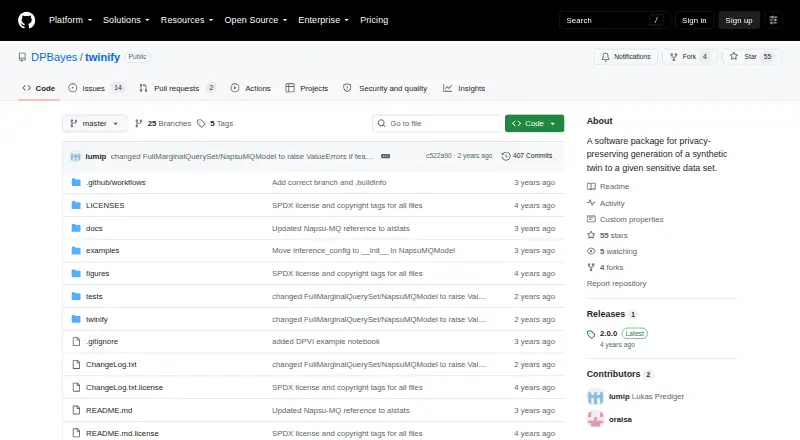
What twinify is
twinify is an open-source package for generating synthetic versions of sensitive tabular datasets with differential privacy. It learns probabilistic models using ε and δ settings, where smaller values indicate stronger privacy. Two methods are included: NAPSU-MQ and differentially private variational inference (DPVI). DPVI can automatically model data or use user-defined NumPyro models, and it handles categorical, continuous, or mixed data. NAPSU-MQ is currently intended only for fully categorical datasets. Automatic modeling can represent missing values by modeling their probability, assuming missingness is independent across features. Users can run twinify as a Python library or command-line tool that reads CSV files. The implementation uses NumPyro, JAX for CPU and GPU kernels, and d3p for private training routines. Stable installation is available from PyPI with pip, while a cloned repository provides the development version. The code is licensed under Apache License 2.0 and is classified for scientific research audiences.
Who it suits
It suits scientific research users who need privacy-preserving synthetic tabular data and can work with Python libraries or command-line tools. It is self-hosted and available through an API-oriented package.
What it does well
- Generates synthetic tabular datasets
- Provides ε and δ privacy controls
- DPVI handles categorical and continuous data
- Usable as library or command-line tool
- Licensed under Apache License 2.0
What to know first
- NAPSU-MQ supports only fully categorical data
- NAPSU-MQ may run long on many dimensions
- DPVI uses an approximate posterior
- DPVI omits extra differential-privacy uncertainty
Limits
NAPSU-MQ is limited to fully categorical data and can take a long time with many feature dimensions. DPVI supports broader data types but gives an approximate posterior and does not explicitly model additional uncertainty from differential privacy.
Getting started
- Open the twinify GitHub website
- Install the stable version from PyPI with pip
- Install from a cloned repository for the development version
- Use twinify as a Python library or command-line tool
- Provide a CSV dataset and choose NAPSU-MQ or DPVI
- Set ε and δ privacy parameters
Verdict
twinify offers two modeling approaches and explicit differential-privacy controls for synthetic tabular data. Method choice matters because NAPSU-MQ has narrower data support, while DPVI has the stated approximation limitation.
Questions
Is twinify free and open source?
Yes. It is free, described as open source, and licensed under Apache License 2.0.
How can twinify be used?
It works as a Python library or a command-line tool that reads CSV datasets.
Which data types are supported?
DPVI supports categorical, continuous, and mixed data. NAPSU-MQ currently supports only fully categorical data.
What privacy controls are available?
Users set ε and δ parameters for differential privacy. Smaller values indicate stronger privacy.
How is twinify installed?
The stable version can be installed from PyPI with pip. A development version can be installed from a cloned repository.
Who maintains twinify?
The DPBayes GitHub organization describes itself as providing differential-privacy software from the Finnish Center for Artificial Intelligence FCAI.
Facts from twinify's own pages
- Data types
- DPVI can handle categorical, continuous, or mixed data; NAPSU-MQ is currently suitable only for fully categorical data. · github.com, 4 Oct 2026
- DPVI limitation
- DPVI supports categorical, continuous, and mixed data, but produces an approximate posterior and does not explicitly capture the additional uncertainty due to differential privacy. · github.com, 5 Oct 2026
- Inference methods
- It implements NAPSU-MQ and differentially private variational inference (DPVI). · github.com, 4 Oct 2026
- Installation
- The stable version is installed with pip from PyPI, and the development version can be installed from the cloned GitHub repository. · github.com, 5 Oct 2026
- Integrations
- The implementation relies on NumPyro for modeling and inference, JAX for CPU and GPU kernels, and d3p for differentially private training routines. · github.com, 5 Oct 2026
- Intended audience
- The package metadata classifies twinify for scientific research audiences. · github.com, 4 Oct 2026
- License
- The codebase is licensed under Apache License 2.0. · github.com, 5 Oct 2026
- Limitations
- NAPSU-MQ may run for a long time on datasets with many feature dimensions, while DPVI approximates the true posterior and does not explicitly capture additional uncertainty due to differential privacy. · github.com, 4 Oct 2026
- Maintainer organization
- The DPBayes GitHub organization describes itself as providing differential privacy software from the Finnish Center for Artificial Intelligence FCAI. · github.com, 4 Oct 2026
- Maker
- The DPBayes GitHub organization describes itself as differential privacy software from the Finnish Center for Artificial Intelligence (FCAI). · github.com, 5 Oct 2026
- Maker details
- The opened maker page does not state a headquarters or founding year. · github.com, 5 Oct 2026
- Methods
- It implements NAPSU-MQ and differentially private variational inference (DPVI). · github.com, 5 Oct 2026
- Missing values
- Automatic modeling handles missing values by assuming they are missing at random, independently of whether other feature values are missing. · github.com, 5 Oct 2026
- Modeling
- DPVI automatic modeling builds mixture models from user-specified feature distributions; users can also supply NumPyro models. · github.com, 5 Oct 2026
- NAPSU-MQ limitation
- NAPSU-MQ currently supports only fully categorical data and may run for a long time on datasets with many feature dimensions. · github.com, 5 Oct 2026
- Privacy controls
- Users can set ε and δ privacy parameters, with smaller values indicating stronger privacy. · github.com, 5 Oct 2026
- Privacy method
- It learns probabilistic models under differential privacy, with ε and δ parameters for setting the privacy level. · github.com, 4 Oct 2026
- Purpose
- twinify generates privacy-preserving synthetic twins of sensitive tabular datasets. · github.com, 5 Oct 2026
- Usage
- It can be used as a Python library or a command-line tool that operates on CSV datasets. · github.com, 5 Oct 2026
- Ways to use it
- The package can be used as a Python library or as a command-line tool that reads CSV datasets. · github.com, 4 Oct 2026
Where twinify stands on Freedom251
- AI Synthetic Data Generators#25 of 25