Freedom251 › Chaos Engineering Platforms
Tumult
What Tumult is
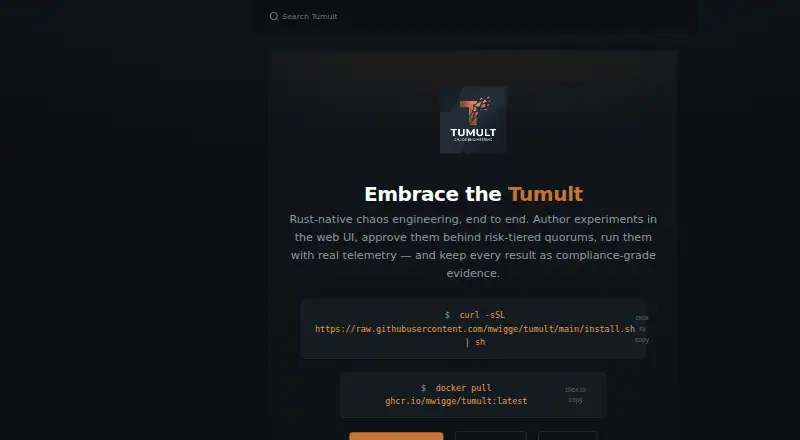
Tumult is a Rust-native chaos engineering platform for authoring, approving, running, and analyzing resilience experiments. Teams can create experiments in the web UI or write them in TOON and run them from the CLI. Its 16 plugins provide 91 chaos actions across systems such as Kubernetes, Docker, PostgreSQL, MySQL, Redis, Kafka, SSH, and CPU, memory, and I/O stress. Runs use T0–T3 risk tiers and can require quorum approval, expire by TTL, and pin experiment content hashes. Tumult records actions in a hash-chained audit trail and offers a two-step emergency stop plus a stop-all kill switch. Its daemon ingests OpenTelemetry traces, metrics, and logs into Kronika, an embedded DuckDB store that supports SQL queries and Parquet export. Tumult can also export telemetry to Jaeger, SigNoz, or any OTLP backend. Compliance mappings cover DORA, NIS2, PCI-DSS 4.0, ISO 22301, ISO 27001, SOC 2, and Basel III; R2 evidence packs are available for DORA, NIS2, ISO 27001, and SOC 2. Compatible agents can use 40 MCP tools over stdio or Streamable HTTP. Tumult is Apache-2.0 open source and self-hosted, distributed as a static binary or Docker image.
Who it suits
Tumult suits engineering and reliability teams that need controlled fault injection, approvals, audit trails, and analysis of resilience experiments. It also fits teams using Kubernetes, OpenTelemetry, or compatible MCP agents as part of their testing workflows.
What it does well
- Open source under the Apache-2.0 license.
- Provides 91 chaos actions across 16 plugins.
- Supports gated approvals, quorum, TTL, and content-hash pinning.
- Includes emergency stop, stop-all switch, and hash-chained audit trail.
- Stores telemetry in DuckDB with SQL queries and Parquet export.
- Offers MCP tools for compatible agents.
What to know first
- Self-hosted deployment requires installing the binary or Docker image.
- No experiment scheduling is supported.
- Script plugins can execute arbitrary commands if a registered plugin is malicious.
Limits
Tumult is self-hosted and does not support experiment scheduling. Its script plugins execute shell scripts, and Tumult trusts their content.
Getting started
- Visit https://tumult.rs/.
- Choose the shell installer or Docker image for deployment.
- Use the web UI to create an experiment, or write it in TOON for CLI use.
- Configure approvals and risk tiers for runs as needed.
- Connect telemetry destinations such as Jaeger, SigNoz, or another OTLP backend.
Verdict
Choose Tumult if you want an open-source, self-hosted platform for authoring and controlling resilience experiments, with audit and telemetry analysis built in. Look elsewhere if experiment scheduling is required or if your deployment cannot accept the script-plugin security boundary.
Questions
Is Tumult free?
Tumult is free and open source under the Apache-2.0 license.
Which platforms does Tumult support?
Tumult lists API, Linux, macOS, self-hosted, web, and Windows. Prebuilt binaries are listed for macOS x86_64 and aarch64, and Linux x86_64 gnu/musl and aarch64 musl.
Can Tumult test Kubernetes and cloud or network faults?
Kubernetes, cloud fault injection, and network fault injection are listed as supported.
Can teams schedule experiments?
No. Tumult does not support experiment scheduling.
Which compliance frameworks does Tumult cover?
It maps experiments to DORA, NIS2, PCI-DSS 4.0, ISO 22301, ISO 27001, SOC 2, and Basel III. R2 evidence packs are available for DORA, NIS2, ISO 27001, and SOC 2; the other frameworks are mapping-only.
What is the security consideration for plugins?
Script plugins execute shell scripts, and Tumult trusts plugin script content. A malicious registered plugin can execute arbitrary commands.
Facts from Tumult's own pages
- Agent integration
- The MCP server exposes 40 tools over stdio or Streamable HTTP for compatible agents to discover plugins, run experiments, query analytics, and recommend tests. · tumult.rs, 8 Oct 2026
- Analytics
- The daemon ingests OpenTelemetry traces, metrics, and logs into an embedded DuckDB store called Kronika, which supports SQL queries and Parquet export. · tumult.rs, 8 Oct 2026
- Approval controls
- Runs use risk tiers T0–T3, with gated approvals that can require a quorum, expire by TTL, and pin the experiment content hash. · tumult.rs, 8 Oct 2026
- Approvals and audit
- Runs use risk tiers T0–T3, with gated approvals supporting quorum, time-to-live limits, content-hash pinning, and separation of duties; actions enter a hash-chained audit trail. · tumult.rs, 8 Oct 2026
- Audit and stop controls
- Tumult provides a two-step emergency stop, a stop-all kill switch, and a hash-chained audit trail. · tumult.rs, 8 Oct 2026
- Compliance reporting
- Tumult maps experiments to DORA, NIS2, PCI-DSS 4.0, ISO 22301, ISO 27001, SOC 2, and Basel III; its R2 evidence pack is available for DORA, NIS2, ISO 27001, and SOC 2, while the other listed frameworks are mapping-only. · tumult.rs, 8 Oct 2026
- Deployment
- Tumult is distributed as a static binary and as prebuilt Docker images on GHCR; the site says the binary needs no Python or runtime dependencies. · tumult.rs, 8 Oct 2026
- Emergency stops
- Tumult provides a two-step emergency stop and a stop-all kill switch to halt runs. · tumult.rs, 8 Oct 2026
- Experiment authoring
- Experiments can be created in the web UI or written in TOON and run from the CLI. · tumult.rs, 8 Oct 2026
- Fault actions
- The homepage describes 16 plugins and 91 chaos actions across databases, Kafka, containers, Kubernetes, SSH, and CPU, memory, and I/O stress. · tumult.rs, 8 Oct 2026
- Fault injection
- The site lists 16 plugins and 91 chaos actions covering technologies including Kubernetes, Docker, PostgreSQL, MySQL, Redis, Kafka, SSH, and CPU, memory, and I/O stress. · tumult.rs, 8 Oct 2026
- Install options
- The homepage provides a shell installer and a Docker image, and describes Tumult as a static binary with no runtime dependencies. · tumult.rs, 8 Oct 2026
- License
- Tumult is open source under the Apache-2.0 license. · tumult.rs, 8 Oct 2026
- License and pricing
- The site describes Tumult as open source under the Apache-2.0 license; the opened maker pages did not state a price or trial offer. · tumult.rs, 8 Oct 2026
- MCP integration
- Tumult provides 40 Model Context Protocol tools over stdio or Streamable HTTP for compatible agents to discover plugins, run experiments, query analytics, and make recommendations. · tumult.rs, 8 Oct 2026
- Observability integrations
- Tumult exports telemetry using OpenTelemetry; the homepage names Jaeger, SigNoz, and any OTLP backend as destinations. · tumult.rs, 8 Oct 2026
- Platforms
- The site lists prebuilt binaries for macOS and Linux, and documents native Windows fault support through the tumult-windows plugin. · tumult.rs, 8 Oct 2026
- Plugin security boundary
- The security assessment says script plugins execute shell scripts and that Tumult trusts plugin script content, so a malicious registered plugin can execute arbitrary commands. · tumult.rs, 8 Oct 2026
- Purpose
- Tumult is a Rust-native chaos engineering platform for defining, running, and analyzing experiments that test how systems behave under failure conditions. · tumult.rs, 8 Oct 2026
- Security
- The production deployment guide says HTTP exposure beyond loopback requires authentication and documents TLS configuration for the analytics daemon's HTTP and gRPC listeners. · tumult.rs, 8 Oct 2026
- Security assessment
- Tumult's security assessment dated 2026-06-08 reports zero known HIGH or CRITICAL vulnerabilities and five transitive dependency advisories, all rated Low or Medium. · tumult.rs, 8 Oct 2026
- Supported binary platforms
- The homepage lists prebuilt binaries for macOS x86_64 and aarch64, and Linux x86_64 gnu/musl and aarch64 musl. · tumult.rs, 8 Oct 2026
Where Tumult stands on Freedom251
- Chaos Engineering Platforms#17 of 25