Freedom251 › Chaos Engineering Platforms
PowerfulSeal
What PowerfulSeal is
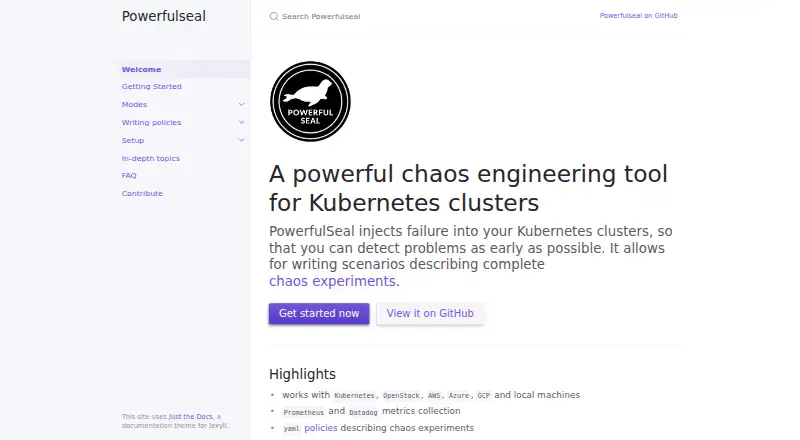
PowerfulSeal injects failures into Kubernetes clusters so users can identify problems early. Users describe chaos experiments in YAML policy files and choose among autonomous, interactive, and label modes. It works with Kubernetes, OpenStack, AWS, Azure, GCP, and local machines. Autonomous mode supports metrics through stdout, Prometheus, or Datadog, and its web interface can display logs and the policy. Policies can be set for a single run, such as in a CI pipeline, or for continuous execution by default. Label mode can restrict which pods may be killed and specify allowed days, times, and probability. PowerfulSeal can run inside Kubernetes and load scenarios from Kubernetes Custom Resources. Local installation is available through pip and requires Python 3.7 or newer; a Docker image is published for each release. Cloud use requires credential configuration, and the tool needs SSH, cloud, and Kubernetes API access. When corresponding environment variables are provided, it excludes its own pod name and host IP from kill operations. It is Apache-2.0 licensed and does not require external databases or Spinnaker.
Who it suits
PowerfulSeal suits teams using Kubernetes or supported cloud environments who want to define and run failure-injection experiments. Its modes include controls for limiting which pods may be targeted and when.
What it does well
- Defines experiments in YAML policy files
- Works with Kubernetes, cloud platforms, and local machines
- Autonomous metrics support stdout, Prometheus, and Datadog
- Label mode can limit targets, times, and probability
What to know first
- Local pip installation requires Python 3.7 or newer
- Cloud use requires credential configuration
- Needs SSH, cloud, and Kubernetes API access
Plans
| Plan | Billed and limits | Price |
|---|---|---|
| Apache-2.0 open-source | Self-hosted Kubernetes chaos testing · pip or Docker installation | Free |
As powerfulseal.github.io lists them, read 1 Oct 2026. The maker's own page has the final word.
Getting started
- Visit the PowerfulSeal website.
- Choose a local pip installation, which requires Python 3.7 or newer, or use a published Docker image.
- Configure SSH, Kubernetes API, and any required cloud credentials.
- Write a chaos experiment policy in YAML.
- Choose autonomous, interactive, or label mode and configure a single run or continuous execution.
Verdict
PowerfulSeal provides several ways to run and constrain failure-injection scenarios, including Kubernetes deployment and local installation. Users should account for its Python requirement and access needs for SSH, cloud, or Kubernetes APIs.
Questions
How much does PowerfulSeal cost?
The Apache-2.0 open-source plan is free. PowerfulSeal also has a free plan.
Which environments does PowerfulSeal support?
It works with Kubernetes, OpenStack, AWS, Azure, GCP, and local machines.
How can I install or deploy it?
Local installation is available through pip and requires Python 3.7 or newer. Docker images are published for releases, and PowerfulSeal can also run inside a Kubernetes cluster.
Which metrics collectors are available?
Autonomous mode supports stdout, Prometheus, and Datadog metric collectors.
What license does PowerfulSeal use?
PowerfulSeal is distributed under the Apache-2.0 license.
Facts from PowerfulSeal's own pages
- Chaos experiments
- It lets users write scenarios describing complete chaos experiments. · powerfulseal.github.io, 1 Oct 2026
- Cloud credentials
- Cloud provider setup supports Azure, AWS, OpenStack and GCP credential configurations. · powerfulseal.github.io, 1 Oct 2026
- Dependencies
- The tool does not require external databases or Spinnaker, apart from SSH, cloud and Kubernetes API access. · powerfulseal.github.io, 1 Oct 2026
- Docker distribution
- A Docker image is built and published to Docker Hub for each release. · powerfulseal.github.io, 1 Oct 2026
- Experiment scheduling
- Policies can configure one run for CI pipelines or continuous execution by default. · powerfulseal.github.io, 1 Oct 2026
- Granular targeting
- Label mode can control which pods may be killed, on which days and times, and with what probability. · powerfulseal.github.io, 1 Oct 2026
- Installation
- Local installation is available through pip and requires Python 3.7 or newer. · powerfulseal.github.io, 1 Oct 2026
- Kubernetes deployment
- PowerfulSeal can run inside a Kubernetes cluster and load scenarios from Kubernetes Custom Resources. · powerfulseal.github.io, 1 Oct 2026
- License
- PowerfulSeal is distributed under the Apache-2.0 license. · powerfulseal.github.io, 1 Oct 2026
- Metrics
- Autonomous mode supports stdout, Prometheus and Datadog metric collectors. · powerfulseal.github.io, 1 Oct 2026
- Operating modes
- PowerfulSeal provides autonomous, interactive and label modes. · powerfulseal.github.io, 1 Oct 2026
- Policy format
- Chaos experiment policies are written as YAML files. · powerfulseal.github.io, 1 Oct 2026
- Purpose
- PowerfulSeal injects failure into Kubernetes clusters to detect problems early. · powerfulseal.github.io, 1 Oct 2026
- Safety behavior
- PowerfulSeal excludes its own pod name and host IP from kill operations when the corresponding environment variables are provided. · powerfulseal.github.io, 1 Oct 2026
- Supported environments
- The tool works with Kubernetes, OpenStack, AWS, Azure, GCP and local machines. · powerfulseal.github.io, 1 Oct 2026
- Web interface
- The autonomous mode web interface can show logs and the policy. · powerfulseal.github.io, 1 Oct 2026
Where PowerfulSeal stands on Freedom251
- Chaos Engineering Platforms#14 of 25