Freedom251 › Terminal Multiplexers
TUIOS
What TUIOS is
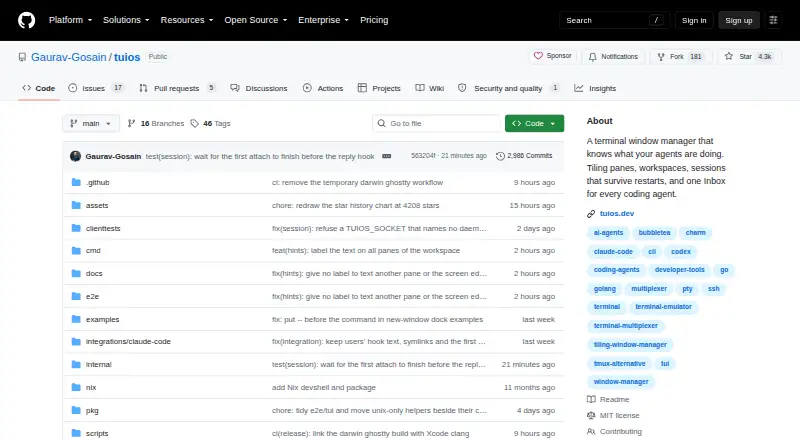
TUIOS is a free, MIT-licensed terminal multiplexer and window manager for people coordinating coding agents, terminal sessions, and work across local and remote machines. It organizes terminal work into workspaces and panes, with binary space partitioning, master-stack, and scrolling layouts; users can also disable tiling. A vim-style modal interface and copy mode support terminal navigation, with up to 10,000 lines of scrollback per window. TUIOS detects coding agents in panes and shows their states in pane titles and the session rail. Its Inbox brings together approvals, questions, errors, and finished turns that need attention across sessions. Documented integrations cover agents including Claude Code, Codex, Copilot, Cursor Agent, Gemini CLI, opencode, and others; the README says an integration install command connects 19 agent harnesses. A daemon keeps sessions available after detaching, including over SSH. Layouts and working directories return after daemon restarts or reboots, while running programs and scrollback do not. Users can add remote machines as hosts, attach to their sessions, or run a pane there. A separate tuios-web binary provides a browser terminal. Scripts and programs can control the daemon through a JSON protocol, CLI commands, tape scripts, and hooks. Prebuilt binaries are available for Linux, macOS, Windows, and FreeBSD. TUIOS requires a true-color terminal; source builds require Go 1.26.6 or newer.
Who it suits
TUIOS suits people managing coding agents and multiple terminal sessions, especially when work spans local and remote machines. Its Inbox and agent status display are useful for keeping track of approvals, questions, errors, and completed turns across sessions.
What it does well
- Free and MIT licensed.
- Tracks coding-agent states in panes and a shared Inbox.
- Supports multiple pane layouts, or turning tiling off.
- Sessions can stay available after detaching, including over SSH.
- Remote hosts can run sessions or individual panes.
- Offers a JSON control protocol, CLI, tape scripts, and hooks.
What to know first
- Requires a terminal with true-color support.
- After a restart, running programs and scrollback do not return.
- Building from source requires Go 1.26.6 or newer.
- Security response times are not guaranteed.
Limits
TUIOS is free. After a daemon restart or reboot, layouts and working directories return, but running programs and scrollback do not; each window's copy mode supports up to 10,000 lines of scrollback.
Getting started
- Open the TUIOS GitHub project page.
- Choose a prebuilt binary for Linux, macOS, Windows, or FreeBSD.
- Use a terminal with true-color support.
- Install agent integrations with the documented integration command if needed.
- Start sessions and arrange panes in workspaces; add a remote machine as a host when needed.
- Use tuios-web for a browser terminal, or connect scripts through the JSON control protocol.
Verdict
Pick TUIOS if you want a free terminal workspace that tracks coding agents and can reconnect to sessions on local or remote machines. Look elsewhere if you need running programs and scrollback restored after a daemon restart or reboot, or cannot use a true-color terminal.
Questions
Is TUIOS free?
Yes. It has a free plan and is MIT licensed.
Which platforms does TUIOS support?
Prebuilt binaries are provided for Linux, macOS, Windows, and FreeBSD. A separate tuios-web binary serves a browser terminal.
Which coding agents does it integrate with?
Documented integrations include Claude Code, Codex, Copilot, Cursor Agent, Gemini CLI, opencode, Kilo, Amp, Kimi Code CLI, Pi, oh-my-pi, and Qwen Code. The README says the integration install command connects 19 agent harnesses.
Can TUIOS keep sessions available after detaching?
Yes. A daemon keeps sessions running after detaching, including over SSH. Layouts and working directories return after a daemon restart or reboot, but running programs and scrollback do not.
Can it run sessions on other machines?
Yes. Users can add another machine as a host, attach to its sessions, or run a pane there over SSH.
What does TUIOS require?
It requires a true-color terminal. Building from source requires Go 1.26.6 or newer.
Facts from TUIOS's own pages
- Agent integrations
- The documented integrations include Claude Code, Codex, Copilot, Cursor Agent, Gemini CLI, opencode, Kilo, Amp, Kimi Code CLI, Pi, oh-my-pi and Qwen Code. · tuios.dev, 7 Oct 2026
- Agent monitoring
- It tracks coding-agent states in panes and shows them in pane titles and the session rail. · tuios.dev, 7 Oct 2026
- Agent tools
- It detects coding agents including Claude Code and Codex, displays their status, and collects approvals, questions and finished turns in one Inbox. · tuios.dev, 7 Oct 2026
- Automation
- TUIOS provides a JSON control protocol, CLI commands, tape scripts and hooks for driving sessions and running commands on events. · tuios.dev, 7 Oct 2026
- Automation API
- Scripts and programs can drive the daemon through line-delimited JSON on its Unix socket. · tuios.dev, 7 Oct 2026
- Inbox
- The Inbox collects approvals, questions, errors and finished turns that need attention across sessions. · tuios.dev, 7 Oct 2026
- Integrations
- The README says `tuios integration install` connects 19 agent harnesses, including Claude Code, Codex, Gemini CLI and opencode. · github.com, 7 Oct 2026
- Intended users
- The site presents TUIOS for people managing coding agents, terminal sessions and work across local and remote machines. · tuios.dev, 7 Oct 2026
- Layouts
- It supports BSP tiling, master-stack and scrolling layouts, as well as manually arranged windows. · tuios.dev, 7 Oct 2026
- License
- The project is MIT licensed. · tuios.dev, 7 Oct 2026
- Persistent sessions
- A daemon keeps sessions running after detaching so users can attach again later, including over SSH. · tuios.dev, 7 Oct 2026
- Product
- TUIOS is a terminal multiplexer and window manager with workspaces, tiling, persistent sessions and a vim-style modal interface. · github.com, 7 Oct 2026
- Remote access
- Sessions and individual panes can run on other machines over SSH, and a separate tuios-web binary serves a browser terminal. · tuios.dev, 7 Oct 2026
- Remote machines
- Users can add another machine as a host and attach to its sessions or run a pane there. · tuios.dev, 7 Oct 2026
- Requirements
- TUIOS requires a terminal with true color support, and building from source requires Go 1.26.6 or newer. · tuios.dev, 7 Oct 2026
- Security
- The control socket is restricted to the user through a mode 0700 directory, and pane actions can be limited by grants. · tuios.dev, 7 Oct 2026
- Security reporting
- The security policy requests private vulnerability reports by email and says response times are not guaranteed because the project is maintained in personal free time. · github.com, 7 Oct 2026
- Security support
- Security reports should be sent privately by email; the maintainer says response times are not guaranteed because the project is maintained in personal free time. · github.com, 7 Oct 2026
- Sessions
- A daemon keeps sessions available after detaching; layout and working directories return after a daemon restart or reboot, but running programs and scrollback do not. · tuios.dev, 7 Oct 2026
- Supported platforms
- The project provides prebuilt binaries for Linux, macOS, Windows and FreeBSD. · tuios.dev, 7 Oct 2026
- Terminal features
- It includes vim-style copy mode with up to 10,000 lines of scrollback per window, kitty graphics and keyboard protocol support, and sixel passthrough. · tuios.dev, 7 Oct 2026
- Themes
- The documentation describes 342 built-in themes and an in-app settings page. · tuios.dev, 7 Oct 2026
Where TUIOS stands on Freedom251
- Terminal Multiplexers#23 of 29