Freedom251 › Virtual Meeting Room Software
TrueMetaverse
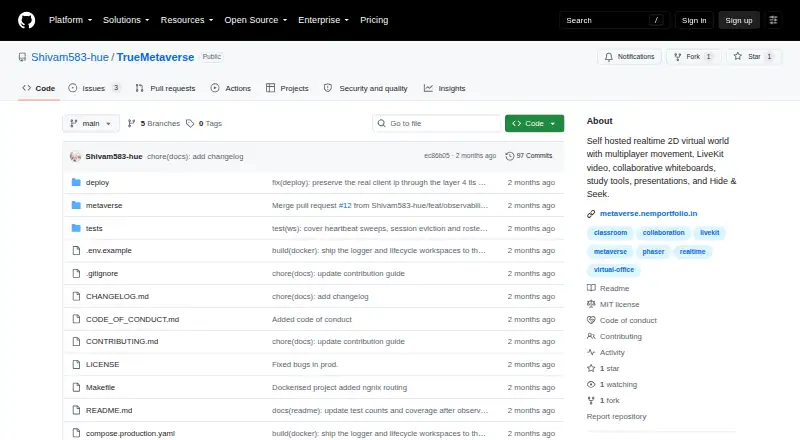
What TrueMetaverse is
TrueMetaverse is a self-hosted, realtime 2D world for study, meetings, presentations, games, and social time online. Users create or join pixel-art spaces with room codes, grid movement, realtime presence, and collision-aware maps. Five maps are included: Study Library, Multi-room House, Virtual Office, Classroom, and Enchanted Forest Hide & Seek. The Hide & Seek mode supports 3–12 players per room, with server-controlled roles, timers, tagging, line of sight, concealment zones, and spectator states.
Shared activities include LiveKit audio and video rooms, screen sharing, and a synchronized Excalidraw whiteboard controlled by its creator. Study sessions provide persistent timers and daily, weekly, monthly, and all-time leaderboards. The browser app documents keyboard controls on desktop and joystick and zoom controls on touch devices. The maker documents a Docker deployment that can run its frontend, APIs, realtime server, database, media services, TLS, and TURN on one VPS. The source is licensed under MIT. The README describes JWT authentication, salted scrypt password hashing, per-IP failed-login rate limits, and server-side validation of realtime actions. Restarting the single WebSocket process clears room, whiteboard, and active game state.
Who it suits
TrueMetaverse suits groups or organizations looking to host shared online spaces for study, meetings, presentations, games, or informal social time. It is especially relevant to teams comfortable with self-hosting and Docker deployment.
What it does well
- Free and open source under the MIT License.
- Five maps cover study, office, classroom, home, and game settings.
- LiveKit supports audio, video, screen sharing, and TURN fallback.
- Study sessions include persistent timers and multiple leaderboards.
- Browser access includes desktop keyboard and touch controls.
What to know first
- Hide & Seek is capped at 12 players per room.
- Restarting the single WebSocket process clears ephemeral room and activity state.
- No certified global concurrency figure is reported.
- The documented local LiveKit configuration recommends a Linux host.
Limits
Hide & Seek supports 3–12 players per room. Other rooms have no hard participant cap, but the maker reports no certified global concurrency figure; restarting the single WebSocket process clears room, whiteboard, and active game state.
Getting started
- Open the TrueMetaverse GitHub repository.
- Review the documented Docker deployment and stack.
- Deploy the frontend, APIs, realtime server, database, and media services on a host.
- For the documented local LiveKit configuration, use a Linux host.
- Open the browser application and use desktop keyboard or touch controls.
Verdict
Groups able to host their own service should consider TrueMetaverse for its mix of shared spaces, calls, screen sharing, games, and study tools. Look elsewhere if you need a certified global concurrency capacity or room state that survives restarting the WebSocket process.
Questions
Is TrueMetaverse free?
Yes. It is free and open source, with source code licensed under MIT.
Can I self-host it?
Yes. The maker documents a Docker deployment, with the application and supporting services able to run on one VPS.
What platforms can I use to access it?
It is a browser application, with keyboard controls on desktop and joystick and zoom controls on touch devices.
How many players can join Hide & Seek?
Hide & Seek supports 3–12 players per room.
Does it support calls and screen sharing?
Yes. LiveKit provides audio and video rooms, screen sharing, and TURN fallback for restrictive networks.
What happens when the WebSocket process restarts?
Room, whiteboard, and active game state reside in a single WebSocket process, so restarting it clears that ephemeral state.
Facts from TrueMetaverse's own pages
- Availability limitation
- Room, whiteboard, and active game state reside in a single WebSocket process, and restarting it clears that ephemeral state. · github.com, 4 Oct 2026
- Collaboration
- Presentation mode includes screen sharing, and the classroom whiteboard synchronizes Excalidraw scenes with server-side permission and payload checks. · github.com, 9 Oct 2026
- Communication
- LiveKit provides audio, camera video, and screen sharing, with TURN fallback for restrictive networks. · github.com, 9 Oct 2026
- Deployment
- The project provides a Docker Compose deployment with the web app, APIs, real-time server, PostgreSQL, LiveKit, Redis, TLS routing, and TURN configuration. · github.com, 9 Oct 2026
- Hide & Seek
- Hide & Seek supports 3–12 players, with server-controlled roles, timers, tagging, line of sight, concealment zones, and spectator states. · github.com, 9 Oct 2026
- Integrations
- The documented stack integrates LiveKit, Excalidraw, PostgreSQL, Redis, Docker Compose, and Cloudflare DNS. · github.com, 9 Oct 2026
- License
- The source code is licensed under the MIT License. · github.com, 9 Oct 2026
- Limit
- The README says there is no certified global concurrency figure because combined WebSocket, WebRTC, and TURN load testing has not been done; rooms other than Hide & Seek have no hard participant cap. · github.com, 9 Oct 2026
- Maker
- The GitHub repository is published under the account Shivam583-hue; the README does not state a headquarters or founding date. · github.com, 9 Oct 2026
- Maps
- It includes five maps: Study Library, Multi-room House, Virtual Office, Classroom, and Enchanted Forest Hide & Seek. · github.com, 9 Oct 2026
- Maps and game
- It provides five maps and an authoritative Hide & Seek mode for 3–12 players per room. · github.com, 4 Oct 2026
- Multiplayer
- Shared worlds support real-time presence, grid movement, collision-aware positioning, room creation, and short join codes. · github.com, 9 Oct 2026
- Platform support
- The README describes a browser application and responsive touch controls; its local LiveKit configuration recommends a Linux host because it uses host networking. · github.com, 9 Oct 2026
- Product
- TrueMetaverse is a self-hosted, real-time 2D virtual world for studying, meeting, presenting, playing, and spending time together online. · github.com, 9 Oct 2026
- Scaling limit
- The maker reports no certified global concurrency figure; Hide & Seek is capped at 12 players per room, while other rooms have no hard participant cap. · github.com, 4 Oct 2026
- Security
- The project documents JWT authentication, salted scrypt password hashing, per-IP rate limits on failed signup and signin attempts, and server-side validation of room and game actions. · github.com, 9 Oct 2026
- Shared spaces
- Users can create or join pixel-art spaces with realtime presence, grid movement, collision-aware maps, and room codes. · github.com, 4 Oct 2026
- Study tools
- Study sessions use persistent timers and leaderboards with daily, weekly, monthly, and all-time rankings. · github.com, 9 Oct 2026
- Support
- For vulnerability reports, the maker says they will acknowledge reports as soon as practical; no general support service is specified in the README. · github.com, 4 Oct 2026
- Supported access
- The README documents a browser application with keyboard controls on desktop and joystick and zoom controls on touch devices. · github.com, 4 Oct 2026
- Vulnerability reporting
- The maker asks that suspected vulnerabilities be reported privately by email or Discord rather than through public GitHub issues. · github.com, 4 Oct 2026
Where TrueMetaverse stands on Freedom251
- Virtual Meeting Room Software#17 of 22