Trigo
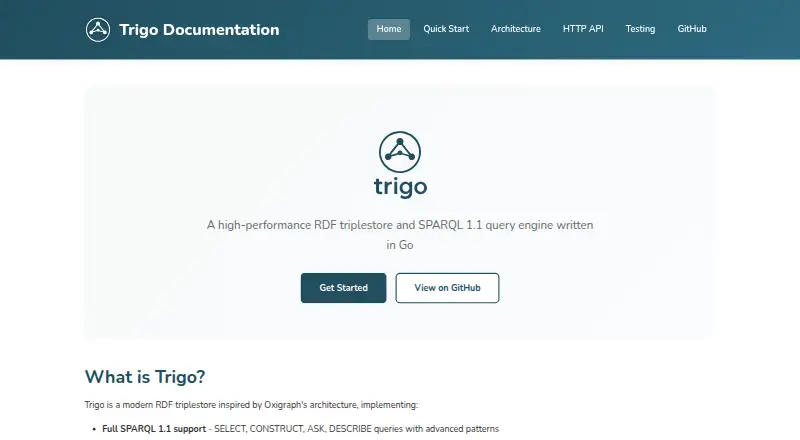
What Trigo is
Trigo is a free, open-source RDF triplestore and SPARQL query engine written in Go. It stores RDF data using a BadgerDB backend and an 11-index architecture, and can run as a self-hosted endpoint server or as a library in Go applications. Its HTTP endpoint supports the W3C SPARQL 1.1 Protocol and can return results in JSON, XML, CSV, or TSV. Supported RDF formats include Turtle, N-Triples, N-Quads, TriG, RDF/XML, and JSON-LD. The browser interface provides a SPARQL editor, visualizations of results, query history, saved queries, and database statistics. The documentation lists several features not yet implemented, including aggregates, GROUP BY, property paths, subqueries, VALUES, and UPDATE operations. Query execution is single-threaded, and joins use nested loops. Trigo reports 100% RDF 1.1 parser test results and 74.4% overall SPARQL test results. The homepage names the MIT License, while the linked GitHub README names Apache License 2.0. The project directs users to its documentation, source code, and issue tracker for help.
Who it suits
Trigo suits developers and data teams that want to store and query RDF data with SPARQL, either through a self-hosted endpoint or within Go applications. Its documented feature limits matter for projects that rely on advanced SPARQL operations.
What it does well
- Runs as a server or a Go library.
- Supports six listed RDF formats.
- HTTP endpoint supports the SPARQL 1.1 Protocol.
- Browser UI includes saved queries and history.
- Free and open source.
What to know first
- Several SPARQL features are not implemented.
- Query execution is single-threaded.
- Joins use nested loops.
- Project pages name different licenses.
Limits
The documented implementation does not yet provide aggregates, GROUP BY, property paths, subqueries, VALUES, or UPDATE operations. Query execution is single-threaded and joins currently use nested loops only.
Getting started
- Open the Trigo project website
- Read the quick-start documentation
- Run Trigo as a standalone endpoint server
- Use Trigo as a library in a Go application
- Load RDF data in a supported format
- Query through the HTTP SPARQL endpoint or browser interface
Verdict
Trigo offers a self-hosted RDF store, an HTTP query endpoint, and a browser interface, but its documented SPARQL gaps and execution limits are important to weigh. Its license information also differs between the homepage and linked README.
Questions
What is Trigo?
Trigo is a Go-written RDF triplestore and SPARQL query engine for storing and querying RDF data.
Which RDF formats are supported?
Supported formats are Turtle, N-Triples, N-Quads, TriG, RDF/XML, and JSON-LD.
Can Trigo run without a hosted service?
Yes. It can be self-hosted as a standalone endpoint server or used as a library in Go applications.
Does Trigo support SPARQL 1.1?
Its HTTP endpoint is described as compliant with the W3C SPARQL 1.1 Protocol, but several listed operations are not yet implemented.
What platforms are listed for Trigo?
Trigo is listed for API, Linux, macOS, web, and Windows.
What license does Trigo use?
The homepage states the MIT License, while the linked GitHub README states Apache License 2.0.
Facts from Trigo's own pages
- Compliance results
- The site reports 99.9% combined RDF parser test compliance and 74.4% overall SPARQL test results. · trigodb.com, 4 Oct 2026
- Execution limitation
- The architecture page describes query execution as single-threaded and says joins currently use nested loops only. · trigodb.com, 9 Oct 2026
- Library and server
- Trigo can be used as a library in Go applications or run as a standalone SPARQL endpoint server. · trigodb.com, 9 Oct 2026
- License
- The Trigo documentation site states that the project is licensed under MIT. · trigodb.com, 9 Oct 2026
- Limits
- The documentation lists SPARQL 1.1 aggregates, GROUP BY, property paths, subqueries, VALUES, and UPDATE operations as not yet implemented. · trigodb.com, 4 Oct 2026
- Product
- Trigo is an RDF triplestore and SPARQL query engine written in Go. · trigodb.com, 9 Oct 2026
- Querying
- Its HTTP endpoint supports the W3C SPARQL 1.1 Protocol and JSON, XML, CSV, and TSV result formats. · trigodb.com, 9 Oct 2026
- Query interface
- It provides an HTTP SPARQL endpoint described as compliant with the W3C SPARQL 1.1 Protocol. · trigodb.com, 4 Oct 2026
- RDF formats
- The documentation lists Turtle, N-Triples, N-Quads, TriG, RDF/XML, and JSON-LD formats. · trigodb.com, 9 Oct 2026
- SPARQL limitation
- The documentation lists aggregates, GROUP BY, property paths, subqueries, VALUES, and UPDATE operations as unsupported or not yet implemented. · trigodb.com, 9 Oct 2026
- Standards validation
- The site reports 100% RDF 1.1 parser test results and 74.4% overall SPARQL test results. · trigodb.com, 9 Oct 2026
- Storage
- Trigo uses BadgerDB storage with an 11-index architecture. · trigodb.com, 9 Oct 2026
- Support
- The quick start guide directs users to the project documentation and source code for help. · trigodb.com, 9 Oct 2026
- Transactions
- The architecture documentation says read transactions use snapshot isolation and write transactions use atomic batch commits. · trigodb.com, 9 Oct 2026
- Use
- It provides a triplestore for storing and querying RDF data using SPARQL. · trigodb.com, 9 Oct 2026
- Ways to use
- The documentation describes running Trigo as a standalone endpoint server or using it as a library in Go applications. · trigodb.com, 4 Oct 2026
- Web interface
- The quick start guide describes a browser interface with a SPARQL editor, result visualizations, query history, saved queries, and database statistics. · trigodb.com, 9 Oct 2026
Where Trigo stands on Freedom251
- RDF Databases#26 of 26