sparq
What sparq is
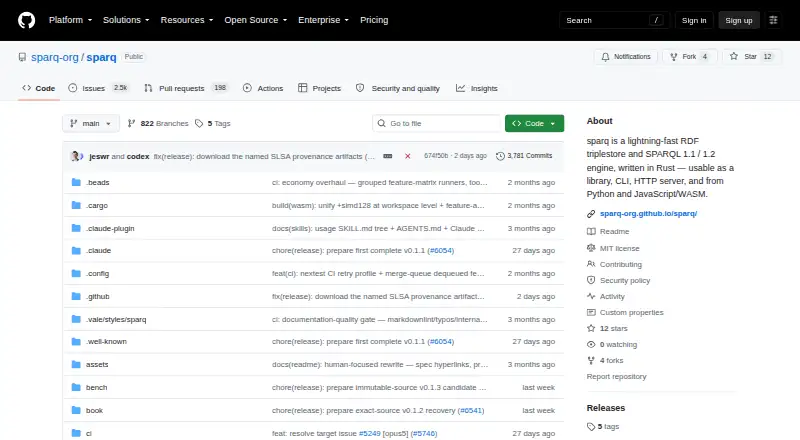
sparq is an open-source RDF triplestore and SPARQL engine written in Rust. It supports SPARQL 1.1 and 1.2 queries, together with SPARQL 1.1 Update actions for inserting, deleting, and loading data. The project is available as a library, command-line interface, HTTP server, Python package, or JavaScript/WebAssembly build. Its HTTP options include SPARQL Protocol and Graph Store services, and self-hosted deployment is documented through a Kubernetes Helm interface. sparq reads Turtle, N-Triples, N-Quads, TriG, JSON-LD, and RDF/XML; optional gzip, bzip2, and zstd decompression is listed for supported inputs. Optional reasoning includes RDFS, OWL-RL, and N3, with SHACL graph validation. Search capabilities include full-text RDF literal search, GeoSPARQL operations, and embedding-based vector and similarity search. The feature list also covers schema introspection and grounded natural-language-to-SPARQL retrieval for LLM agents. RDF-star, reasoning, and federated queries are listed as supported. sparq is MIT licensed, experimental, pre-1.0, and its API is described as unstable.
Who it suits
sparq suits developers and researchers building RDF applications, SPARQL services, or self-hosted semantic-data systems. It also fits projects needing Rust, Python, JavaScript/WebAssembly, CLI, HTTP, reasoning, spatial search, or vector search interfaces.
What it does well
- Open-source MIT license
- SPARQL 1.1 and 1.2 query support
- Multiple interfaces, including Python and JavaScript/WASM
- Supports six listed RDF data formats
- Optional reasoning and SHACL validation
- Full-text, GeoSPARQL, and vector search
What to know first
- Experimental pre-1.0 project with an unstable API
- Self-hosted deployment requires project setup
- Federation is opt-in and host-allowlisted
- ZK and MPC scaffolds are not production security guarantees
Limits
The project is experimental and pre-1.0, with an unstable API and best-effort maintenance rather than contractual service-level agreements. SPARQL SERVICE federation is disabled from the default build; when enabled, outbound access remains denied unless hosts are allowlisted. ZK and MPC capabilities are research scaffolds and should not be relied on for production security, privacy, or integrity.
Getting started
- Open the sparq GitHub repository
- Build the project from source
- Choose the library, CLI, HTTP server, Python package, or JavaScript/WebAssembly build
- Use the listed SPARQL Protocol or Graph Store HTTP interface
- Deploy yourself, including through the Kubernetes Helm interface
Verdict
Choose sparq when you need an open-source, self-hosted RDF store with broad SPARQL support and optional reasoning or search features. Its many interfaces and deployment options suit technical teams. Look elsewhere if you require a stable pre-1.0 API, contractual support commitments, or production security guarantees from the listed research scaffolds.
Questions
Is sparq free to use?
Yes. It is listed as free and open source under the MIT license.
Which platforms does sparq support?
Listed platforms are API, Linux, macOS, self-hosted, and Windows.
What RDF formats can it parse?
The supported formats listed are Turtle, N-Triples, N-Quads, TriG, JSON-LD, and RDF/XML.
Does sparq support reasoning and federated queries?
Yes. Reasoning and federated queries are listed as supported. Federation requires an opt-in Cargo feature and per-host allowlisting.
How can developers use sparq?
It is available as a library, CLI, HTTP server, Python package, and JavaScript/WebAssembly build.
Is the API stable?
No. The maker describes sparq as experimental, pre-1.0, and having an unstable API.
Facts from sparq's own pages
- AI retrieval
- The feature list describes schema introspection and grounded natural-language-to-SPARQL retrieval for LLM agents. · github.com, 5 Oct 2026
- Deployment
- The repository lists a Kubernetes Helm deployment interface and documents building the project from source. · github.com, 5 Oct 2026
- Development integrations
- The repository documents an eye-js/eyereasoner migration API backed by sparq's N3 reasoner and agent-use skills for Claude Code and other AI agents. · github.com, 5 Oct 2026
- Federation limit
- SPARQL SERVICE federation is an opt-in Cargo feature that is off in the default build; when enabled, outbound access is denied by default and must be allowlisted per host. · github.com, 5 Oct 2026
- FIPS posture
- The project states that it has no FIPS 140-2/140-3 validated cryptographic module and makes no FIPS or CMVP claim. · github.com, 5 Oct 2026
- Interfaces
- It can be used as a library, CLI, HTTP server, Python package, and JavaScript/WebAssembly build. · github.com, 5 Oct 2026
- Interfaces and deployment
- The project lists a CLI, SPARQL Protocol and Graph Store HTTP server, JavaScript/WASM build, Python package, and Kubernetes Helm deployment. · github.com, 5 Oct 2026
- License
- The repository identifies the project license as MIT. · github.com, 5 Oct 2026
- Maturity and API
- The project describes itself as experimental and pre-1.0, and says its API is unstable. · github.com, 5 Oct 2026
- Product
- sparq is an experimental, pre-1.0 RDF triplestore and SPARQL 1.1/1.2 engine written in Rust. · github.com, 5 Oct 2026
- Queries and updates
- The feature list includes SPARQL 1.1/1.2 queries and SPARQL 1.1 Update for inserting, deleting, and loading data. · github.com, 5 Oct 2026
- Query and update
- It supports SPARQL 1.1 and 1.2 queries, plus SPARQL 1.1 Update operations to insert, delete, and load data. · github.com, 5 Oct 2026
- RDF formats
- It parses Turtle, N-Triples, N-Quads, and TriG, with optional gzip, bzip2, and zstd decompression. · github.com, 5 Oct 2026
- Reasoning and validation
- Optional capabilities include RDFS, OWL-RL, and N3 reasoning, plus SHACL graph validation. · github.com, 5 Oct 2026
- Research security limits
- The security policy says its ZK and MPC research scaffolds must not be relied on for production security, privacy, or integrity guarantees. · github.com, 5 Oct 2026
- Search
- Optional capabilities include full-text search over RDF literals, GeoSPARQL spatial operations, and embedding-based vector and similarity search. · github.com, 5 Oct 2026
- Search features
- The listed capabilities include full-text search, GeoSPARQL spatial functions and filters, and embedding-based vector and similarity search. · github.com, 5 Oct 2026
- Security caveat
- The security policy says the ZK and MPC capabilities are research scaffolds and must not be relied on for production security, privacy, or integrity guarantees. · github.com, 5 Oct 2026
- Security reporting
- The project requests private vulnerability reports through GitHub Security Advisories or email and targets acknowledgement within five business days and an initial assessment within ten business days. · github.com, 5 Oct 2026
- Security status
- The maker describes sparq as experimental and says its API is unstable and pre-1.0. · github.com, 5 Oct 2026
- Security support
- The project says it is maintained on a best-effort basis by a small team, with target acknowledgment within five business days and an initial assessment within ten business days; these are not contractual SLAs. · github.com, 5 Oct 2026
- Support
- The maker says sparq is maintained on a best-effort basis by a small team and that response targets are not contractual service-level agreements. · github.com, 5 Oct 2026
- What it does
- sparq is an experimental research RDF triplestore and SPARQL 1.1/1.2 engine written in Rust, available as a library, CLI, HTTP server, Python package, and JavaScript/WASM build. · github.com, 5 Oct 2026
Where sparq stands on Freedom251
- RDF Databases#25 of 26