Freedom251 › AI 3D Model Generators
TRELLIS
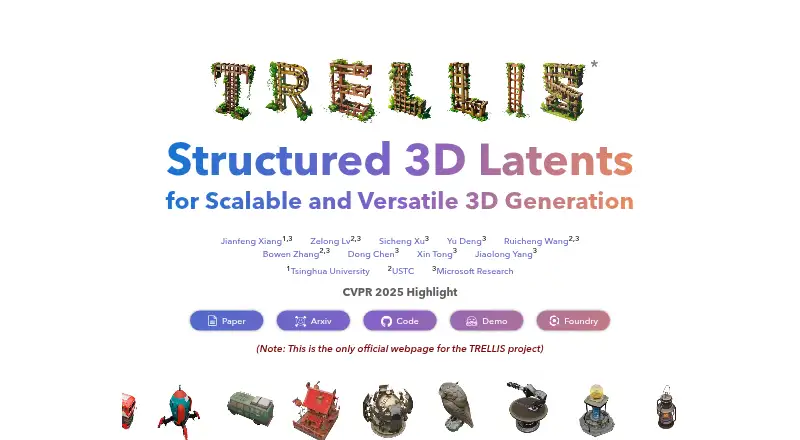
What TRELLIS is
TRELLIS is a free, open-source research model for generating 3D assets from text or image prompts. It can represent an asset as a radiance field, 3D Gaussians, or a mesh through a shared Structured Latent representation. The model can also create asset variants and edit targeted regions in response to text or image prompts. Its pretrained image-to-3D and text-to-3D models range from 342 million to 2 billion parameters, and the project describes training on 500,000 3D objects. Example exports include textured meshes in GLB format and 3D Gaussians in PLY format.
The project includes a Gradio web demo that can be installed and run locally. Running the code requires an NVIDIA GPU with at least 16 GB of memory, CUDA for compiling some submodules, and Python 3.8 or later; Conda is recommended for managing dependencies. Linux is the tested operating system, while Windows setup is described as not fully tested. TRELLIS is strongest at artistic-style assets, with limited ability to generate photorealistic real-world objects. For text prompts, the project recommends first generating an image and then using the image-conditioned model, as text-conditioned results are less creative and detailed.
Who it suits
TRELLIS suits researchers and creators who want to generate or edit 3D assets from text or images and can run the code on a suitable NVIDIA GPU. Its academic and research use focus, artistic-style strengths, and local installation requirements are important considerations for prospective users.
What it does well
- Generates assets from text or image prompts.
- Produces radiance fields, 3D Gaussians, and meshes.
- Supports prompt-based variants and targeted local edits.
- Example exports include GLB meshes and PLY Gaussians.
- Free and open source under MIT for models and most code.
What to know first
- Requires an NVIDIA GPU with at least 16 GB of memory.
- CUDA and Python 3.8 or later are required.
- Windows setup is not fully tested.
- Project materials are not intended for commercial use.
Limits
The project materials are intended for academic and research purposes and are not intended for commercial use. The model has limited ability to generate photorealistic real-world objects, and text-conditioned results are less creative and detailed than image-conditioned results.
Getting started
- Visit the TRELLIS project website.
- Prepare an NVIDIA GPU with at least 16 GB of memory.
- Install Python 3.8 or later and CUDA; Conda is recommended for dependencies.
- Install the project and, if needed, its Gradio demo dependencies.
- Run the local demo and use text or image prompts to generate assets.
Verdict
Choose TRELLIS if you need a research-focused tool for prompt-based 3D generation and have the required GPU and software setup. It is less suited to photorealistic real-world objects, and its project materials are intended for academic and research use rather than commercial use.
Questions
How much does TRELLIS cost?
TRELLIS is free.
Is TRELLIS open source?
The models and most code use the MIT License. Some submodules have separate licenses.
Which platforms does TRELLIS support?
The listed platforms are Linux, self-hosted, web, and Windows. The code is tested on Linux, and Windows setup is described as not fully tested.
What can TRELLIS generate and export?
It generates radiance fields, 3D Gaussians, and meshes. Example exports are textured meshes in GLB and 3D Gaussians in PLY.
What hardware and software does it require?
It requires an NVIDIA GPU with at least 16 GB of memory, CUDA for compiling some submodules, and Python 3.8 or later. Conda is recommended for managing dependencies.
Can I use TRELLIS commercially?
The project page says its materials are for academic and research purposes and are not intended for commercial use.
Facts from TRELLIS's own pages
- Demo
- The repository provides a Gradio web demo that users can run locally after installing its demo dependencies. · github.com, 7 Oct 2026
- Dependencies
- Installation requires CUDA for compiling some submodules and Python 3.8 or higher, with Conda recommended for dependency management. · github.com, 7 Oct 2026
- Editing
- It can generate variants of an asset and manipulate targeted local regions using text or image prompts. · microsoft.github.io, 7 Oct 2026
- Exports
- The usage example exports textured meshes as GLB and 3D Gaussians as PLY files. · github.com, 7 Oct 2026
- Formats
- The example exports textured meshes as GLB files and 3D Gaussian representations as PLY files. · github.com, 7 Oct 2026
- Hardware
- The code requires an NVIDIA GPU with at least 16 GB of memory; the repository says it has been verified on A100 and A6000 GPUs. · github.com, 7 Oct 2026
- Hardware requirement
- The repository says an NVIDIA GPU with at least 16 GB of memory is necessary. · github.com, 7 Oct 2026
- License
- TRELLIS models and most code use the MIT License, while some submodules have separate licenses. · github.com, 7 Oct 2026
- License and use
- The project page says its materials are for academic and research purposes and are not intended for commercial use; the repository says the models and most code use the MIT License, with some submodules under different licenses. · microsoft.github.io, 7 Oct 2026
- Model scale
- The project provides pretrained models with up to 2 billion parameters, trained on a dataset of 500,000 3D assets. · github.com, 7 Oct 2026
- Model sizes
- The project describes models with up to 2 billion parameters trained on a dataset of 500,000 3D objects. · microsoft.github.io, 7 Oct 2026
- Model variants
- The repository lists image-to-3D and text-to-3D pretrained models ranging from 342 million to 2 billion parameters. · github.com, 7 Oct 2026
- Operating system
- The code is tested on Linux, and the repository describes Windows setup as not fully tested. · github.com, 7 Oct 2026
- Operating systems
- The code is tested on Linux; Windows setup is described as not fully tested. · github.com, 7 Oct 2026
- Outputs
- The model can produce Radiance Fields, 3D Gaussians, and meshes. · github.com, 7 Oct 2026
- Purpose
- TRELLIS is a research model that generates 3D assets from text or image prompts. · microsoft.github.io, 7 Oct 2026
- Quality
- The project says its models generate detailed geometry and texture, while noting that photorealistic real-world object generation is limited. · microsoft.github.io, 7 Oct 2026
- Representations
- It can produce radiance fields, 3D Gaussians, and meshes from a shared Structured Latent representation. · microsoft.github.io, 7 Oct 2026
- Research limits
- The project page says the model is strongest at artistic-style assets and has limited ability to generate photorealistic real-world objects. · microsoft.github.io, 7 Oct 2026
- Security reporting
- The project directs vulnerability reports to the Microsoft Security Response Center rather than public GitHub issues. · github.com, 7 Oct 2026
- Support
- The repository uses GitHub Issues for bug reports and feature requests, and says support is limited to the listed resources. · github.com, 7 Oct 2026
- Text-generation caveat
- The repository recommends generating an image first and then using the image-conditioned model because text-conditioned models are less creative and detailed due to data limitations. · github.com, 7 Oct 2026
- Web demo
- The repository provides a Gradio web demo that users can install and run locally. · github.com, 7 Oct 2026
Where TRELLIS stands on Freedom251
- AI 3D Model Generators#23 of 24