Transglot
What Transglot is
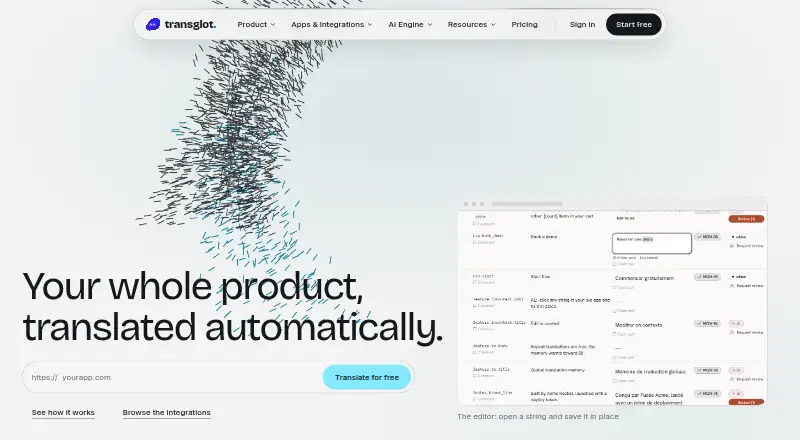
Transglot translates software text into configured languages and checks each translated row for placeholders, plurals, glossary terms, and length. A failing row is repaired once, then refused if it still does not pass. Glossa Flux drafts changed strings across configured languages, while Glossa Deep provides a careful pass for selected strings on eligible plans. Translations can publish to an edge bundle over the air without redeployment or app store review. The integrations page lists 41 connectors, including WordPress, Shopify, GitHub, GitLab, Figma, and Google Drive. Developer tools include a CLI, GitHub Action, REST API, signed webhooks, and MCP server. Transglot states support for 708 ICU-recognized locales, with structural fallback for other tags. The free plan includes 100,000 words to start, then 10,000 per month, one project, 14 target languages, and three seats. Paid plans start at $19/mo, and a 14-day trial is listed. It is aimed at product and engineering teams shipping software or content in multiple languages.
Who it suits
Transglot is for product and engineering teams localizing apps, websites, storefronts, games, or documentation. Its developer tools and connectors support teams integrating translation work into software workflows.
What it does well
- Checks translations for placeholders, plurals, glossary terms, and length.
- Offers 41 listed connectors.
- Includes a CLI, GitHub Action, API, webhooks, and MCP server.
- Free plan starts with 100,000 words.
- 14-day trial listed.
What to know first
- Free plan has one project and three seats.
- Free plan includes 14 target languages.
- Hosted platform is not open source and has no self-host build.
- Live disks are not encrypted at the volume level.
Limits
The free plan includes one project, 14 target languages and three seats, with 100,000 words to start and 10,000 words per month afterward. Starter is $15 per month and includes 300,000 words per month.
Plans
| Plan | Billed and limits | Price |
|---|---|---|
| Free | free forever · 100,000 words to start, then 10,000/month · 1 project · 14 target languages · 3 seats | Free |
| Starter | billed monthly · 300,000 words/month · unlimited target languages · 3 editor seats · unlimited projects | $15 a month |
| Team | billed monthly · 1,000,000 words/month · unlimited target languages · editor seats and projects · Glossa Deep, MQM scorecards and priority queue | $39 a month |
| Business | billed monthly · 4,000,000 words/month · unlimited target languages, editor seats and projects · Glossa Deep · priority queue | $149 a month |
| Starter | billed annually ($150 a year) · 300,000 words/month · unlimited target languages · 3 editor seats · unlimited projects | $150 a year |
| Team | billed annually ($390 a year) · 1,000,000 words/month · unlimited target languages · editor seats and projects · Glossa Deep, MQM scorecards and priority queue | $390 a year |
| Enterprise | Custom · unlimited words/month · SAML, SCIM and audit log · named contact | On request |
As transglot.ai lists them, read 30 Sept 2026. The maker's own page has the final word.
Getting started
- Open the Transglot website.
- Choose the free plan or a paid plan.
- Use the 14-day trial if starting through an eligible trial offer.
- Connect a listed integration or use the CLI, GitHub Action, REST API, signed webhooks or MCP server.
- Configure the target languages for your software text.
Transglot is a localization service that moves software strings through translation, checking, and delivery back to the product. It is aimed at product and engineering teams with multilingual apps, sites, stores, games, or documentation. The strongest case is a development-centered workflow with built-in safeguards; teams needing self-hosting or very high, predictable volume should look elsewhere.
Overview
Transglot combines translation memory, glossary management, context screenshots, and role permissions so teams can reuse approved language and review strings with product context. Its audience is broad, but the workflow is most convincing when localization is part of an active release process rather than an occasional manual job.
The service supports 708 ICU-recognized locales in its current table and uses structural fallback for other tags. That is unusually broad coverage for products with regional variants, although teams should still confirm that fallback behavior suits their language requirements.
Key features
Glossa Flux creates drafts for changed strings across configured languages. On eligible plans, Glossa Deep provides a more careful pass for selected strings. Translation memory and glossaries help preserve established terminology, while screenshots and permissions support review by writers, developers, and other contributors.
Every translated row is checked for placeholders, plurals, glossary terms, and length. Transglot repairs a failed row once and refuses it if the second check still fails. That defined gate can catch common software-localization errors before release, but rejected strings still require human resolution.
Transglot says translations can be published to an edge bundle over the air, avoiding a redeployment or app-store review for those updates. Its integration catalog contains 41 connectors, including WordPress, Shopify, GitHub, GitLab, Figma, and Google Drive. A CLI, GitHub Action, REST API, signed webhooks, and MCP server give engineering teams several automation paths. Game delivery is file-based, so game studios should ensure that fits their build pipeline.
Security protections include TLS 1.2 or better for data in transit and AES-256 encryption for database backups; live disks are not encrypted at the volume level. Transglot says customer content is not used to train AI models and is sent only to listed providers for translation. SOC 2 Type II auditing is in progress, ISO/IEC 42001 is being pursued, and GDPR and CCPA/CPRA alignment is reported without certification. The CLI, MCP server, and framework SDKs are MIT-licensed, but the hosted platform is proprietary and has no self-host build.
Pricing
The Free plan costs nothing, forever. It starts with 100,000 words, then provides 10,000 words per month, one project, 14 target languages, and three seats. It is suitable for a small proof of concept, but the project, language, and recurring word limits make it a poor fit for a growing localization program.
Starter costs $15 a month, billed monthly. It raises usage to 300,000 words per month, removes the project cap, allows unlimited target languages, and includes three editor seats. This is the practical entry point for a small product team; it gives up the higher-tier review and queue features.
Team is $39 a month, billed monthly, with 1,000,000 words per month, unlimited target languages, editor seats, and projects. It adds Glossa Deep, MQM scorecards, and a priority queue, making it the better choice for teams that need deeper review and faster processing.
Business costs $149 a month, billed monthly, and includes 4,000,000 words per month, unlimited target languages, editor seats, and projects, plus Glossa Deep and a priority queue. Enterprise has custom pricing and unlimited words. A 14-day trial is offered; paid plans are monthly, so buyers should budget around the stated quota rather than assume unlimited throughput.
Platforms
Transglot is offered through the web and API. Its developer tooling extends access through the CLI, GitHub Action, REST API, signed webhooks, and MCP server, but the hosted service cannot be deployed as a self-managed installation.
Who it's for
Choose Transglot if your product or engineering team ships multilingual software and wants translation connected to source control, design, content, or release automation. Its locale coverage, quality gates, and over-the-air edge delivery are especially useful for continuously changing products. It is less suitable for buyers who require self-hosting, certified compliance today, or a simple one-off translation tool.
Pros and cons
Pros
- Four automated checks target placeholders, plurals, glossary terms, and length before publication.
- Developer integrations and delivery options can fit localization into existing build workflows.
- 708 ICU locales, translation memory, screenshots, and glossary tools support complex multilingual products.
- A free tier and 14-day trial lower the cost of evaluating the workflow.
Cons
- Free usage falls to 10,000 words per month after its initial allowance and is limited to one project and 14 languages.
- Higher word volumes require monthly upgrades, while Enterprise pricing is custom.
- The hosted platform is not open source and has no self-host build.
- Live disks lack volume-level encryption, and stated SOC 2 and ISO initiatives are not complete certifications.
Alternatives
Crowdin is worth considering if you need broader platform coverage, including Android, iOS, desktop systems, and web, with a free plan.
locize suits smaller projects that can work within a free allowance of 2,000 words, two languages, five namespaces, and one user, with paid access from $7 a month.
OneSky is an alternative for teams interested in AI-driven quality estimation or multi-agent translation.
Tolgee is a fit when self-hosting and a free 30,000-word, three-seat plan matter.
Weblate is suited to buyers wanting self-hosted deployment or Premium Cloud plans priced in euros.
Live Link Face is a free iOS and Android app rather than a comparable localization platform.
ECI Flow is free to qualified game development companies and publishers.
Localazy is appealing if a free plan with 200 source keys, unlimited seats, and unlimited languages matches your scale.
For broader category browsing, see Game Localization Software and Translation Software.
Verdict
Transglot is a strong choice for software teams that want automated translation checks, developer integrations, and fast edge delivery in one workflow. Its main reasons to look elsewhere are the recurring word quotas, proprietary hosted deployment, and security certifications that are still in progress.
Verdict
Transglot combines translation drafting, quality checks, integrations, and developer tools for software localization. Its free plan has limits on words, projects, target languages, and seats; paid plans start at $19/mo.
Questions
Does Transglot have a free plan?
Yes. Free is listed as free forever, with 100,000 words to start and then 10,000 words per month, one project, 14 target languages and three seats.
How much do the paid plans cost?
Starter is $15 per month, Team is $39 per month and Business is $149 per month. Enterprise is listed without a price.
Which platforms does Transglot support?
Transglot lists web and API platforms.
Is Transglot open source?
The CLI, MCP server and framework SDKs are MIT licensed. The hosted platform is not open source and has no self-host build.
Which integrations are available?
The integrations page lists 41 connectors, including WordPress, Shopify, GitHub, GitLab, Figma and Google Drive.
What does the 14-day trial cover?
A 14-day trial is listed. The plan details do not specify which features or plan the trial covers.
Facts from Transglot's own pages
- AI data use
- Transglot says it does not train AI models on customer content and sends strings to listed providers only for translation. · transglot.ai, 30 Sept 2026
- AI translation
- Glossa Flux drafts changed strings across configured languages, while Glossa Deep provides a careful pass for selected strings on eligible plans. · transglot.ai, 30 Sept 2026
- Compliance
- Transglot reports SOC 2 Type II audit in progress, ISO/IEC 42001 pursuing, and GDPR and CCPA/CPRA aligned but not certified. · transglot.ai, 30 Sept 2026
- Delivery
- Transglot says translations can publish to an edge bundle over the air without a redeployment or app store review. · transglot.ai, 30 Sept 2026
- Developer tools
- Transglot offers a CLI, GitHub Action, REST API, signed webhooks, and MCP server. · transglot.ai, 30 Sept 2026
- Free plan
- Yes · transglot.ai, 20 Sept 2026
- Integrations
- The integrations page lists 41 connectors, including WordPress, Shopify, GitHub, GitLab, Figma, and Google Drive. · transglot.ai, 30 Sept 2026
- Open source and hosting
- The CLI, MCP server, and framework SDKs are MIT licensed, but the hosted platform is not open source and has no self-host build. · transglot.ai, 30 Sept 2026
- Product
- Transglot translates software text into configured languages, checks translations against four quality gates, and writes them back to their source. · transglot.ai, 30 Sept 2026
- Quality checks
- Each translated row is checked for placeholders, plurals, glossary terms, and length, then repaired once or refused if it still fails. · transglot.ai, 30 Sept 2026
- Security
- The security page states that data in transit uses TLS 1.2 or better and database backups use AES-256 encryption, while live disks are not encrypted at the volume level. · transglot.ai, 30 Sept 2026
- Paid from
- 19 · transglot.ai, 20 Sept 2026
- Support
- The vulnerability disclosure page says an engineer acknowledges reports within three business days and provides an initial assessment within ten business days. · transglot.ai, 30 Sept 2026
- Supported audience
- Transglot says it is for product and engineering teams shipping apps, websites, storefronts, games, or documentation in multiple languages. · transglot.ai, 30 Sept 2026
- Supported locales
- Transglot states that it supports 708 ICU-recognized locales in its current table, with structural fallback for other tags. · transglot.ai, 30 Sept 2026
- Translation memory
- Yes · transglot.ai, 20 Sept 2026
Where Transglot stands on Freedom251
- Translation apps#27 of 158
- Translation Software#77 of 156
- Game Localization Software#13 of 24