Freedom251 › Service Virtualization Software

Traffic Parrot
What Traffic Parrot is
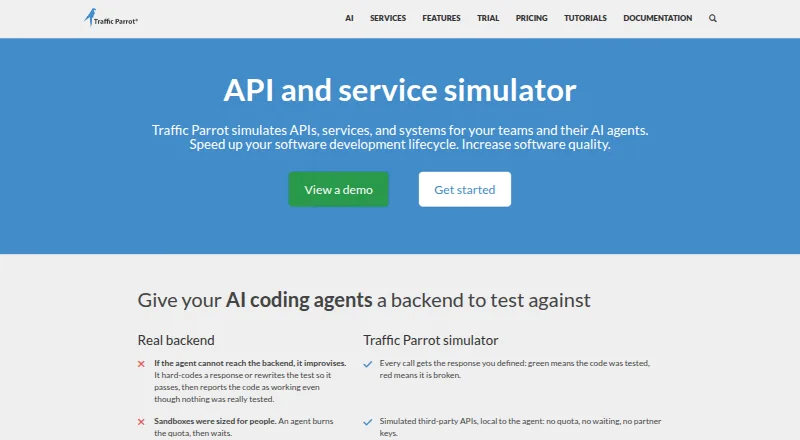
Traffic Parrot simulates APIs, services, and other systems so teams can test applications and microservices separately from the systems they depend on. It records and replays traffic across HTTP(S), gRPC, JMS, IBM MQ, Thrift, and file transfers. Scripting and templates can produce dynamic responses, while stateful simulation, fault injection, and database and messaging virtualization address different testing needs. Teams can automate it through APIs and Maven or Gradle plugins; listed integrations include Selenium, Cucumber, JUnit, JMeter, SoapUI, Jenkins, and GitHub. An MCP server lets AI assistants discover and call its tools, with optional bearer-token authentication. It can run in Docker, Kubernetes, OpenShift, major cloud environments, CI/CD pipelines, laptops, and virtual machines. Traffic Parrot requires Java 17 or later and supports Windows, Linux, macOS, and other systems with a supported Java runtime. Pricing is available on request, and a free 14-day trial requires a request form and business email. The product is based in London and offers email support.
Who it suits
Traffic Parrot suits development and testing teams that need to simulate dependencies and automate tests across APIs and services. It may also suit teams using the listed integrations and deployment environments.
What it does well
- Records and replays six listed traffic types.
- Supports dynamic responses through scripting and templates.
- Offers APIs and Maven and Gradle automation plugins.
- Includes stateful simulation and fault injection.
What to know first
- No shared-environment user management is offered.
- FAST, Kafka, MQTT, and some protocols are beta-only.
- Requires Java 17 or later.
- Trial requests require a business email address.
Limits
The free trial lasts 14 days. Shared-environment user management is not offered, so anyone with the WebUI URL can access it without restrictions. FAST, Kafka, MQTT, CORBA, SAP RFC and several other technologies are available through the beta programme.
Plans
| Plan | Billed and limits | Price |
|---|---|---|
| Traffic Parrot Enterprise | Price depends on floating licence count and selected features, protocols and technologies; quantity discounts apply | On request |
As trafficparrot.com lists them, read 29 Sept 2026. The maker's own page has the final word.
Getting started
- Visit the Traffic Parrot website.
- Request the free 14-day trial using the form and a business email address.
- Choose an environment such as Docker, Kubernetes, a listed cloud, a CI/CD pipeline, a laptop or a VM.
- Use a system with Java 17 or later.
- Contact the maker for Enterprise pricing based on licence count and selected features, protocols and technologies.
Verdict
Traffic Parrot covers a broad range of service simulation and automation needs, with deployment options spanning local machines, cloud, and CI/CD. Teams using a shared WebUI environment should account for the stated access limitation.
Questions
Does Traffic Parrot have a free plan?
No. The maker offers a free 14-day trial.
How do I get the trial?
Request it through a form that requires a business email address.
What does Traffic Parrot cost?
Pricing is on request. Enterprise pricing depends on floating licence count and selected features, protocols and technologies; quantity discounts apply.
Which operating systems are supported?
Traffic Parrot supports Windows, Linux, macOS and other operating systems with a supported Java runtime. It requires Java 17 or later.
Which tools does it integrate with?
The maker lists compatibility with Selenium, Cucumber, JUnit, JMeter, SoapUI, Jenkins, GitHub, Maven and Gradle, among other tools.
How can I contact support?
The maker lists email support at [email protected].
Facts from Traffic Parrot's own pages
- AI integration
- A built-in MCP server lets AI assistants discover and call Traffic Parrot tools, with optional bearer-token authentication. · trafficparrot.com, 29 Sept 2026
- Automation
- Traffic Parrot can be controlled through APIs and provides Maven and Gradle plugins for automated testing. · trafficparrot.com, 29 Sept 2026
- Deployment
- The product can run in Docker, Kubernetes, OpenShift, AWS, Azure, Google Cloud, CI/CD pipelines, laptops and VMs. · trafficparrot.com, 29 Sept 2026
- Dynamic responses
- Users can use scripting and templating to generate dynamic responses. · trafficparrot.com, 29 Sept 2026
- Headquarters
- London, United Kingdom · trafficparrot.com, 28 Sept 2026
- Integrations
- The maker lists compatibility with Selenium, Cucumber, JUnit, JMeter, SoapUI, Jenkins, GitHub, Maven and Gradle, among other tools. · trafficparrot.com, 29 Sept 2026
- Platform requirements
- Traffic Parrot requires Java 17 or above and supports Windows, Linux, macOS and other operating systems with a supported Java runtime. · trafficparrot.com, 29 Sept 2026
- Purpose
- Traffic Parrot simulates APIs, services and systems so teams can test applications and microservices in isolation. · trafficparrot.com, 29 Sept 2026
- Record and replay
- It supports recording and replaying HTTP(S), gRPC, JMS, IBM MQ, Thrift and file transfers. · trafficparrot.com, 29 Sept 2026
- Security limitation
- The tools comparison page says shared-environment user management is not offered, so anyone with the WebUI URL can access it without restrictions. · trafficparrot.com, 29 Sept 2026
- Support
- The maker lists support by email at [email protected]. · trafficparrot.com, 29 Sept 2026
- Supported protocol limits
- FAST, Kafka, MQTT, CORBA, SAP RFC and several other technologies are listed as available through the beta programme. · trafficparrot.com, 29 Sept 2026
- Target users
- The maker describes its customers as including startups and established e-commerce and financial institutions. · trafficparrot.com, 29 Sept 2026
- Trial
- The maker offers a free 14-day trial, requested through a form requiring a business email address. · trafficparrot.com, 29 Sept 2026
Where Traffic Parrot stands on Freedom251
- Service Virtualization Software#19 of 21