Freedom251 › Service Virtualization Software
Servirtium
What Servirtium is
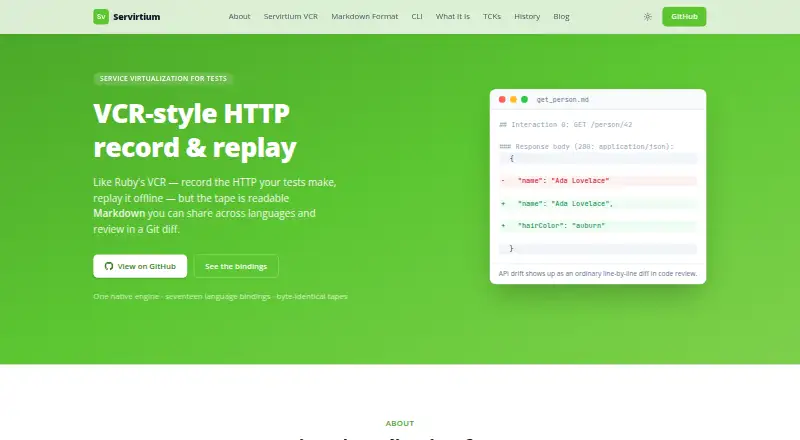
Servirtium is an open-source HTTP record-and-replay tool for test automation. It saves HTTP interactions from tests as Markdown tapes, then replays those saved requests and responses offline so test runs do not need to call the real service. Tapes can include headers and bodies, with XML or JSON payloads displayed in code fences, and their readable format makes them shareable across programming languages and reviewable in Git diffs. Teams can use tape changes to spot API compatibility shifts during code review or CI.
The project uses a native engine with bindings for Go, Python, Java, .NET, Rust, Ruby, JavaScript and TypeScript, Dart, PHP, Haskell, Elixir, Pharo, Nim, Zig, Lua, Erlang, and Gleam. It works with any unit-test or spec framework. A standalone CLI can serve tapes as an HTTP stub, lint them, and import or export HTTP Archive files. Its HAR bridge names Chrome DevTools, Fiddler, Charles, mitmproxy, and Postman. Redaction and tape normalization can help manage transient values such as IDs and timestamps. Playback requires recorded request headers and bodies to match, unless masking or redaction accounts for changing values. Servirtium is available for API, Linux, macOS, and self-hosted use; it is an in-process library and CLI, not a hosted SaaS endpoint.
Who it suits
Servirtium suits teams that test software consuming vendor web APIs and want repeatable offline HTTP interactions. API vendors can also use it to share example scenarios, while teams choosing it should be prepared to use it for test automation rather than production traffic.
What it does well
- Offline playback avoids calls to the real service during tests.
- Markdown tapes can be shared across languages and reviewed in Git diffs.
- Works with any unit-test or spec framework.
- CLI can serve, lint, and transfer HTTP Archive files.
- Redaction and normalization address transient IDs and timestamps.
What to know first
- Playback fails when request headers or bodies differ from recorded values.
- Focused on HTTP and test automation, not production service connections.
Limits
Playback depends on matching recorded request headers and bodies; optional masking or redaction can handle transient values. Servirtium is described as a test-automation tool focused on HTTP, with production deployments connecting to real services.
Getting started
- Visit https://servirtium.dev/.
- Use the native engine through a language binding for your project.
- Add it to a unit-test or spec framework of your choice.
- Record HTTP interactions into Markdown tapes.
- Use the CLI to serve, lint, or import and export tapes.
Verdict
Choose Servirtium if you need open-source HTTP recordings that can be replayed offline in tests and reviewed as Markdown. Look elsewhere if you need a hosted endpoint or a tool intended to connect production deployments to virtualized services.
Questions
How much does Servirtium cost?
It is free and open source.
Which programming languages have bindings?
The project lists Go, Python, Java, .NET, Rust, Ruby, JavaScript and TypeScript, Dart, PHP, Haskell, Elixir, Pharo, Nim, Zig, Lua, Erlang, and Gleam.
Which test frameworks does it support?
It is described as agnostic about test runners and usable with any unit-test or spec framework.
Can Servirtium work offline?
Yes. It replays saved Markdown recordings without calling the real service.
What can the CLI do?
It can serve tapes as a live HTTP stub, lint tapes, and import or export HTTP Archive files.
Is it a hosted service?
No. Servirtium is described as an in-process testing library with file-based tapes and a standalone CLI.
Facts from Servirtium's own pages
- Audience
- The site describes it for teams consuming vendor web APIs and vendors shipping example usages. · servirtium.dev, 8 Oct 2026
- CI and API drift
- The site describes using tape changes and Git diffs to identify API compatibility changes in CI or code review. · servirtium.dev, 8 Oct 2026
- CLI
- A standalone CLI can serve tapes as a live HTTP stub, lint tapes, and import or export HTTP Archive files. · servirtium.dev, 8 Oct 2026
- Deployment model
- The project describes Servirtium as an in-process testing library with file-based tapes and a standalone CLI, rather than a hosted SaaS endpoint. · github.com, 8 Oct 2026
- Engine and bindings
- The current project describes one native engine with language bindings, including Go, Python, Java, .NET, Rust, Ruby, JavaScript and TypeScript, Dart, PHP, Haskell, Elixir, Pharo, Nim, Zig, Lua, Erlang and Gleam. · servirtium.dev, 8 Oct 2026
- HAR integrations
- The CLI imports and exports HTTP Archive files and names Chrome DevTools, Fiddler, Charles, mitmproxy, and Postman as sources or tools. · servirtium.dev, 8 Oct 2026
- Integrations
- The HAR bridge names Chrome DevTools, Fiddler, Charles, mitmproxy and Postman as sources of captures it can convert. · servirtium.dev, 8 Oct 2026
- Notable limit
- The site says Servirtium is focused on HTTP and is used for test automation, with production deployments connecting to real services. · servirtium.dev, 8 Oct 2026
- Offline playback
- Playback uses saved Markdown recordings, so tests can run without calling the real service. · servirtium.dev, 8 Oct 2026
- Playback matching
- Playback fails when request headers or bodies differ from the recording, and the site describes optional masking and redaction for transient data. · servirtium.dev, 8 Oct 2026
- Pricing and support
- The opened maker pages provide no product pricing, trial terms or support offer. · servirtium.dev, 8 Oct 2026
- Production use
- The site describes Servirtium as exclusively for test automation and says production deployments connect to the real services. · servirtium.dev, 8 Oct 2026
- Purpose
- Servirtium records HTTP conversations from tests and replays them offline without calling the real service. · servirtium.dev, 8 Oct 2026
- Redaction
- The shared engine includes redaction and whole-tape normalization features for handling values such as transient IDs and timestamps. · servirtium.dev, 8 Oct 2026
- Release history
- The site says the Servirtium beta, with Markdown record/playback syntax, a Java library, and examples, was released in autumn 2019. · servirtium.dev, 8 Oct 2026
- Request matching
- Playback fails when the request headers or body differ from the recorded interaction; the site recommends deliberate masking or redaction for transient values. · servirtium.dev, 8 Oct 2026
- Security and compliance
- The opened product pages describe redaction features but make no security certification or compliance claims. · servirtium.dev, 8 Oct 2026
- Shared engine
- The current VCR project uses one native record/replay engine with language bindings, and the site lists seventeen bindings. · servirtium.dev, 8 Oct 2026
- Tape contents
- A Markdown tape can capture HTTP requests, responses, headers, and bodies, with XML or JSON payloads shown in code fences. · servirtium.dev, 8 Oct 2026
- Tape format
- Recordings use human-readable Markdown that teams can share across languages and review in Git diffs. · servirtium.dev, 8 Oct 2026
- Test frameworks
- The site says Servirtium is agnostic about test-runner choice and can be used with any unit-test or spec framework. · servirtium.dev, 8 Oct 2026
- Test runners
- Servirtium is described as agnostic about test-runner choices and usable with any unit test or spec framework. · servirtium.dev, 8 Oct 2026
- Use cases
- The site identifies teams consuming vendor web APIs and API vendors sharing example scenarios as intended users. · servirtium.dev, 8 Oct 2026
Where Servirtium stands on Freedom251
- Service Virtualization Software#20 of 21