Freedom251 › Distributed Tracing Tools
Tracekit
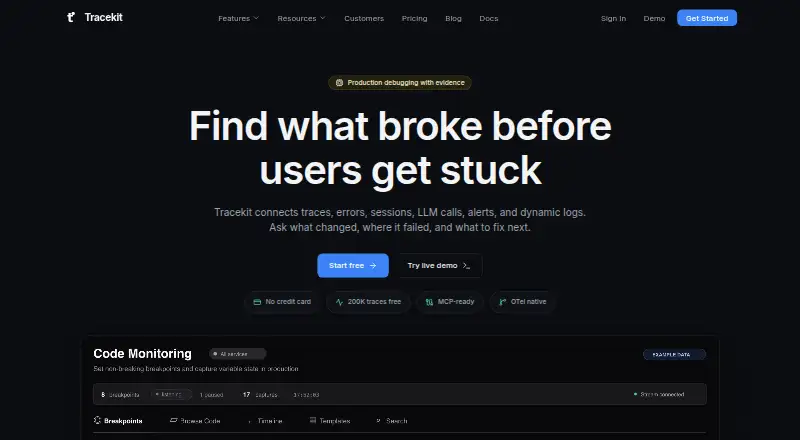
What Tracekit is
Tracekit is cloud software for developers investigating production issues across services. It brings analytics, OpenTelemetry-native distributed tracing, session replay, LLM calls, alerts, GitHub pull requests, MCP, and dynamic logs together. Tracing follows requests from browser to database. Dynamic logs capture variable state and stack traces from live production traffic without a redeployment. For LLM observability, calls appear as spans in distributed traces, with latency, token usage, costs, and prompt quality tracked. Named providers include OpenAI, Anthropic, and Cohere; OpenAI and Anthropic clients are automatically instrumented.
Tracekit accepts standard OTLP over HTTP. Existing OpenTelemetry users can configure an exporter without an SDK for tracing and metrics. Listed SDKs include Go, Node.js, Python, PHP, Java, Ruby, .NET, and browser and framework options such as React, Vue, Angular, Next.js, and Nuxt. Its MCP server offers 11 read-only tools for querying traces, service health, alerts, anomalies, dynamic log captures, LLM calls, and root cause analysis; access uses OAuth 2.1 with PKCE. Plans range from a free developer sandbox to paid options from $24/month. The listed deployment model is cloud, with API and web platforms.
Who it suits
Tracekit suits developers who need to follow production requests across services and investigate issues involving logs, alerts, or LLM calls. Its plan descriptions also identify solo developers and side projects, small teams, and growing startups with multiple services as audiences for paid tiers.
What it does well
- Follows request lifecycles from browser to database.
- Captures live production state without redeploying.
- Tracks LLM latency, token usage, costs, and prompt quality.
- Accepts standard OTLP over HTTP.
- MCP tools are read-only and use OAuth 2.1 with PKCE.
- Lists SDKs for backend languages and web frameworks.
What to know first
- Free plan is limited to 200K traces per month.
- Free plan retains data for seven days.
- Free plan allows one team member.
- Trace retention differs across plan and privacy-policy descriptions.
Limits
The Free plan includes 200K traces per month, seven-day retention, one team member, 100 AI credits per month, three alert rules, and two dashboards. The pricing page lists plan retention from seven to 60 days, while the privacy policy describes a seven-to-90-day range.
Plans
| Plan | Billed and limits | Price |
|---|---|---|
| Free | $0/forever · 200K traces/month · 7-day data retention · 1 team member · 100 AI credits/month · 3 alert rules · 2 dashboards · Community support | Free |
| Starter | $24/month; $290/year · 1M traces/month · 30-day data retention · 3 team members · 1,000 AI credits/month · 10 alert rules · 5 dashboards · Email support (6hr) | $24 a month |
| Pro | $249/month; $2,990/year · 50M traces/month · 60-day data retention · 25 team members · 15,000 AI credits/month · Unlimited alerts + dashboards · 20 webhook endpoints · Priority support (1hr) | $249 a month |
| Growth | $82/month; $990/year · 10M traces/month · 45-day data retention · 10 team members · 4,000 AI credits/month · Unlimited alert rules · 10 dashboards · 5 webhook endpoints · Priority support (3hr) | $82 a month |
As tracekit.dev lists them, read 30 Sept 2026. The maker's own page has the final word.
Getting started
- Open https://tracekit.dev/.
- Choose the Free plan or a paid plan, starting at $24/month.
- Connect using standard OTLP over HTTP or configure an exporter if you already use OpenTelemetry.
- Alternatively, use one of the listed backend, browser, or framework SDKs.
- Use the web or API platform to access Tracekit.
Verdict
Choose Tracekit if you want OpenTelemetry-based tracing alongside dynamic logs and LLM observability, with plans for individuals through growing teams. The free tier is constrained to 200K monthly traces, one team member, and seven-day retention; paid plans start at $24/month.
Questions
Is there a free plan?
Yes. Free includes 200K traces per month and seven-day data retention.
How much do paid plans cost?
Starter is $24/month, Growth is $82/month, and Pro is $249/month.
Which platforms does Tracekit support?
The listed platforms are API and web.
Does Tracekit support OpenTelemetry?
Yes. It accepts standard OTLP over HTTP, and existing OpenTelemetry users can configure an exporter without an SDK for tracing and metrics.
Which LLM providers are named?
The LLM observability page names OpenAI, Anthropic, and Cohere. OpenAI and Anthropic clients are automatically instrumented.
What integrations are listed for alerting?
Alerting supports Slack, Discord, Teams, PagerDuty, and OpsGenie.
Facts from Tracekit's own pages
- AI assistant access
- The MCP server exposes 11 read-only tools for querying traces, service health, alerts, anomalies, dynamic log captures, LLM calls, and root cause analysis. · tracekit.dev, 30 Sept 2026
- Audience
- Tracekit describes Free as a developer sandbox, Starter as suited to solo developers and side projects, Growth for small teams, and Pro for growing startups with multiple services. · tracekit.dev, 30 Sept 2026
- Compliance
- Tracekit’s privacy policy says it complies with GDPR and CCPA, and lists SOC 2 Type II standards and PCI DSS via Stripe. · tracekit.dev, 30 Sept 2026
- Data retention
- The pricing page lists plan retention periods of 7, 30, 45, and 60 days, while the privacy policy says trace data retention follows the plan and ranges from 7 to 90 days. · tracekit.dev, 30 Sept 2026
- Dynamic logs
- Dynamic logs capture variable state and stack traces from live production traffic without redeploying. · tracekit.dev, 30 Sept 2026
- Founded
- 2025 · tracekit.dev, 28 Sept 2026
- Ingestion
- Tracekit accepts standard OTLP over HTTP, and existing OpenTelemetry users can configure an exporter without using an SDK for tracing and metrics. · tracekit.dev, 30 Sept 2026
- Integrations
- Alerting supports Slack, Discord, Teams, PagerDuty, and OpsGenie; the Growth plan lists all integrations, including OpsGenie, Teams, and PagerDuty. · tracekit.dev, 30 Sept 2026
- LLM observability
- Tracekit tracks LLM latency, token usage, costs, and prompt quality, with calls represented as spans in distributed traces. · tracekit.dev, 30 Sept 2026
- LLM providers
- The LLM observability page names OpenAI, Anthropic, and Cohere among supported providers, and says OpenAI and Anthropic clients are automatically instrumented. · tracekit.dev, 30 Sept 2026
- MCP security
- The MCP documentation says authentication uses OAuth 2.1 with PKCE and that the read-only tools do not modify, delete, or send data to third parties. · tracekit.dev, 30 Sept 2026
- Privacy and security
- Tracekit’s privacy policy states that it uses TLS 1.3 in transit, AES-256 at rest, role-based access controls, 24/7 security monitoring, and quarterly security assessments. · tracekit.dev, 30 Sept 2026
- Product
- Tracekit connects analytics, traces, session replay, LLM calls, alerts, GitHub pull requests, MCP, and dynamic logs to help developers investigate production issues. · tracekit.dev, 30 Sept 2026
- SDKs
- Tracekit lists backend SDKs for Go, Node.js, Python, PHP, Java, Ruby, and .NET, plus browser and framework SDKs including React, Vue, Angular, Next.js, and Nuxt. · tracekit.dev, 30 Sept 2026
- Support
- Support ranges from community support on Free to email support with a 6-hour response time on Starter and priority support with stated 3-hour or 1-hour response times on Growth and Pro. · tracekit.dev, 30 Sept 2026
- Tracing
- Tracekit provides OpenTelemetry-native distributed tracing across services, following request lifecycles from browser to database. · tracekit.dev, 30 Sept 2026
Where Tracekit stands on Freedom251
- Distributed Tracing Tools#23 of 32