Freedom251 › Security Orchestration, Automation, and Response Software
Tracecat
What Tracecat is
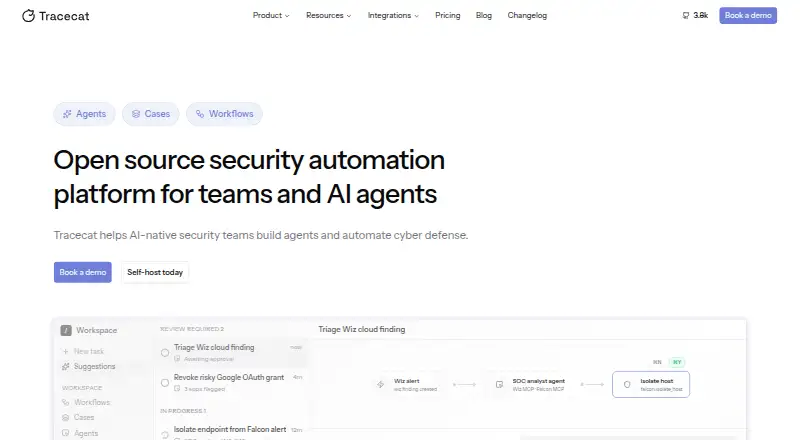
Tracecat is an open-source security automation platform for teams building cyber defense with AI agents. Its product combines workflows, cases, tables, integrations, agent presets, skills, and a hosted MCP server catalog. Workflows support loops, conditional steps, parallel subflows, and Python, Bash, or Ansible scripts. Tracecat advertises 500+ integrations across SIEM, EDR, MDM, identity, and other areas; the hosted catalog lists 56 servers, including Elastic, Splunk, CrowdStrike Falcon, Wiz, Okta, Slack, Jira, GitHub, and AWS. Teams can use managed cloud or self-host the product; Open Source can be deployed with Docker or AWS Fargate. The Open Source plan is free, billed Free forever, and includes unlimited workflows, cases, and agents. It also includes case management with comments, attachments, and custom fields. Enterprise has custom pricing and adds human-in-the-loop tool approvals, advanced case capabilities, and 24/7 Slack and email support. The company is based in New York City and was founded in 2024.
Who it suits
Tracecat suits AI-native security teams automating focused Tier 1 and Tier 2 work, including phishing, suspicious OAuth grants, EDR malware alerts, and cloud findings. It offers both managed cloud and self-hosted deployment.
What it does well
- Free Open Source plan includes unlimited workflows, cases, and agents.
- Workflow steps support Python, Bash, and Ansible scripts.
- Advertises 500+ integrations across security and identity categories.
- Open Source includes case management, comments, attachments, and custom fields.
What to know first
- Open Source excludes human-in-the-loop tool approvals.
- Advanced case features are reserved for Enterprise.
- Enterprise pricing is custom and not listed.
Limits
Open Source monthly executions are self-managed. It excludes tool approvals and the agent inbox, advanced case features, multi-tenant workspaces, Git sync, custom roles and SCIM, and enterprise support.
Plans
| Plan | Billed and limits | Price |
|---|---|---|
| Open Source | Free forever · Unlimited workflows, cases, and agents · Self-hosted · Monthly executions self-managed · Tool approvals and agent inbox, advanced cases, multi-tenant workspaces, Git sync, custom roles and SCIM, and enterprise support excluded | Free |
| Enterprise | Custom · Unlimited workflows, cases, and agents · Cloud (US / EU) or self-hosted · Monthly executions custom pricing · 24/7 Slack and email support · Custom SLAs | On request |
As tracecat.com lists them, read 30 Sept 2026. The maker's own page has the final word.
Getting started
- Open the Tracecat website.
- Choose managed cloud or self-hosted deployment.
- For Open Source self-hosting, deploy with Docker or AWS Fargate.
- Use the free forever Open Source plan, or contact Tracecat about Enterprise custom pricing.
Tracecat is a security automation platform for teams building AI-assisted cyber defense. It is best suited to AI-native security teams automating focused Tier 1 and Tier 2 work. Its free self-hosted edition is substantial, but approvals and advanced casework sit behind Enterprise.
Overview
Tracecat brings security workflows, case management, and agentic AI together with tables, agent presets, skills, integrations, and a hosted MCP server catalog. Workflow logic includes loops, conditional branches, parallel subflows, and Python, Bash, and Ansible scripts. That flexibility suits teams with the engineering capacity to build and maintain their own playbooks; it is less compelling for buyers seeking a turnkey tool.
Teams can use managed cloud or self-host Tracecat. Open Source supports Docker and AWS Fargate, while Enterprise also offers a Kubernetes Helm chart. The homepage states SOC 2 Type II and describes the product as air-gappable, relevant to organizations with stringent security and deployment requirements.
Key features
- Workflow automation: Loops, conditions, parallel subflows, and scripting support playbook automation and alert enrichment. These tools can accommodate varied response processes, but their value depends on a team's ability to design and operate workflows.
- Integrations and threat intelligence: Tracecat advertises 500+ integrations spanning SIEM, EDR, MDM, identity providers, and other categories, and supports threat-intelligence actions. Its hosted MCP catalog lists 56 servers, including Elastic, Splunk, CrowdStrike Falcon, Wiz, Okta, Slack, Jira, GitHub, and AWS. The broad advertised coverage is useful when connecting diverse security tools; the published integration count and catalog count describe different offerings.
- Agents and approvals: Agentic AI, presets, and skills support teams building agent-based security work. Human approval of agent tools is an Enterprise feature, with a unified inbox; Open Source excludes tool approvals and the agent inbox. That makes the free edition less suitable when teams need a formal human checkpoint before agent actions.
- Case management: Open Source includes cases, comments, attachments, and custom fields. Enterprise adds case tasks, metrics, triggers, correlation, and other advanced features, so teams with basic case needs can start free, while those needing richer investigation workflows must budget for a custom-priced plan.
- Security and support: Open Source includes SSO and organization audit logs. Enterprise adds platform audit logs, custom roles, service accounts, and SCIM, as well as 24/7 Slack and email support and custom SLAs. Community support through Discord and GitHub issues is the trade-off for free users.
Pricing
| Plan | Price | What it includes |
|---|---|---|
| Open Source | free; billed Free forever | Unlimited workflows, cases, and agents; self-hosted deployment; monthly executions are self-managed; Discord community and GitHub issues. |
| Enterprise | Custom pricing | Unlimited workflows, cases, and agents; cloud in the US or EU, or self-hosted deployment; custom monthly executions; 24/7 Slack and email support; custom SLAs. |
Open Source is a strong starting point for teams comfortable operating a self-hosted system and managing their own execution volume. It excludes tool approvals and the agent inbox, advanced case features, multi-tenant workspaces, Git sync, custom roles and SCIM, and enterprise support. Enterprise preserves unlimited workflows, cases, and agents but leaves price and execution allowance to a custom agreement, so buyers should weigh those terms against their support and governance needs.
Platforms
Tracecat supports web, API, and self-hosted use. Open Source deploys with Docker or AWS Fargate; Enterprise also lists a Kubernetes Helm chart, while managed cloud is available in the US or EU on Enterprise.
Who it's for
Tracecat targets AI-native security teams, especially those automating focused Tier 1 and Tier 2 workflows such as phishing, suspicious OAuth grants, EDR malware alerts, and cloud findings. It is a good fit when a team wants to combine automation, cases, and agent tools and can manage its own deployment. Teams that require tool approvals, advanced case capabilities, or enterprise support should look to Enterprise; organizations wanting a ready-made product rather than configurable workflows may prefer another approach.
Pros and cons
- Pro: The free plan has unlimited workflows, cases, and agents, making it possible to build substantial self-hosted automation without a per-workflow cap.
- Pro: Workflow branching, parallel subflows, and Python, Bash, and Ansible scripts support tailored security playbooks.
- Pro: Cases, agent features, and a broad advertised integration range sit in one platform, reducing the need to separate those functions across tools.
- Con: Open Source excludes human approvals for agent tools, limiting its fit for teams that require review before agent actions.
- Con: Advanced casework, multi-tenant workspaces, Git sync, custom roles, SCIM, and enterprise support require Enterprise, whose price is custom.
- Con: Open Source execution volume is self-managed, and community support is not a substitute for Enterprise's 24/7 support and custom SLAs.
Alternatives
For a free, self-hosted option with no feature gates or per-action billing, consider OpenSOAR. If you want a web-based security analytics service with a free tier capped at 20 daily credits, seven-day log retention, and up to three users, Sumo Logic is another option. Tines may suit teams looking for a web-based workflow service whose free edition allows three live workflows.
For a free product available across API, self-hosted, and web platforms, compare Wildbox. Buyers considering a paid API and web option can also review Palo Alto Networks Cortex Cloud API Security. Cyware Security Orchestration and Automation uses custom quotes based on deployment and selected capacity or add-ons; Defensys SOAR Platform is another paid option with pricing not stated. Shuffle offers a free starting point and a Starter plan at $29 a month.
Browse more options in SOAR Software and Runbook Automation Software.
Verdict
Tracecat is a strong choice for technically equipped, AI-native security teams that want broad workflow control, case management, and agent capabilities with a free self-hosted entry point. Its main reason to choose it is the breadth of the Open Source plan; its main reason to look elsewhere is the Enterprise boundary around approvals, advanced casework, governance, and support.
Verdict
Tracecat brings workflow automation, case management, and AI-agent tools into one security platform, with a free self-hosted option. Teams needing tool approvals or advanced case features should note that these require Enterprise.
Questions
Is Tracecat free?
Yes. Open Source costs nothing and is billed Free forever, with unlimited workflows, cases, and agents.
What does Enterprise cost?
Enterprise is billed at a custom price; no amount is listed.
Which deployment options are available?
Tracecat offers managed cloud and self-hosting. Open Source can be deployed using Docker or AWS Fargate; Enterprise also lists a Kubernetes Helm chart.
Is Tracecat open source?
Yes. The Open Source plan includes workflows, cases, tables, integrations, agent presets, skills, and a hosted MCP server catalog.
What is excluded from Open Source?
It excludes human-in-the-loop tool approvals, the agent inbox, advanced case features, multi-tenant workspaces, Git sync, custom roles and SCIM, and enterprise support.
What support comes with each plan?
Open Source includes Discord community support and GitHub issues. Enterprise includes 24/7 Slack and email support plus custom SLAs.
Facts from Tracecat's own pages
- Agent approvals
- Enterprise includes tool approvals with a unified inbox, while the pricing comparison marks human-in-the-loop tool approvals as unavailable on Open Source. · tracecat.com, 30 Sept 2026
- Cases
- Open Source includes case management, comments, attachments, and custom fields, while Enterprise adds case tasks, metrics, triggers, correlation, and other advanced case features. · tracecat.com, 30 Sept 2026
- Company location and founding
- Y Combinator lists Tracecat as founded in 2024 and located in New York City, NY. · ycombinator.com, 30 Sept 2026
- Compliance
- Tracecat’s homepage states SOC 2 Type II and describes the product as air-gappable. · tracecat.com, 30 Sept 2026
- Deployment
- Tracecat offers managed cloud and self-hosted deployment, with Open Source deployable using Docker or AWS Fargate and Enterprise also listing a Kubernetes Helm chart. · tracecat.com, 30 Sept 2026
- Founded
- 2024 · tracecat.com, 28 Sept 2026
- Headquarters
- New York City, New York, United States · tracecat.com, 28 Sept 2026
- Hosted MCP catalog
- The MCP catalog page lists 56 hosted servers, including Elastic, Splunk, CrowdStrike Falcon, Wiz, Okta, Slack, Jira, GitHub, and AWS. · tracecat.com, 30 Sept 2026
- Integrations
- Tracecat advertises 500+ integrations across SIEM, EDR, MDM, identity providers, and other categories. · tracecat.com, 30 Sept 2026
- Product scope
- The open source product includes agentic AI, workflows, cases, tables, integrations, agent presets, skills, and a hosted MCP server catalog. · tracecat.com, 30 Sept 2026
- Purpose
- Tracecat is an open source security automation platform for teams and AI agents that helps AI-native security teams build agents and automate cyber defense. · tracecat.com, 30 Sept 2026
- Security
- The pricing page lists SSO and organization audit logs for Open Source, and platform audit logs, custom roles, service accounts, and SCIM for Enterprise. · tracecat.com, 30 Sept 2026
- Support
- Open Source includes Discord community and GitHub issues; Enterprise includes 24/7 Slack and email support and custom SLAs. · tracecat.com, 30 Sept 2026
- Who it is for
- Tracecat describes its target users as AI-native security teams and says the platform supports focused Tier 1 and Tier 2 workflows such as phishing, suspicious OAuth grants, EDR malware alerts, and cloud findings. · tracecat.com, 30 Sept 2026
- Workflow tools
- Workflows support loops, if-conditions, parallel subflows, and Python, Bash, and Ansible scripts. · tracecat.com, 30 Sept 2026