Freedom251 › Digital Forensics Software
Timesketch
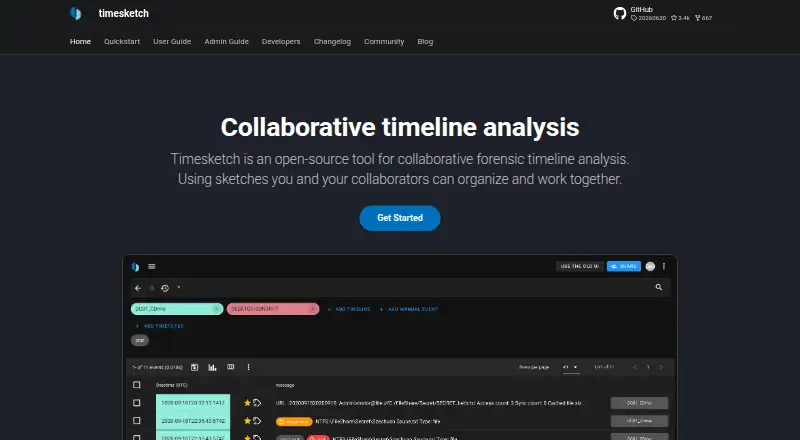
What Timesketch is
Timesketch is a free, open-source tool for collaborative forensic timeline analysis. A case is represented as a sketch, where teams can organize timelines, comments, saved views, and stories. Users can search and filter timeline data, explore it in charts, and preserve discoveries as views. Sketches can be private or shared with individuals, groups, or all system users. Data can be imported from Plaso storage files and CSV or JSON files; Python analyzers run in background workers to enrich timelines by tagging events or creating views. The web interface is accompanied by a REST API and command-line client for searching, filtering, uploading timelines, and running analyzers. Docker is the only installation approach described as tested and actively maintained, and the guide calls for Ubuntu 22.04 and at least 8 GB of RAM. Index size depends on available disk space, and searches across a sketch can fail when a timeline exceeds 150 indices. Optional TLS setup is documented for the web server.
Who it suits
Timesketch suits forensic teams that need to organize and collaboratively examine timeline data in a self-hosted tool. It assumes users can provide the documented Ubuntu environment and at least 8 GB of RAM.
What it does well
- Free and open source
- Supports case collaboration and private sketches
- Imports Plaso, CSV, and JSON data
- Offers a web interface, REST API, and CLI
- Python analyzers can tag events
What to know first
- Docker is the only tested, maintained installation method
- Installation guide calls for Ubuntu 22.04 and 8 GB RAM
- Searches can fail above 150 indices in a timeline
- Index size depends on available disk space
Limits
The free plan is self-hosted. Index size is bounded by physical disk space, and searches across a sketch can fail when a timeline has more than 150 indices.
Plans
| Plan | Billed and limits | Price |
|---|---|---|
| Timesketch | Open-source tool · self-hosted installation | Free |
As timesketch.org lists them, read 9 Oct 2026. The maker's own page has the final word.
Getting started
- Open the Timesketch website.
- Prepare an Ubuntu 22.04 system with at least 8 GB of RAM.
- Install with Docker, the preferred and actively maintained method.
- Import Plaso storage files or CSV or JSON data.
- Create a sketch and organize timelines, views, comments, and stories.
- Invite users or groups, or keep the sketch private.
Verdict
Timesketch brings search, chart exploration, saved findings, and shared case work into a free, self-hosted tool. Plan for its stated deployment requirements and the documented search limitation on large timelines.
Questions
How much does Timesketch cost?
The listed Timesketch plan costs nothing. It is an open-source tool for self-hosted installation.
Is there a free plan or trial?
The plan is free, and a free plan is listed. No free trial is listed.
Which platforms does Timesketch support?
The listed platforms are API, Linux, self-hosted, and web. The installation guide calls for Ubuntu 22.04, and Docker is the only tested and actively maintained installation method.
What files can I import and export?
The quickstart describes Plaso storage files and CSV and JSON imports. Listed evidence sources also include JSONL, Pandas DataFrame, Python dict, XLS, and XLSX; export formats are CSV, JSONL, ZIP, and Markdown.
Is Timesketch open source, and who owns it?
Yes. The site says it is not an official Google product, though the code is owned by Google.
What integrations are documented?
Analyzer integrations include Sigma, Google Safe Browsing, BigQuery, Yeti, and HashR. Sigma support is described as alpha functionality with known performance and functionality issues.
Facts from Timesketch's own pages
- Analyzers
- Python analyzers run in background workers to enrich timeline data and can tag events or create saved views. · timesketch.org, 9 Oct 2026
- API and CLI
- Timesketch provides a web interface and REST API, plus a command-line client for searching, filtering, uploading timelines, and running analyzers. · timesketch.org, 9 Oct 2026
- Cases
- A sketch usually represents one case and can organize multiple timelines, views, comments, and stories. · timesketch.org, 9 Oct 2026
- Collaboration
- Sketches can be shared with individual users, groups, all system users, or kept private. · timesketch.org, 9 Oct 2026
- Data import
- The quickstart says Timesketch supports Plaso storage files and CSV and JSON formatted files. · timesketch.org, 9 Oct 2026
- Deployment
- The preferred installation method is Docker, and the documentation says it is the only tested and actively maintained installation method. · timesketch.org, 9 Oct 2026
- Google status
- The site says Timesketch is not an official Google product, though the code is owned by Google. · timesketch.org, 9 Oct 2026
- Integrations
- Documented analyzer integrations include Sigma, Google Safe Browsing, BigQuery, Yeti, and HashR. · timesketch.org, 9 Oct 2026
- Purpose
- Timesketch is an open-source tool for collaborative forensic timeline analysis. · timesketch.org, 9 Oct 2026
- Search and exploration
- Users can search timelines, apply filters, view timeline data in charts, and save discoveries as views. · timesketch.org, 9 Oct 2026
- Security
- The installation guide documents optional TLS setup for the web server. · timesketch.org, 9 Oct 2026
- Sigma limitation
- The Sigma documentation describes Timesketch support as alpha functionality with known performance and functionality issues. · timesketch.org, 9 Oct 2026
- Storage limit
- The documentation says index size is limited by physical disk space and warns that searches across a sketch can fail when a timeline has more than 150 indices. · timesketch.org, 9 Oct 2026
- Support
- The project lists user and developer mailing lists and a Timesketch Slack community as resources. · timesketch.org, 9 Oct 2026
- System requirements
- The installation guide calls for Ubuntu 22.04 and at least 8 GB of RAM. · timesketch.org, 9 Oct 2026
Where Timesketch stands on Freedom251
- Digital Forensics Software#12 of 30