Freedom251 › Personal Email Services

Thelemail
by Thelemail
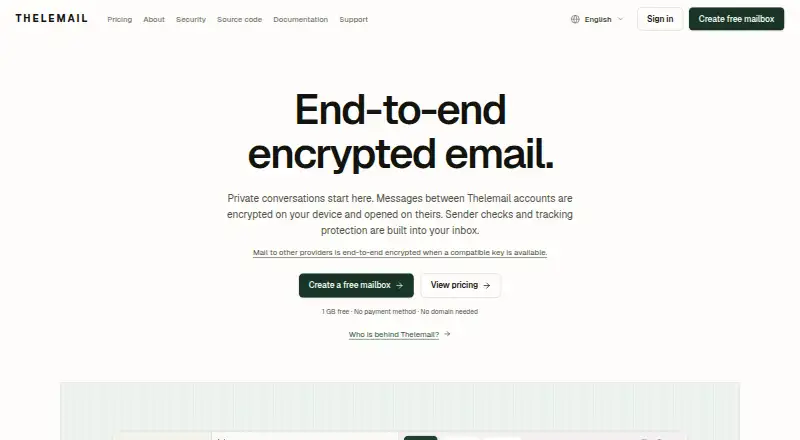
What Thelemail is
Thelemail hosts private email for individuals, families and small teams, including people using their own domains. Messages exchanged between Thelemail accounts are encrypted on the sender’s device and decrypted by the recipient’s device. Mailbox contents are stored as ciphertext protected by an account key held by the user, not the server. For mail sent outside the service, it uses WKD/OpenPGP if the recipient has published a compatible key; otherwise it uses standard SMTP with TLS where supported. Custom-domain setup checks ownership and prepares SPF, DKIM and DMARC before incoming mail moves. Core processing and encrypted storage are hosted in the EU. Thelemail includes TOTP and WebAuthn two-factor authentication. Its browser and macOS clients, key transparency log and local export tool are published under AGPL-3.0; the export tool decrypts messages on the user’s computer into MBOX files. Android, iOS, macOS and web are listed platforms. A free plan is available; paid plans start at €2/user/mo (annual).
Who it suits
Thelemail suits households, homelabbers, technical domain administrators and founder-run small teams seeking hosted email, including those with custom domains. Its plans include options for individual mailboxes and family or team use.
What it does well
- Mail between accounts is encrypted on users’ devices.
- Mailbox storage is encrypted with a key the server lacks.
- Custom-domain setup prepares SPF, DKIM and DMARC.
- TOTP and WebAuthn two-factor authentication are included.
- Local export tool writes decrypted mail to MBOX files.
What to know first
- Standard IMAP/SMTP access is not currently available.
- There is no local bridge for other mail clients.
- No independent security audit or formal certification is complete.
Limits
The free individual plan includes one mailbox and 1 GB, with no custom domains, aliases or shared addresses. The Free Family plan allows up to six mailboxes with 1 GB each and one shared @thelemail.com alias.
Plans
| Plan | Billed and limits | Price |
|---|---|---|
| Free | forever · 1 mailbox · 1 GB storage · no custom domains · no aliases/shared addresses | Free |
| Free Family | forever · up to 6 mailboxes · 1 GB each · 1 shared @thelemail.com alias · no payment method | Free |
| Personal | €24 billed once a year · 1 mailbox · 15 GB storage · 1 custom domain · unlimited aliases | €2 a month |
| Personal Plus | €48 billed once a year · 1 mailbox · 50 GB storage · 3 custom domains · unlimited aliases | €4 a month |
| Team | €54 a mailbox, billed once a year · from 3 mailboxes · 25 GB per mailbox · up to 5 custom domains · unlimited aliases · roles and org settings · 90-day audit logs · priority support | €4.50 a month |
| Family | €60 billed once a year · up to 6 mailboxes · 10 GB per mailbox · 2 custom domains · unlimited aliases | €5 a month |
| Business | €84 a mailbox, billed once a year · from 3 mailboxes · 100 GB per mailbox · up to 10 custom domains · unlimited aliases · roles and org settings · 1-year audit logs · same-business-day priority support | €7 a month |
| Family Plus | €96 billed once a year · up to 6 mailboxes · 30 GB per mailbox · 4 custom domains · unlimited aliases | €8 a month |
As thelemail.com lists them, read 30 Sept 2026. The maker's own page has the final word.
Getting started
- Visit the Thelemail website.
- Choose a free or paid individual, family or team plan.
- Use the Android, iOS, macOS or web client.
- For a custom domain, complete the ownership check and domain preparation before incoming mail is moved.
Thelemail is a privacy-focused hosted email service for individuals, households and small teams, including users with their own domains. It suits technical administrators who can manage DNS and are willing to use dedicated web, mobile or desktop clients. Its device-side encryption and EU storage are strong reasons to choose it, while the absence of standard mail protocols and an independent audit narrows its audience.
Overview
Thelemail’s freemium service targets domain-aware users, homelabbers and founder-led organisations. It combines encrypted mailbox storage with custom-domain administration and plans that scale from one mailbox to small business groups. The trade-off is a more controlled client environment: Apple Mail, Thunderbird and similar applications cannot connect through IMAP or SMTP, and no local bridge is provided.
Key features
Messages exchanged between Thelemail accounts are encrypted on the sender’s device and decrypted on the recipient’s device. Mail stored on the service remains ciphertext protected by a random account key that the server does not hold. This gives the strongest privacy when both parties use Thelemail, rather than making every outbound message automatically end-to-end encrypted.
For external recipients, Thelemail uses WKD/OpenPGP when a compatible public key is published. Without such a key, it falls back to standard SMTP with TLS where supported, so protection for outside contacts depends on their configuration. Custom-domain onboarding verifies ownership and prepares SPF, DKIM and DMARC before incoming mail is transferred, a useful safeguard against common delivery and spoofing problems.
Core processing and encrypted mailbox storage are hosted in the EU. TOTP and WebAuthn provide two-factor authentication. The production browser client, macOS application, key-transparency log and local export utility are released under AGPL-3.0. The export utility decrypts mail on the user’s computer and writes standard MBOX files, giving technically capable users a practical migration route. There has been no independent security audit or formal compliance certification, which matters to organisations with assurance requirements.
Pricing
The free individual plan costs nothing forever and includes one mailbox with 1 GB storage. It excludes custom domains, aliases and shared addresses, so it is primarily a way to try the service or run a small personal inbox.
Personal costs €24 a year, billed once a year and displayed as €2 / month. It provides one mailbox, 15 GB storage and one custom domain, making it the sensible entry point for a personal domain. Personal Plus is €48 a year, also billed annually and displayed as €4 / month; it raises storage to 50 GB and allows three custom domains while still limiting you to one mailbox.
Free Family costs nothing forever, supports up to six mailboxes with 1 GB each and adds one shared @thelemail.com alias. It requires no payment method, but has no custom-domain capability. Family is €60 a year, billed annually at a flat €5 / month, with up to six mailboxes, 10 GB per mailbox and two custom domains. Family Plus costs €96 a year, or €8 / month flat, and increases each mailbox to 30 GB with four custom domains.
Team costs €54 a mailbox per year, billed once a year, from three mailboxes. It includes 25 GB per mailbox, up to five custom domains and 90-day audit-log retention. Business costs €7.00 per month, billed as €84 a mailbox once a year, from three mailboxes. It adds 100 GB per mailbox, up to 10 custom domains, unlimited aliases, roles and organisation settings, one-year audit logs and same-business-day priority support. Business is the appropriate tier when administration and support outweigh the higher per-user commitment.
Platforms
Thelemail provides Android and iOS apps, a macOS client and web access. That covers common mobile and Apple desktop use, but the lack of IMAP/SMTP and a bridge rules out conventional third-party mail applications.
Who it's for
Choose Thelemail if you administer domains, want EU-hosted encrypted storage and can work within its native clients. Personal and family tiers fit privacy-conscious households; Team and Business suit small groups that need domain controls, aliases or retained audit logs. It is a poor fit for users whose workflow depends on Thunderbird, Apple Mail or another standard IMAP/SMTP client, and a cautious choice for buyers requiring independent audit evidence.
Pros and cons
- Pros: device encryption for Thelemail-to-Thelemail mail; ciphertext mailbox storage with a server-held key excluded; EU hosting; SPF, DKIM and DMARC preparation for custom domains; TOTP and WebAuthn; AGPL-3.0 clients and export tooling; family and team plans with clear mailbox quotas.
- Cons: no IMAP/SMTP or local bridge; external end-to-end encryption requires the recipient’s WKD/OpenPGP key; free individual storage is only 1 GB and excludes domains; no independent security audit or formal compliance certification.
Alternatives
For a broader comparison, see Private Email Services and Personal Email Services.
Aster Mail is a freemium, open-source option with Android, iOS, Linux, macOS, web and Windows clients, useful when cross-platform coverage and a 10 GB encrypted free tier matter.
Disroot Email is free and supports webmail plus IMAP, SMTP, SMTPS and POP, making it the better choice for standard mail-client compatibility.
Proton Mail offers a freemium service across web, desktop and mobile with a 1 GB free tier for users seeking an established alternative.
eclipso Mail Europe provides a free 4 GB mailbox with POP3/SMTP, IMAP and calendar/contact protocols.
PreVeil is a freemium encrypted email and file service with Outlook, Gmail and File Explorer integrations.
Riseup Email is a free, invite-required service with 1 GB storage.
Tuta Mail is a freemium encrypted-mail alternative with a 1 GB free plan and calendar support.
Mailo is a freemium service whose free tier includes 1 GB mail storage, aliases and IMAP4/EAS access.
Verdict
Thelemail is a good match for technically confident individuals, families and small teams that prioritise device-encrypted mail, EU hosting and custom-domain control. Its main reason to look elsewhere is decisive for many users: conventional IMAP/SMTP clients are unsupported, and the service has not completed independent security assurance.
Verdict
Thelemail combines device-encrypted mail, EU-hosted storage and custom-domain support with individual, family and team plans. Readers who depend on standard IMAP/SMTP clients should note that those connections and a local bridge are unavailable.
Questions
Is there a free plan?
Yes. Free options include an individual plan with one mailbox and 1 GB, and Free Family with up to six mailboxes and 1 GB each.
What do paid plans cost?
Personal is €24.00 per year, displayed as €2 / month. Paid options also include Personal Plus at €48.00 per year, Family at €60.00 per year and Team at €54.00 per year per mailbox.
Which platforms does Thelemail support?
Thelemail is available on Android, iOS, macOS and the web.
Can I use a custom domain?
Yes. Custom-domain setup checks ownership and prepares SPF, DKIM and DMARC before incoming mail is moved.
Is Thelemail open source?
The production browser client, macOS desktop client, key transparency log and local export tool are published under AGPL-3.0.
Can I use Apple Mail or Thunderbird?
Standard IMAP/SMTP access for Apple Mail, Thunderbird and similar clients is not currently available, and there is no local bridge.
Facts from Thelemail's own pages
- Audit status
- Thelemail has not completed an independent security audit or formal compliance certification. · thelemail.com, 30 Sept 2026
- Client limitation
- Standard IMAP/SMTP access for Apple Mail, Thunderbird and similar clients is not currently available, and there is no local bridge. · thelemail.com, 30 Sept 2026
- Data residency
- Core mail processing and encrypted mailbox storage are hosted in the EU. · thelemail.com, 30 Sept 2026
- Domain setup
- Custom-domain setup checks domain ownership and prepares SPF, DKIM and DMARC before incoming mail is moved. · thelemail.com, 30 Sept 2026
- End-to-end encryption
- Mail between Thelemail accounts is encrypted on the sender’s device and decrypted on the recipient’s device. · thelemail.com, 30 Sept 2026
- Export
- The public local export tool decrypts mail on the user’s computer and writes standard MBOX files. · thelemail.com, 30 Sept 2026
- External encryption
- Outbound mail is encrypted with WKD/OpenPGP when the recipient publishes a compatible key; otherwise standard SMTP with TLS where supported is used. · thelemail.com, 30 Sept 2026
- Free plan
- Yes · thelemail.com, 22 Sept 2026
- Headquarters
- Setúbal, Portugal · thelemail.com, 28 Sept 2026
- Intended users
- The service is aimed at technical domain administrators, homelabbers, households and founder-run small teams. · thelemail.com, 30 Sept 2026
- Open source
- The production browser client, macOS desktop client, key transparency log and local export tool are published under AGPL-3.0. · thelemail.com, 30 Sept 2026
- Purpose
- Thelemail provides private email hosting for individuals, families and small teams, including people with their own domains. · thelemail.com, 30 Sept 2026
- Two-factor authentication
- The service includes two-factor authentication using TOTP and WebAuthn. · thelemail.com, 30 Sept 2026
- Zero-access storage
- Stored mailbox content is ciphertext protected by a random account key that the server does not hold. · thelemail.com, 30 Sept 2026
Where Thelemail stands on Freedom251
- Personal Email Services#9 of 115
- Private Email Services#14 of 29