Freedom251 › Network Testing Software
Testground
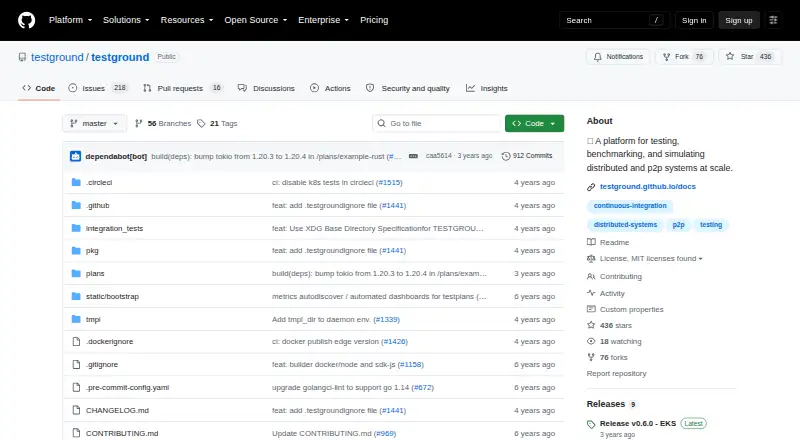
What Testground is
Testground is free software for testing, benchmarking, and simulating distributed and peer-to-peer systems at scale. It is designed for runs from 2 to 10,000 instances: local runners suit 2–300, while Kubernetes runners suit 300–10,000. Test plans may be written in Go, JavaScript, C, or shell, and the listed builders include Go. A Redis-backed coordination API supplies synchronization primitives for distributed workloads. Test instances can shape connectedness, latency, jitter, bandwidth, duplication, and packet corruption. Metrics go to InfluxDB in real time, with results sent in batches after a plan ends; runs can also collect logs, assets, event trails, and participant events. Testground is available as API and self-hosted software with hybrid deployment and active test methods. It is dual-licensed under MIT and Apache Software License v2. Binaries are not distributed, so installation requires building from source with Go 1.16 or later and a running Docker daemon.
Who it suits
Testground suits developers working on experimental protocols, debugging, comparative testing, or compatibility testing across distributed systems. It also fits teams needing controllable network conditions and InfluxDB metrics.
What it does well
- Scales from 2 to 10,000 instances
- Supports Go, JavaScript, C, and shell plans
- Shapes latency, jitter, bandwidth, and packet behavior
- Streams metrics to InfluxDB
- Collects logs and run events
What to know first
- Requires building from source
- Needs Go 1.16 or later and Docker
- Continuous integration is listed as planned
Verdict
Testground provides broad controls for distributed-system experiments, including large-scale runners, network simulation, coordination, and metrics. Its source-build installation and planned workflows should be considered before adoption.
Facts from Testground's own pages
- Audience
- The project describes use for experimental protocol development, debugging, comparative testing, and backward- and forward-compatibility testing. · github.com, 9 Oct 2026
- Builders and runners
- Go builders and local executable, local Docker, and Kubernetes runners are listed; local runs suit 2–300 instances and Kubernetes runs suit 300–10,000. · github.com, 9 Oct 2026
- Coordination
- A Redis-backed coordination API provides synchronization primitives for distributed test workloads. · github.com, 4 Oct 2026
- Current workflow limits
- The README marks continuous integration and interoperability testing as planned workflows. · github.com, 9 Oct 2026
- Installation
- The README says binaries are not distributed and installation requires building from source, with Go 1.16 or newer and a running Docker daemon. · github.com, 9 Oct 2026
- Installation limit
- The README says binaries are not distributed and users must build from source, with Go 1.16 or later and a running Docker daemon required. · github.com, 4 Oct 2026
- Integrations
- The README points to Kubernetes, AWS cluster setup instructions, and InfluxDB metrics and results; it describes Jupyter integration as upcoming. · github.com, 9 Oct 2026
- Language support
- Test plans may be written in Go, JavaScript, C, or shell, while the project says its available builders are for Go and TypeScript builders were in progress. · github.com, 9 Oct 2026
- License
- The project is dual licensed under MIT and Apache License 2.0. · github.com, 9 Oct 2026
- Metrics
- For Go test plans, the project describes automatic pprof diagnostics and real-time metrics sent to InfluxDB. · github.com, 9 Oct 2026
- Metrics and results
- Testground emits metrics to InfluxDB in real time and pushes results there in batches after a test plan concludes. · github.com, 4 Oct 2026
- Network simulation
- Test instances can shape connectedness, latency, jitter, bandwidth, duplication, and packet corruption. · github.com, 9 Oct 2026
- Outputs
- Users can collect logs, assets, event trails, and run events from participants in a test run. · github.com, 4 Oct 2026
- Purpose
- Testground tests, benchmarks, and simulates distributed and peer-to-peer systems at scale. · github.com, 9 Oct 2026
- Scale
- The project says it can scale from 2 to 10,000 test instances. · github.com, 9 Oct 2026
- Security controls
- A v0.5.3 release note says traffic routing defaults to DenyAll and the daemon supports basic authentication with configured tokens. · github.com, 4 Oct 2026
- Test plans
- Test plans coordinate distributed workloads using synchronization primitives such as signals and barriers. · github.com, 9 Oct 2026
Where Testground stands on Freedom251
- Network Testing Software#24 of 33