Freedom251 › Test Management Software
Tesbo
What Tesbo is
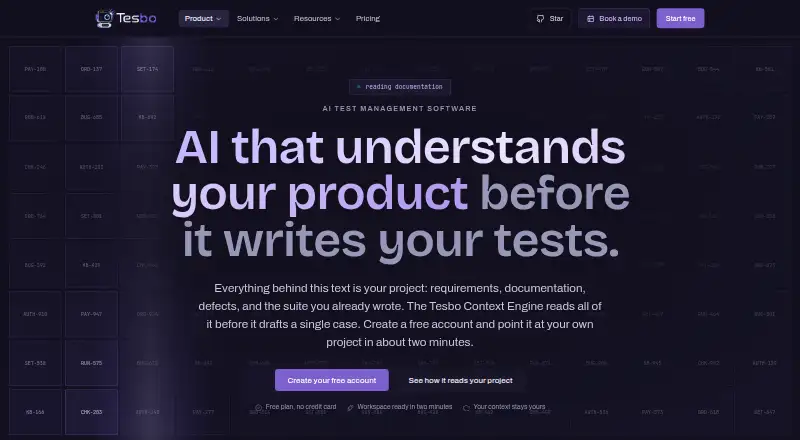
Tesbo is an AI-driven test management platform that uses project context to draft test cases. Its Context Engine reads Jira and Linear stories, existing test cases, and product documentation; generated cases cite source requirements and documents, and the requirements traceability matrix fills as cases are created. Engineers can approve, edit, or reject cases, and the site says cases do not reach the repository without human review. Tesbo also provides nested test suites, priorities, rich steps, bug tracking, test runs, plans, and reports. Reporting includes pass rates, flaky-test detection, and risk hotspots. Its MCP server can provide project context to Claude, Cursor, or a user's own agent under human-approval rules, and audit logs record actions by agents and people. Tesbo is offered as a web app, API, or on customer-managed infrastructure. Community is a complete open-source self-hosted product under Apache 2.0. Cloud subscriptions are priced per workspace, and the plans include free Launch and paid Pro options.
Who it suits
Tesbo is aimed at QA engineers and QA managers who need test design, coverage, and release evidence. Its self-hosted Community edition may suit teams prepared to manage their own deployment and related costs.
What it does well
- Generated cases cite source requirements and documents.
- Human review is required before cases reach the repository.
- Includes test runs, plans, and reports.
- Community is open source under Apache 2.0.
- Cloud pricing is per workspace, not per seat.
What to know first
- Community customers handle deployment, storage, security, and provider costs.
- Launch is limited to two projects and 500 MB.
- Downgrading to Launch requires reducing data or exporting it first.
- Cloud subscriptions renew automatically unless canceled before renewal.
Limits
Launch is limited to two projects, 500 MB total workspace storage, three team members, one core agent, and Jira integration. Community is self-hosted, so deployment, storage, security, and provider costs are the customer’s responsibility.
Plans
| Plan | Billed and limits | Price |
|---|---|---|
| Community | Free forever · Self-hosted · Unlimited projects and team members · Unlimited test cases, plans, runs, and activity · 1 core agent · Community integrations | Free |
| Launch | $0/ workspace / month · Up to 2 projects · 500 MB total workspace storage · Up to 3 team members · Unlimited activity within 2 projects · 1 core agent · Jira integration | Free |
| Pro | Billed monthly · Unlimited projects and team members · Unlimited test cases, plans, runs, and activity · 5 GB total workspace storage · Full agent marketplace · Jira, Linear, and more integrations | $40 a month |
As tesbo.io lists them, read 7 Oct 2026. The maker's own page has the final word.
Getting started
- Open tesbo.io and choose the web app, API, or customer-managed infrastructure route.
- For self-hosting, start with the free Community edition under Apache 2.0.
- For Tesbo Cloud, start with Launch or choose Pro for its listed project, storage, and integration allowances.
- Connect Jira or Linear stories, existing test cases, or product documentation as project context.
- Review generated cases by approving, editing, or rejecting them before repository delivery.
Tesbo is an AI-driven test management platform for teams that want requirements, generated test cases, and release evidence connected in one workflow. It suits QA engineers and managers who need review controls and traceability; self-hosting is an option for teams prepared to run the infrastructure themselves.
Overview
Tesbo reads Jira and Linear stories, existing test cases, and product documentation to draft cases with links back to their source requirements. That focus on traceability makes it more than a case generator: its matrix fills as cases are generated, while engineers retain approval, editing, and rejection control before cases reach a repository.
The broader test-management set—suites, priorities, steps, bug tracking, plans, runs, and reports—gives QA teams a place to organize work beyond generation. Reporting covers pass rates, flaky tests, and risk hotspots. The trade-off is that the free hosted Launch plan is tightly capped, while the unlimited free Community edition puts operating costs and responsibility on the customer.
Key features
- Context-aware generation: The Context Engine uses project stories, existing cases, and documentation. Citing source requirements helps reviewers check whether a generated case reflects the intended product behavior.
- Human review and traceability: Engineers can approve, edit, or reject drafts, and the workflow keeps unreviewed cases from reaching the repository. This is a meaningful safeguard for teams wary of letting generated tests flow straight into project work.
- Test management and reporting: Nested suites, priorities, rich steps, bug tracking, test runs, plans, and reports support ongoing QA work. Pass rates, flaky-test detection, and risk hotspots help teams assess runs and release risk, though the product's value depends on keeping its test data current.
- Agent connections and audit: The MCP server can give Claude, Cursor, or a team's own agent project context under human-approval rules. Audit logs record actions by both agents and people, useful when teams need an activity trail.
Pricing
Tesbo has free self-hosted and cloud options, plus a paid cloud tier. Cloud subscriptions are priced per workspace, not per seat, and renew automatically unless canceled before renewal.
- Community — free, billed Free forever: The complete open-source product under Apache 2.0, with unlimited projects, team members, cases, plans, runs, and activity; one core agent and community integrations. It fits organizations able to manage deployment, storage, security, and provider costs themselves. Those responsibilities make it a poor fit for teams seeking managed hosting.
- Launch — free, billed $0/ workspace / month: The hosted entry point allows up to 2 projects, 500 MB of workspace storage, and 3 team members, with unlimited activity within those projects, one core agent, and Jira integration. It can suit a small team evaluating a cloud workflow, but project and storage limits constrain sustained use. After downgrading to Launch, customers must reduce to 2 projects and 500 MB or export data before the downgrade takes effect.
- Pro — $40 a month, billed monthly: This cloud plan removes project and team-member caps, keeps cases, plans, runs, and activity unlimited, provides 5 GB of storage, and adds the full agent marketplace plus Jira, Linear, and more integrations. It is the clearer fit for teams that need managed cloud use across multiple projects. Its stated storage allowance remains 5 GB.
There is no free trial. Community offers breadth without a subscription but requires self-management; Launch costs nothing but has strict workspace caps; Pro is the paid managed-cloud choice.
Platforms
Tesbo is available through the web, API, and self-hosted deployment. The API and MCP server make it relevant to teams incorporating test management into other tools or agent workflows, while self-hosting suits customers who want to run it on their own infrastructure.
Who it's for
Tesbo is strongest for QA engineers and managers who want test design, coverage, and release evidence tied to requirements, with people reviewing generated work. It also suits teams already working with Jira or Linear, particularly if they want project context available to an agent. Teams without capacity to manage infrastructure should favor the cloud plans; those needing more than 500 MB or two projects on a free hosted workspace will need Pro or another option.
Pros and cons
- Pro: Generated cases cite requirements and documents, and generation fills the traceability matrix, making coverage easier to connect to project inputs.
- Pro: Human approval controls and audit logs address oversight of both generated cases and agent or human actions.
- Pro: Unlimited hosted projects and team members on Pro avoid per-seat pricing as a team grows.
- Con: Launch's two-project, three-member, and 500 MB caps make the free cloud tier a limited long-term home for expanding teams.
- Con: Community shifts deployment, storage, security, and provider costs to the customer, so its zero subscription price is not zero operational effort.
- Con: Pro includes 5 GB of storage, a limit teams with substantial test assets should account for.
Alternatives
For a wider comparison, see AI Test Case Generators, Test Management Software, and Test Flakiness Management Software.
- Katalon Studio is worth considering if you want low-code and full-code authoring, an AI Assistant and MCP Server, and web, mobile, and desktop coverage.
- QAEverest offers a free tier with a starter credit allocation, request allowance, and all six services switched on.
- aqua has a free Guest plan with unlimited seats and read-only access, which may suit people who need to view rather than manage test work.
- Qase has a free plan capped at four users and two projects, with 500 MB storage, 30-day test history, 5k monthly API results, and two active test runs.
- TestMap.ai offers a free Starter plan with two projects, two team members, 50 AI tests per user per month, a Chrome extension, and basic test management.
- TestPilot has a free plan with 20 generations per month, manual test steps, CSV export, Jira integration, and saved-test history.
- TestQuality offers a free plan with a visual test-plan builder, test cycles, story linking, and a human-in-the-loop test-case builder.
- TestStory AI has a free plan with 25 credits per month, AI test generation, export and sharing options, integrations, and MCP.
Verdict
Tesbo is a strong fit for QA teams that want requirements-linked test generation, human review, and test reporting in one system. Its best reason to choose it is the combination of traceability and controls around AI-generated work; its main reason to look elsewhere is the operational burden of self-hosting or the modest storage and project limits on free cloud use. Choose Community if you can run the infrastructure, Launch for a small hosted workspace, and Pro when a growing team needs uncapped projects and members.
Verdict
Tesbo links generated test cases to project requirements and includes review controls, test management, and reporting. Community is free to self-host; Cloud Pro costs $40 a month, billed monthly.
Questions
Is there a free plan?
Yes. Community is free forever and self-hosted. Tesbo Cloud also has a Launch plan priced at $0.
How much does Pro cost?
Pro is $40 a month, billed monthly. The pricing note also describes paid access as starting from $30/mo (annual).
What is included in the free Launch plan?
Launch includes up to two projects, 500 MB workspace storage, up to three team members, one core agent, and Jira integration.
Can Tesbo be self-hosted?
Yes. Community is the complete open-source product under Apache 2.0 and runs on customer-managed infrastructure. Deployment, storage, security, and provider costs are the customer’s responsibility.
Which platforms are available?
Tesbo lists API, self-hosted, and web platforms.
Which tools can provide context to Tesbo’s agent server?
The Tesbo MCP server can provide project context to Claude, Cursor, or a customer’s own agent under human-approval rules.
Facts from Tesbo's own pages
- Audit
- Tesbo says its audit logs record every action by an agent or human. · tesbo.io, 7 Oct 2026
- Cloud billing
- Tesbo Cloud is priced per workspace rather than per seat, and subscriptions renew automatically unless canceled before renewal. · tesbo.io, 7 Oct 2026
- Context sources
- The Context Engine reads Jira and Linear stories, existing test cases, and product documentation before generating cases. · tesbo.io, 7 Oct 2026
- Downgrade
- After downgrading to Launch, customers must reduce projects and storage to 2 projects and 500 MB or export data before the downgrade takes effect. · tesbo.io, 7 Oct 2026
- Integrations
- The Tesbo MCP server can provide project context to Claude, Cursor, or a user's own agent under human-approval rules. · tesbo.io, 7 Oct 2026
- Intended users
- The site presents Tesbo for QA engineers and QA managers, emphasizing test design, coverage, and release evidence. · tesbo.io, 7 Oct 2026
- Product
- Tesbo describes itself as an AI-driven test management platform that uses project context to draft test cases. · tesbo.io, 7 Oct 2026
- Reporting
- Runs, plans, and reports include pass rates, flaky-test detection, and risk hotspots. · tesbo.io, 7 Oct 2026
- Review
- Engineers can approve, edit, or reject generated cases, and the site says nothing reaches the repository without human review. · tesbo.io, 7 Oct 2026
- Self-hosted limits
- The Community plan leaves deployment, storage, security, and provider costs to the customer. · tesbo.io, 7 Oct 2026
- Self-hosting
- Tesbo can run on infrastructure managed by the customer, and the pricing page describes the Community edition as the complete open-source product under Apache 2.0. · tesbo.io, 7 Oct 2026
- Test management
- Tesbo includes nested test suites, priorities, rich steps, bug tracking, test runs, plans, and reports. · tesbo.io, 7 Oct 2026
- Traceability
- Generated cases cite their source requirements and documents, and the requirements traceability matrix fills from case generation. · tesbo.io, 7 Oct 2026
Where Tesbo stands on Freedom251
- Test Management Software#11 of 48
- AI Test Case Generators#9 of 21
- Test Flakiness Management Software#20 of 31